Wild camping at Oeschinensee, what is actually allowed
At Oeschinensee, wild camping is banned. And unlike at many other Swiss hotspots, this ban is not an empty phrase on a tourism page, it sits behind two real, fineable legal grounds. Here is which ones, how high the fine really is, and where in the region you can legally spend a night outside.
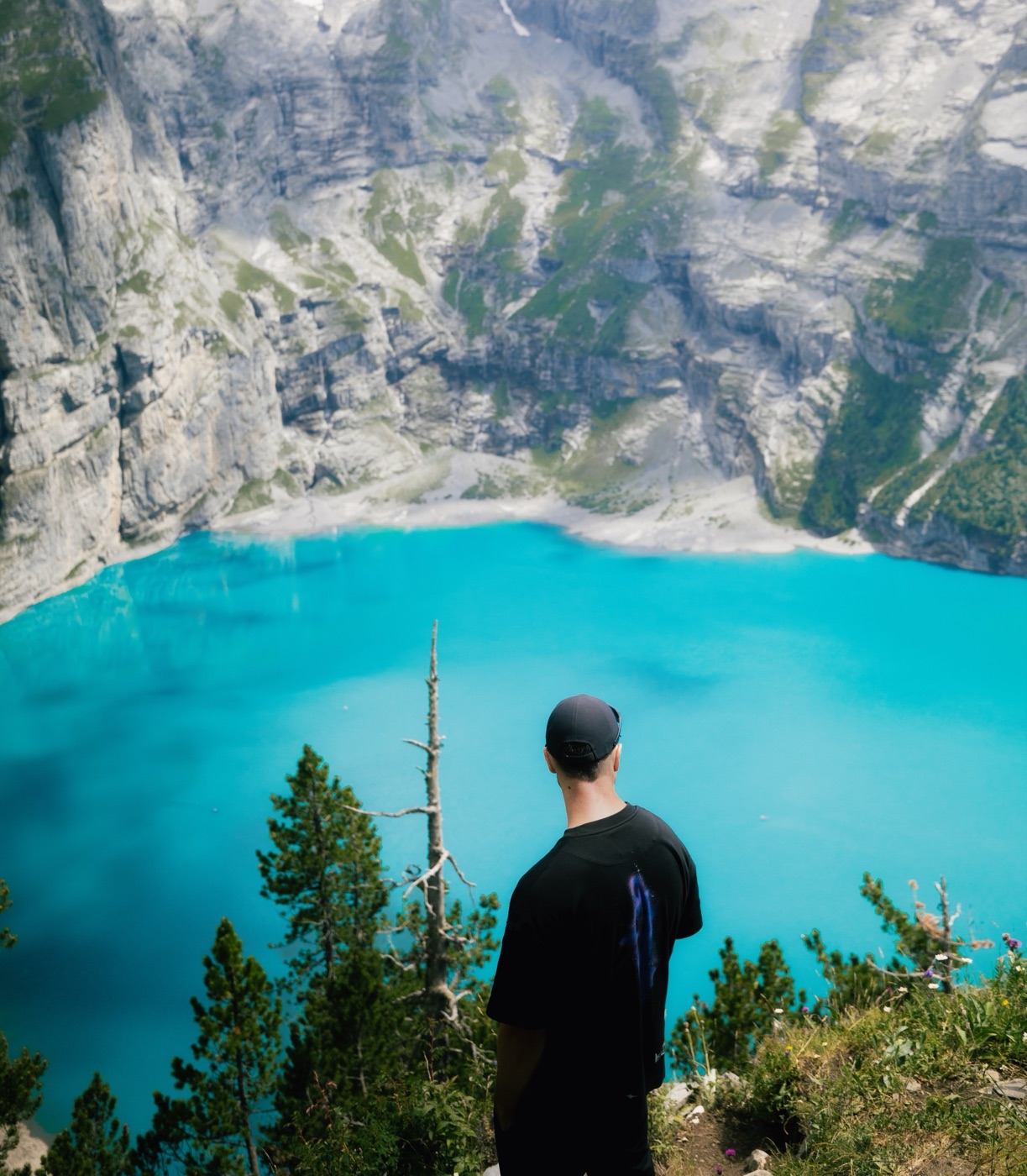
What do these mean?
Illegal A specific rule bans it, usually with a fine, and it can be enforced. Sleep somewhere else.
Not allowed No real place to camp here. A gated site, a developed area, or nowhere sensible to lie down, even if no fine is attached.
It depends You can sleep here, but there's a condition first: ask the landowner, book a spot, stay inside a set zone, or use a bivvy instead of a tent. The report says which.
Tolerated No rule clearly allows or bans it, but a single night is accepted in practice and nobody enforces against it. Normal for high bivouacs above the treeline.
Legal Camping one night is fine here. Either a rule allows it, or we checked every law and found nothing against it. Still: pitch late, leave early, no trace.
Camping, bivouacking, emergency bivouac: here the difference decides
In everyday use, people throw "wild camping", "tenting" and "bivouacking" into one pot. At Oeschinensee it is worth looking closely, because the municipality of Kandersteg distinguishes these things in its regulation, and it is exactly this difference that decides whether you are fineable.
Camping, that is with a tent. The municipal police regulation defines "camping" as any form of overnight stay in tents, caravans, motorhomes, cars or similar shelters, and makes clear that even the mere pitching of a tent falls under it1. That is the classic case of "wild camping", and it is banned across the whole municipality.
Bivouacking, that is without a tent. The same regulation expressly takes one thing out:
"Sleeping outdoors without a tent, in an igloo or in a snow cave (bivouacking) is not covered by this."Kandersteg municipal police regulation (Gemeindepolizeireglement), Art. 6 (definition of "camping")
A tentless bivouac, that is just a sleeping bag and maybe a mat or bivvy bag, is according to the regulation not camping and is therefore not caught by the ban in Art. 7. That is the one real legal difference between the two words at this place. But be careful, and this is the part that is easy to skim over: at the lake itself this gap helps you nothing, because the landowners' judicial prohibition (more on that in a moment) expressly includes bivouacking there. So the exception for the tentless bivouac only bites far above the lake, outside the prohibition perimeter.
Emergency bivouac, that is the real emergency. To be separated from all this again is the genuine emergency bivouac (Notbiwak). Anyone caught out by a sudden change in the weather, an injury, exhaustion or nightfall and no longer able to descend safely is in an emergency. An unplanned bivouac in such a situation is covered by the defence of justifying necessity, which in criminal law justifies an otherwise prohibited act if it averts an immediate danger that cannot be averted otherwise12. But that is exactly that: a real emergency, not a planning option. Anyone who arrives with full camping gear and says "emergency" afterwards does not fall under it and is treated like any other wild camping. The emergency bivouac is not a loophole, but the exception for a real mountain emergency.
Unlike at the Saxer Lücke: here the ban is real
At many places in Switzerland a tourism page says "wild camping not allowed", and behind it there is no enforceable law at all, only the wish to keep people away. At the Saxer Lücke in the Alpstein it is like that: "not allowed" is not the same there as "banned and fineable".
At Oeschinensee it is different, and to be fair you have to say so. Here the "banned" is real. It does not sit on a brochure, but on two concrete, enforceable legal instruments: a municipal regulation passed by the electorate, and a court-ordered prohibition by the landowners. Anyone who pitches a tent here really does risk a fine. Let us look at the two in turn.
The two real bans
1. The tent ban applies across the whole municipality
On 1.1.2021 the municipality of Kandersteg gave itself a new municipal police regulation (Gemeindepolizeireglement), passed at the ballot box. The decisive sentence is short1:
"Camping outside the areas specially designated and authorised for it is not permitted."Kandersteg municipal police regulation (Gemeindepolizeireglement), Art. 7 para. 1 (in force since 1.1.2021)
Why this catches Oeschinensee is set out in a definition one article higher. The regulation deliberately defines "public space" broadly, namely as the entire freely accessible municipal territory, expressly including "forest and pasture (Art. 699 ZGB)" and "the public waters"1. The lake basin therefore lies fully within the scope. The ban is not lake-specific, it applies everywhere in the municipality except on the authorised sites.
So even the mere pitching of a tent is "camping" (the tentless bivouac is not, see above). The fine is governed by Art. 26 of the regulation: up to CHF 5'000, in minor cases a warning suffices. The implementing municipal police ordinance (Gemeindepolizeiverordnung) sets a fixed fixed-penalty amount of CHF 200 for the camping ban, plus the costs of restoring the site2.
2. The bivouac ban at the lake is a court decision
In the camping summer of 2020, at times over 50 tents stood at Oeschinensee, with the corresponding rubbish and faeces problems. In response, the landowners around the lake, the Alpgenossenschaft Oeschinenholz and the railway, obtained a judicial prohibition (richterliches Verbot). "Judicially prohibited" is not an advertising slogan, but the legal term for a court prohibition under Article 258 of the Swiss Code of Civil Procedure (Zivilprozessordnung, ZPO)3:
"A person with a real right in a property may apply to the court for an order that any interference with possession be desisted from and that any contravention be punished, on complaint, with a fine of up to 2000 francs."Art. 258 para. 1 ZPO (SR 272)
Such a prohibition is issued by the court, published on signs, and then applies against everyone who can see the sign. The operating company puts it expressly like this on oeschinensee.ch: "Camping, bivouacking and overnight stays in hammocks or similar are judicially prohibited."4 Unlike the municipal regulation, this prohibition therefore also catches the tentless bivouac, and so closes, at the lake, exactly the gap that the regulation leaves open. The existence of the prohibition is documented beyond the operator's page by the local press; some 40 objections were lodged against the order5.
What is NOT the fine-bearing norm: BLN, UNESCO, hunting ban
Around Oeschinensee, big labels are gladly cited. They are all correct, only none of them is the reason you get fined. That matters, because anyone who relies on the wrong sign ends up arguing off target.
- BLN inventory. The lake lies in BLN object 1507 "Bernese High Alps and Aletsch-Bietschhorn area (northern part)", verified on the federal map6. But the BLN binds the authorities to undiminished preservation (Art. 6 NHG), it is not a norm that fines an individual camper.
- UNESCO World Heritage. Since the 2007 extension, Oeschinensee lies within the perimeter of the "Swiss Alps Jungfrau-Aletsch" World Heritage Site7. That is an international label, implemented through existing law. It has no fine of its own.
- Not a federal hunting ban district. Contrary to a widespread assumption, the lake does not lie in a federal hunting ban district. The federal map shows nothing at the lake; the canton of Bern has exactly four such districts, the nearest being "Kiental" behind the Hohtürli ridge8. So the strict camping ban of the hunting ban district ordinance precisely does not apply here.
- No cantonal wild camping law. The canton of Bern has no norm that bans wild camping across the board. The enforceable rule here is municipal (the regulation) and civil-law (the court prohibition), not cantonal.
- ZGB Art. 699. The often-invoked "access to forest and pasture is granted to everyone" means passage and the gathering of berries and mushrooms, not overnight stays. Camping and bivouacking are not covered by it, and the article expressly reserves "specifically defined prohibitions", which is exactly what the regulation and the court prohibition are9.
In addition, but not at the lake itself: in the wider Kandertal there are binding wildlife rest zones (Wildruhezonen) (Gehrihorn, Kandersteg, Grosser Lohner), seasonal roughly from December into high summer, enforced through hunting law, a CHF 150 fixed fine for entering one off the marked routes (OBV Anhang 2 Ziff. 12003)10. They lie on the slopes above, not at the shore, and are mainly relevant up high. Before a tour, check on map.geo.admin.ch.
Bivouac versus camping, and the treeline
The well-known rule of thumb, that a single bivouac above the treeline is usually tolerated, comes from the SAC information sheet. It is not a binding legal norm, but a practice recommendation, and at Oeschinensee it does not help for two reasons. First, the lake sits at 1'578 metres, clearly below the local treeline, which in this part of the northern Bernese Oberland runs at roughly 1'900 to 2'200 metres. So the geographical precondition of the rule is not even met. Second, it applies in any case only "where there are no rules to the contrary"11, and here there are two of them. A quiet single night in a sleeping bag at the lakeshore is thus caught by the ban just as much as a tent.
Fines and enforcement in reality
Separate the statutory maximum from what actually happens.
- Statutory maximum: CHF 5'000 for the tent (municipal regulation Art. 26) plus the costs of restoration; CHF 2'000 for the bivouac at the lake (judicial prohibition, Art. 258 ZPO). Anyone who leaves rubbish or faeces additionally risks a fine under environmental protection law, independent of the camping.
- In practice: the fixed fixed-penalty tariff for the camping ban is CHF 200, and the first response is usually no fine at all, but the ranger.
And here a clarification is worth making, one that is often told wrongly: the Oeschinensee rangers are staff of the operating company. They inform, explain and ask people to take down their camp again. But they may not issue state fines themselves4. The path to a formal fine runs via the municipality or the cantonal police, or, in the case of the court prohibition, via a criminal complaint by the landowners. The strategy on site is, by their own account, soft: ranger presence, large rubbish containers, awareness videos, and, since May 2025, an online reservation system for the gondola, to cap visitor numbers. The operators report less rubbish and less wild camping.
I was there in summer. The platform at the lake is packed in high summer, and anyone who turns up in the late afternoon with camping gear is very likely to be approached and asked to leave again. A blanket night-time check at the lake, however, cannot be substantiated from the sources, so I do not claim it. Quiet hours apply from 10pm. In practice this means: the legal ceiling is real (CHF 5'000 or CHF 2'000), the likely outcome is being moved on or a 200-franc penalty. This gap between maximum and practice is not an "allowed after all".
Where you sleep legally in the region
Anyone who wants to see the lake in the best light and still spend a night outside has clear legal options. Wild camping at the lake is not one of them.
Camping Rendez-vous, Kandersteg
By the valley floor, around 1'200 metres, open year-round. This is the only legal tent pitch within reach of the lake, that is, an "area specially designated and authorised for it" within the meaning of Art. 7 of the regulation. About 15 to 20 minutes on foot from the railway, pitches for motorhomes and vans too.
Mountain hotel and chalet at the lake
Right at Oeschinensee there is the Berghaus Oeschinensee and the Chalet Arva with rooms (reservation needed, season roughly May to October). Sleeping indoors means you wake up at the lake, with no camping or bivouac question at all.
SAC huts above
With a reservation via sac-cas.ch: Doldenhornhütte (1'915 m), Fründenhütte (2'562 m) and Blüemlisalphütte (2'840 m, via the Hohtürli) with one of the finest sunrises in the Bernese Oberland. In summer often booked out weeks in advance, check the staffing status beforehand.
Higher up, a bivouac (with caution)
Only here does the bivouac exception from above bite: far above the lake, above the treeline, outside the prohibition perimeter at the lake, outside a wildlife rest zone and its protection period, away from fenced alpine pastures (or with consent), a single night, tentless and without a trace. A tent remains banned there too, across the whole municipality, only the tentless bivouac is tolerated.
Which status applies where right now, and where the next legal bed or legal pitch is, I keep current per spot. That is exactly what is in the Switzerland App for all 141 spots.
General rules for wild camping
This applies everywhere you are actually allowed to sleep outside, so not at Oeschinensee, but high up outside the protected zones. It is not legal text, but decency and common sense.
- No fire. An open fire has no place in the mountains. A gas stove is enough.
- Pitch the tent late, take it down early. Only set up after sunset, gone again before sunrise. A bivouac is one night, not a base.
- Leave no rubbish. Everything you carry up, you carry down again. All of it, including organic scraps and toilet paper.
- At least 50 metres from any body of water for the big business, so you do not foul the drinking water of people and livestock.
- Stay small and quiet. A small group, no speaker, no drone, dogs on the lead.
The one rule that sums up all the others: leaving a place better than you found it is, in general, a valuable attitude.
Disclaimer
This article reflects my research and assessment to the best of my knowledge, as of 19 June 2026. It is based on the publicly accessible and official sources linked below, and on my own observation on site. It is prepared to the best of my knowledge, but does not replace legal advice and is not a binding statement of the current legal situation.
Municipal regulations, fine tariffs, protected areas and court prohibitions can change, and the exact perimeter of a judicial prohibition follows from the signs and the records on site. What is described here may already be out of date by the time you read it. Before every tour, check the current sources yourself, the notices of the municipality of Kandersteg, the operator's page oeschinensee.ch, and the protected-area layers on map.geo.admin.ch. Anyone who spends the night outside bears responsibility for their own conduct and any consequences, including fines, themselves. Hikebeast, Leon Helg and Saftladen GmbH accept no liability for decisions made on the basis of this text, and call on no one to break applicable law.
Frequently asked questions
Is wild camping allowed at Oeschinensee?
Is bivouacking without a tent allowed at Oeschinensee?
How high is the fine?
May the Oeschinensee rangers issue fines?
Does Oeschinensee lie in a hunting ban district or a nature reserve?
Does the SAC bivouac rule apply at Oeschinensee?
Where do you sleep legally in the Kandersteg region?
Leon Helg
Swiss filmmaker and software developer. Spends his free time in the Swiss Alps and maps his favourite spots for Hikebeast. Posts as @leon.helg on Instagram and TikTok.
Sources
- Municipal police regulation (Gemeindepolizeireglement) of the residents' municipality of Kandersteg, in force since 1.1.2021 (adopted at the ballot vote of 13.12.2020 by 294 to 53 votes): Art. 6 lit. a (definition of "public space" incl. forest, pasture under Art. 699 ZGB and public waters), Art. 6 lit. c (definition of "camping" with the literal sentence "Sleeping outdoors without a tent, in an igloo or in a snow cave (bivouacking) is not covered by this"), Art. 7 (camping ban outside authorised areas), Art. 26 (fine up to CHF 5'000), Art. 28 (the earlier camping-regulation ban, Art. 6, was repealed in the process). gemeindekandersteg.ch (PDF). ↩
- Municipal police ordinance (Gemeindepolizeiverordnung) of the residents' municipality of Kandersteg: fixed fixed-penalty tariff of CHF 200 for the camping ban under Art. 7 GPR. gemeindekandersteg.ch (PDF). ↩
- Swiss Code of Civil Procedure (Zivilprozessordnung, ZPO), SR 272, Art. 258 (judicial prohibition, fine up to CHF 2'000 on complaint). fedlex.admin.ch. On the legal nature of judicial prohibitions and on Art. 699 ZGB: Federal Supreme Court BGE 141 III 195. servat.unibe.ch. ↩
- Operating company Oeschinensee (Gondelbahn Kandersteg-Oeschinensee), Outdoor Guidelines and ranger page: "Camping, bivouacking and overnight stays in hammocks or similar are judicially prohibited"; rangers inform and move people on; online reservation system since May 2025. oeschinensee.ch/outdoor-guidelines, oeschinensee.ch/ranger. ↩
- Frutigländer, local reporting on the court prohibition of the Alpgenossenschaft Oeschinenholz on parcel 47 Oeschinensee (Regional Court Oberland) and on the some 40 objections. frutiglaender.ch. ↩
- Federal Inventory of Landscapes and Natural Monuments (BLN), object 1507 "Bernese High Alps and Aletsch-Bietschhorn area (northern part)"; Oeschinensee lies within the perimeter (verified on map.geo.admin.ch, layer "BLN"). Effect via Art. 6 NHG (binding on the authorities). bafu.admin.ch/bln, map.geo.admin.ch. ↩
- UNESCO World Heritage Site "Swiss Alps Jungfrau-Aletsch" (object 1037), with the 2007 extension reaching Oeschinensee. whc.unesco.org. ↩
- Federal Office for the Environment (BAFU/FOEN), federal hunting ban districts (VEJ, SR 922.31): Oeschinensee lies in no such district (verified on map.geo.admin.ch, the layer "federal hunting ban districts" shows nothing at the lake). bafu.admin.ch/jagdbanngebiete. ↩
- Swiss Civil Code (Zivilgesetzbuch, ZGB), SR 210, Art. 699 (access to forest and pasture; no right to overnight stay; reservation of specifically defined prohibitions). fedlex.admin.ch. ↩
- Canton of Bern, Ordinance on the Protection of Wild Animals (WTSchV, BSG 922.63): binding wildlife rest zones in the Kandertal (Gehrihorn, Kandersteg, Grosser Lohner), seasonal. belex.sites.be.ch, map on wildruhezonen.ch. ↩
- Swiss Alpine Club SAC, information sheet "Camping and bivouacking in the Swiss mountains": a single night above the treeline is usually tolerable, provided there are no rules to the contrary and it is done considerately, at least 50 m from any body of water. sac-cas.ch. ↩
- Swiss Criminal Code (Strafgesetzbuch, StGB), SR 311.0, Art. 17 (justifying necessity): an act that carries a criminal penalty may be justified if it averts an immediate danger to oneself or another that cannot be averted otherwise. The legal basis for a genuine, unplanned emergency bivouac in a mountain emergency remaining unpunished; a planned bivouac with full camping gear does not fall under it. See also the SAC information sheet on the emergency bivouac. fedlex.admin.ch. ↩