Wild camping at the Saxer Lücke. Everyone is lying.
Ask an AI whether you are allowed to camp at the Saxer Lücke and it will quote you the official statements from Appenzell: forbidden, a fine is coming. But that is wrong. I spoke with an Alpstein ranger. Here is what really applies.
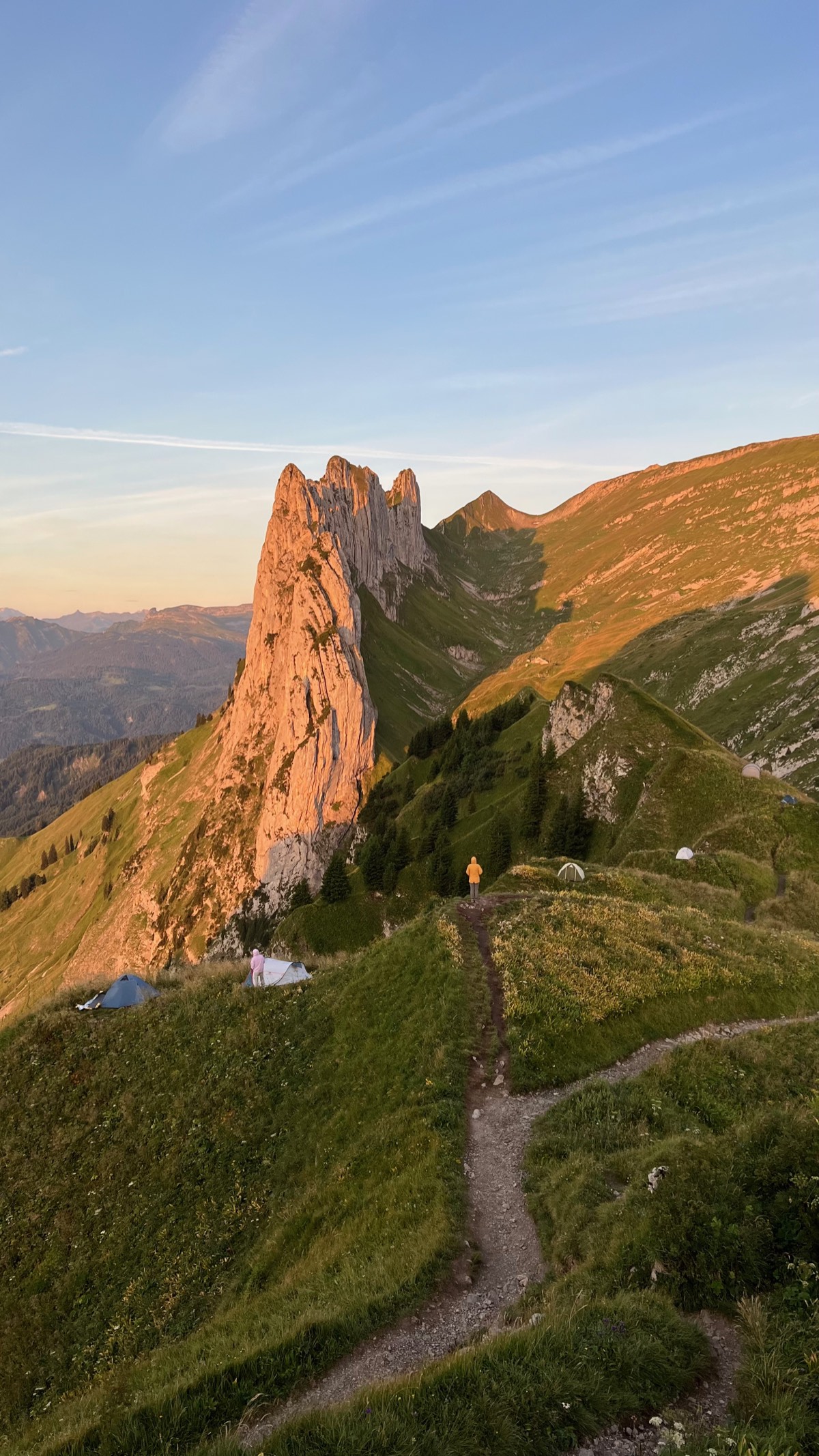
What do these mean?
Illegal A specific rule bans it, usually with a fine, and it can be enforced. Sleep somewhere else.
Not allowed No real place to camp here. A gated site, a developed area, or nowhere sensible to lie down, even if no fine is attached.
It depends You can sleep here, but there's a condition first: ask the landowner, book a spot, stay inside a set zone, or use a bivvy instead of a tent. The report says which.
Tolerated No rule clearly allows or bans it, but a single night is accepted in practice and nobody enforces against it. Normal for high bivouacs above the treeline.
Legal Camping one night is fine here. Either a rule allows it, or we checked every law and found nothing against it. Still: pitch late, leave early, no trace.
What the AI tells you and why it is wrong
Type the question into any chatbot: "Are you allowed to wild camp at the Saxer Lücke?" You get a self-assured answer. Forbidden. Federal hunting ban district. Fines of up to several hundred francs22. The whole Alpstein massif1 is protected, no exception above the tree line, end of story.
That sounds like law and order. It is just wrong. The AI makes two mistakes, and both are typical of how these systems work: they pull together the official authority-speak and present it as fact, without checking whether the geography and the legal hierarchy actually hold up.
Mistake one. It throws "the canton does not want this" and "there is a law that forbids it" into the same pot. That is not the same thing. An authority can find something undesirable, advise against it, and still have no means to fine you for it. That is exactly the situation in Appenzell Innerrhoden at the moment.
Mistake two. It smears the federal hunting ban district "Säntis" over the whole massif, as if every square metre of the Alpstein were inside it. It is not. The eastern ridge with the Kreuzberge, the Staubernkanzel and the Saxer Lücke lies outside the perimeter according to the official boundary description of the ban district.
But the AI does not make this up. It parrots what is written at the official source. And Appenzellerland Tourismus writes literally on its info page about the Alpstein:
"Wildes Zelten ist nicht erlaubt; übernachten Sie in einem Berggasthaus oder auf der Alp und halten Sie sich in jedem Fall an die Weisungen des Alppersonals."11
Read the sentence again. "Wildes Zelten ist nicht erlaubt", wild camping is not allowed. It sounds like a ban, like a fine, like a consequence. That is exactly how it is meant to sound. Only it deliberately does not say "verboten", forbidden, and not "strafbar", punishable, because on the Innerrhoden side it currently is not. They let you believe a penalty looms that does not exist. That is not neutral information about the legal situation. That is targeted deterrence dressed up as the legal situation, and it deliberately creates a false impression.
And now the part that has to be fair: the municipality and the alp farmers have a damn good reason for this hard line. The problem is not camping as such. The problem is the people who do not know how to behave outdoors. The ones who light a fire on the alpine pasture, leave their rubbish behind, show up five strong with a speaker and build half a festival at the Fählensee for days. For exactly these people a clear "not allowed" is the simplest and most effective lever a tourism organisation has. A no keeps more people away than any honest explanation about cantonal borders and fining powers. Understandable. The sentence is still not legally correct, and you have a right to know that.
The conversation with the ranger
A few days ago I was up in the Alpstein, and I ran into one of the new rangers. Friendly, clear, no spoilsport. I asked him exactly what the AI supposedly knows so confidently: is wild camping forbidden here, and can you fine me?
His answer, in essence: there is currently no law that forbids wild camping in the Alpstein. The canton is not fond of wild campers, because too much mess gets left behind, and it is working on a law. But right now it is not illegal. And the rangers are not allowed to hand out fines as long as this law is not finished.
That matches exactly the canton's communication and the way the ranger project is set up. The rangers are not auxiliary police. They have no sovereign powers, may neither take down personal details nor issue ejections nor collect fines12. Their principle is "talk, do not fine". They have been out since the 2026 season, a three-year pilot project of the Bergwirteverein Alpstein together with the canton: around 15 volunteers, on patrol in pairs to fours on weekends and holidays, with cantonal support of up to 35,000 francs, planned until 202813. They talk to guests, point out rubbish, the drone ban and the leash requirement, and if someone really will not listen, they can call the police. Nothing more. The cantonal police are different: they carry out their own, independent checks in the Alpstein and can very much act where a concrete ban applies21.
Three levels, three different answers
The reason everyone talks past each other here is the Swiss legal order. Over every square metre of the Alpstein, three levels lie stacked: federal law, cantonal law and municipal law. At the Saxer Lücke all three give a different answer. Anyone who knows only one level is bound to get it wrong.
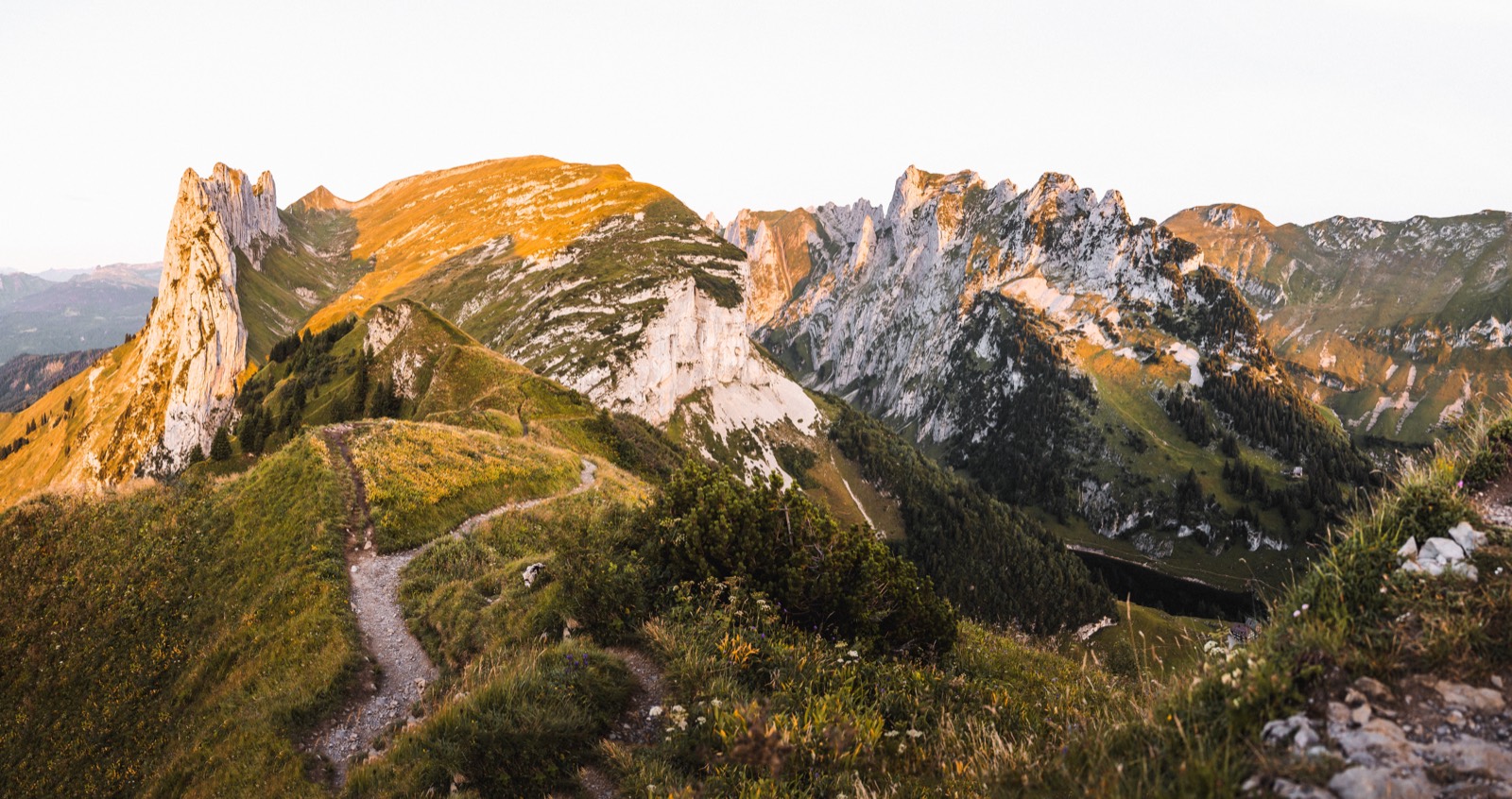
Federal law: the hunting ban district "Säntis"
In all federal hunting ban districts, free camping and pitching tents is forbidden under the federal hunting ban district ordinance (VEJ) to protect wildlife34. That is serious, and it overrides any local tolerance. So anyone who asks whether a ban district is relevant is asking the right question.
The "Säntis" ban district (object no. 16) covers around 3,150 hectares in the southern part of the Alpstein. Under the rules in force, its boundary runs from the Marchstein on Nusshalden along the cantonal border over the Chammhalde to the Säntis summit and from there over the Tierwies to the Grenzchopf5. That is the central, southern block around the Säntis. The entire eastern ridge, that is the Kreuzberge, the Staubernkanzel and the Saxer Lücke itself, lies outside this perimeter according to this description.
Consequently, the strict federal camping ban of the hunting ban district does not apply at the Saxer Lücke. It is exactly this geographic subtlety that the AI overlooks when it declares the whole massif off limits across the board.
But do not rely on my sentence. Look at it yourself. On map.geo.admin.ch you can switch on the "Federal hunting ban districts" layer and look at the perimeter exactly19. In the same breath, switch on the "Wildlife rest zones" layer. Wildlife rest zones are seasonally binding, and where one applies, that is the end of it, regardless of any camping grey zone.
Canton Appenzell Innerrhoden, west side: the grey zone
On the Innerrhoden side of the Lücke there is currently no legally valid law that bans wild camping or free bivouacking in open terrain across the board and backs it with an applicable fine system. In the absence of a public-law penalty provision in open terrain, the cantonal authorities currently cannot impose fixed fines for merely pitching a tent. That is the grey zone everyone talks about, and it is real6.
But something did happen. On 18 June 2025 the Standeskommission, the Innerrhoden cantonal government, adopted the so-called Massnahme B4 as part of its tourism policy67. That was not the ban itself, but the starting signal for it. The Department of Justice, Police and Military was tasked with drafting a restrictive bill. Planned, among other things: a camping ban on public and private parking areas, free bivouacking only with the explicit permission of the landowner, possibly a reservation system89. In parallel, the canton, also in response to congested roads on excursion days, sharply raised parking fees for campers, up to 50 francs per night, to make the logistical base in the valley expensive1017.
On the actual law the Innerrhoden electorate will probably not vote until the 2028 Landsgemeinde9. Until then the grey zone on the Innerrhoden side formally remains. That is the core of what the ranger told me, and it is correct.
Even so, and this is important: the canton's official line stays a no. The Alpstein is "neither a tent pitch nor a campsite", says Appenzellerland Tourismus11, and the "not allowed" that I took apart above belongs to the same page. "Not allowed" and "not finable" are two different things, and the whole debate sits exactly in that gap. In practice that means: where the responsible Sennen agree, a quiet single night in a simple tent is tolerated. Without that agreement, pitching a tent on someone else's alpine land is in principle a civil-law disturbance of possession.
Gemeinde Sennwald, St. Gallen east side: here it is simply forbidden
And now the half of the truth that the everything-is-legal blogs keep from you. The Saxer Lücke drops to the east towards the Rhine valley, and with that into the canton of St. Gallen, specifically into the Gemeinde Sennwald. St. Gallen delegates the regulation of camping to the municipalities, so the ordinance of Sennwald applies14.
Sennwald has a protection ordinance for natural and cultural assets. In the designated protected areas, pitching tents and caravans, camping and bivouacking as well as lighting fires without permission are explicitly forbidden. Intentional or negligent violations are punished with a fine or detention, and the municipal council may appoint wardens who report violations14. There is no grey zone here. Here it is forbidden and directly finable.
This is the point at which the "everything is legal" narrative collapses. There is no single answer at the Saxer Lücke, because a cantonal border runs right through the Lücke, and the two sides of that border treat you completely differently.
The border trap almost everyone falls into
Now the geography comes into play, and it is mean. The ridge at the Saxer Lücke is topographically extremely steep. There are only a handful of flat grassy knolls on which a tent will even stand. And for morphological reasons those lie almost all directly on the crest or slightly east of it2.
East of the crest means: St. Gallen. Means: Gemeinde Sennwald. Means: the explicit, finable ban from above.
That is the trap. Anyone who, in good faith that they are in the liberal Innerrhoden grey zone, pitches their tent on the pass, is, because of the shape of the terrain, almost inevitably already one step too far, namely on St. Gallen soil. With that the camp lies within the scope of the Sennwald protection ordinance, and the harmless grey zone has turned into a punishable act, without the location having felt like it changed at all.
You will find exactly this subtlety in none of the "this is how you camp at the Saxer Lücke" articles the algorithm suggests to you. They talk about the view and the sunset and keep quiet that the most beautiful flat spot often already lies in the forbidden area.
Why the canton is annoyed anyway, and why the grey zone is dying
You could dismiss all of this as hair-splitting. It is not. The reason a law is coming at all is not written in a paragraph, but at the Fählensee, the lake directly below the Lücke, on the ascent route.
In the summer of 2025, at times more than 22 tents and around 50 people stood there at once, building a permanent tent camp over several days and blocking the infrastructure of the Fählenalp15. On top of that rubbish, faeces without sanitary facilities, noise, a disturbed pasture peace. That is no longer a bivouac, that is a wild festival ground in a fragile alpine landscape. The alp farmers have had it up to here, and the complaints about waste, noise and illegal parking are exactly what moved the government to Massnahme B416.
The ban that arrives in 2028 is the bill for the behaviour of 2025.
That is the real point of this story. The grey zone does not exist because someone thinks wild camping is a great thing. It exists because legislation lags behind reality. And it is closing, faster than necessary, because too many people behaved like idiots. Every abandoned rubbish bag, every long-term camp, every campfire on the alp is one more argument for a hard ban. Anyone who still wants to use the Lücke while it is open has exactly one tool to keep it open: impeccable behaviour.
General rules for wild camping
This applies everywhere, not just at the Saxer Lücke, and it is not a legal text but decency and common sense. Anyone who sticks to it is welcome almost everywhere, no matter what the ordinance says.
- No fire. Open fire has no place in the mountains. Drought, wildfire risk and wildlife peace make it irresponsible, and in many places it is forbidden anyway. A gas stove is enough for everything you need.
- Pitch the tent late, take it down early. Set up only after sunset, gone again before sunrise. A bivouac is one night, not a location. Whoever pitches the tent at three in the afternoon and pulls out a camping chair does exactly what no one wants to see.
- Leave no rubbish behind. Everything you carry up you carry back down. Completely. Organic scraps too, toilet paper too. Pack it in and take it with you, that is not a request but the minimum.
- Distance to water. For your business, at least 50 metres away from any stream and lake, so you do not foul the drinking water of people and livestock. That is also the Swiss Alpine Club's guideline for a considerate bivouac18.
- Stay small and quiet. A small group, no sound system, no drone. At the photo hotspots in the Alpstein a drone ban applies anyway20. Dogs on the leash.
- Ask, where there is someone to ask. If there is an alp nearby, ask the Sennen. A quick word costs nothing and is usually the right gesture on a human level too.
The one rule that sums up all the others: leaving a place better than you found it is a valuable attitude in general. Anyone who travels like that leaves no trace and no trouble, and people exactly like that are the reason there are still grey zones where something is tolerated at all.
So what does this mean for you in concrete terms?
Honestly, without sugar-coating in either direction:
- At the Saxer Lücke itself no federal hunting-ban camping prohibition applies, because the Lücke lies outside the Säntis ban district according to the perimeter description. Check the perimeter and the wildlife rest zones yourself on the map anyway.
- On the Innerrhoden side there is currently no cantonal law that makes merely pitching a tent finable. The rangers are not allowed to fine. That is the grey zone, and it is real, as of 18 June 2026.
- On the St. Gallen side (Sennwald) camping is explicitly forbidden and finable with a fine or detention. And the flat spots often lie exactly there.
- Officially, wild camping in the Alpstein is not allowed, but at best tolerated, a quiet night where the Sennen agree.
- The window is closing. The law is expected at the 2028 Landsgemeinde.
Anyone who weighs this up and still spends the night up there does it like this: a single night, small group, clean, quiet, set up late, taken down early, no fire, no rubbish, the Sennen asked, the wildlife rest zones respected.
And at the Fälensee there is even an address where the yes is already settled: at the Fälenalp you may legally pitch your tent for a small contribution of around 15 francs a night, exactly as it is meant to be, with the alp tenant's agreement. Ask on site before you pitch; the Fälensee article has the whole arrangement. Whoever would rather have a safe bed has short distances here too.
Berggasthaus Bollenwees
Down at the Fälensee, the lake directly below the Lücke. From the Saxer Lücke a short descent to the door. Sunset up top, sleep by the lake, back up in the morning. Book ahead.
Berggasthaus Staubern
The guesthouse at the top of the cable car station, where the ridge trail starts. It has rooms and dormitory bunks. Sleep there, and sunset and the way back are the same thing.
Fählenalp
Traditional alp farm directly at the Fälensee, dormitory bunks with dinner and breakfast, fresh alp products. Whoever sleeps on the alp instead of camping next to it solves the whole topic elegantly.
Which status currently applies where, and where the next bed or the next legal pitch is, I keep up to date per spot. That is exactly what is in the Switzerland App for all 141 spots.
Disclaimer
This article reflects my personal assessment and research, as of 18 June 2026. It is based on a personal conversation with an Alpstein ranger in June 2026 as well as on the publicly available sources linked below. It is produced to the best of my knowledge and belief, but does not replace legal advice and does not constitute binding information about the applicable legal situation.
The legal situation in the Alpstein is actively changing right now. The canton of Appenzell Innerrhoden is working on a bill that will probably be voted on at the 2028 Landsgemeinde. Individual municipalities, protected areas and seasonal wildlife rest zones have their own, in part stricter and changing rules. What is described here may already be out of date by the time you read it.
Check the official and current sources yourself before every tour: the canton's announcements, the ordinances of the affected municipalities and the protected-area and wildlife-rest-zone layers on map.geo.admin.ch. Anyone who spends the night outdoors bears responsibility for their own behaviour and any consequences, including any fines, themselves. Hikebeast, Leon Helg and Saftladen GmbH accept no liability for decisions made on the basis of this text, and do not call on anyone to break applicable law or to enter protected areas in which camping is prohibited.
Frequently asked questions
Is wild camping at the Saxer Lücke allowed or forbidden?
Can the Alpstein rangers fine me?
Does the Saxer Lücke lie in the Säntis hunting ban district?
Why do AI and many blogs still say it is forbidden?
When does the legal situation change?
Where can I legally spend the night around the Saxer Lücke?
Leon Helg
Swiss filmmaker and software developer. Spends his free time in the Swiss Alps and maps his favourite spots for Hikebeast. Posts as @leon.helg on Instagram and TikTok.
Sources
- Alpstein, subgroup of the Appenzell Alps across the cantons of Appenzell Innerrhoden, Appenzell Ausserrhoden and St. Gallen. Wikipedia. ↩
- Saxerlücke, pass between the Hüser and the Chrüzberg on the border of Appenzell Innerrhoden and St. Gallen, on the Sax-Schwende fault; the few flat spots lie on or east of the crest. Wikipedia. ↩
- Federal Office for the Environment FOEN, federal hunting ban districts: free camping and pitching tents in the ban districts is prohibited to protect wildlife. bafu.admin.ch/jagdbanngebiete. ↩
- Ordinance on the federal hunting ban districts (VEJ), SR 922.31, Fedlex. fedlex.admin.ch. ↩
- Hunting ban district "Säntis" (object no. 16), around 3,150 hectares in the southern Alpstein; perimeter from the Marchstein on Nusshalden over the Chammhalde to the Säntis summit and over the Tierwies to the Grenzchopf, which puts the eastern ridge incl. the Saxer Lücke outside it. Cf. hunting regulations and species-protection overview. artenschutz.ch. ↩
- Canton Appenzell I.Rh., Standeskommission, "Kanton Appenzell I.Rh. stellt Weichen im Campingtourismus" (decision of 18 June 2025): mandate to draft the legal basis, until then no cantonal penalty provision for free camping. ai.ch. ↩
- Canton Appenzell I.Rh., tourism policy, Massnahme B4 (implementation). ai.ch/massnahme-b4. ↩
- "Appenzell Innerrhoden schränkt den Camping-Tourismus ein": planned are a camping ban on public and private parking areas as well as bivouacking only with the landowner's permission. SWI swissinfo.ch, June 2025. swissinfo.ch. ↩
- "Innerrhoder Regierung will Biwakieren im Alpstein verbieten": bill in preparation, vote expected at the 2028 Landsgemeinde. SRF Regionaljournal Ostschweiz, 19 June 2025. srf.ch. ↩
- "Appenzell reagiert auf verstopfte Strassen an Ausflugstagen": reservation and parking-guidance system as well as higher fees in response to excursion traffic. htr.ch. htr.ch. ↩
- Appenzellerland Tourismus AI, "Zelten und Camping": official line "Der Alpstein ist weder ein Zelt- noch ein Campingplatz. Wildes Zelten ist nicht erlaubt", with reference to mountain inns, staying on the alp and official campsites. appenzell.ch. ↩
- "Warum jetzt Ranger im Alpstein unterwegs sind": the rangers hold no sovereign powers, may neither take down personal details nor impose fines, principle "talk, do not fine". SRF News. srf.ch. ↩
- Ranger pilot project of the Bergwirteverein Alpstein, 2026 season: around 15 volunteers, in pairs to fours on weekends and holidays, no police powers, running until 2028, cantonal support of up to CHF 35,000. srf.ch. ↩
- Gemeinde Sennwald (canton of St. Gallen), protection ordinance for natural and cultural assets: in the protected areas, camping, bivouacking, lighting fires without permission and parking caravans are forbidden, violations are punished with a fine or detention, the municipal council may appoint wardens. sennwald.ch (Schutzverordnung), Ortsplanungsrevision. ↩
- "Alpstein AI: Dauer-Camper nerven Einheimische, trotz Verbot": at the Fählensee in the summer of 2025 at times more than 22 tents and around 50 people, multi-day tent camp, blocked alpine infrastructure. Nau.ch. nau.ch. ↩
- "Zoff um Insta-Hotspot: Appenzell Innerrhoden zieht die Schraube beim Camping-Tourismus an". Blick, June 2025. blick.ch. ↩
- Canton Appenzell I.Rh., "Appenzell I.Rh. regelt Parkierung neu": progressive tariffs for camping vehicles in public space, up to CHF 50 per night, plus a digital parking and reservation system. ai.ch. ↩
- Swiss Alpine Club SAC, information sheet "Campieren und Biwakieren in den Schweizer Bergen": a single night above the tree line is in principle tolerable, considerate, at least 50 metres distance from water, with priority for the protected-area, cantonal and landowner rules. sac-cas.ch. ↩
- Federal geoportal map.geo.admin.ch with the layers "Federal hunting ban districts", "Wildlife rest zones" and "BLN objects" to check the perimeter and seasonal protection periods. map.geo.admin.ch. ↩
- Appenzell Innerrhoden, drone ban at the photo hotspots Äscher and Seealpsee. SRF News. srf.ch. ↩
- Canton Appenzell I.Rh., cantonal police, "Alpstein, polizeiliche Kontrollen": independent checks by the cantonal police in the Alpstein area. ai.ch. ↩
- TCS, "Wildcampen in der Schweiz, erlaubt oder verboten?" and Beobachter, "Hier ist Wildcamping erlaubt, die grosse Übersicht": fine ranges and cantonal differences for wild camping in Switzerland. tcs.ch, beobachter.ch. ↩