Wild camping at the Wangsersee
A night in a tent at the Wangsersee is allowed, and no permit is needed. Bad Ragaz exempts the occasional single tent from its own camping ban, and the commune on the northern shore has no camping rule at all. The Wildsee, an hour's walk on, is in a federal game reserve.
What do these mean?
Illegal A specific rule bans it, usually with a fine, and it can be enforced. Sleep somewhere else.
Not allowed No real place to camp here. A gated site, a developed area, or nowhere sensible to lie down, even if no fine is attached.
It depends You can sleep here, but there's a condition first: ask the landowner, book a spot, stay inside a set zone, or use a bivvy instead of a tent. The report says which.
Tolerated No rule clearly allows or bans it, but a single night is accepted in practice and nobody enforces against it. Normal for high bivouacs above the treeline.
Legal Camping one night is fine here. Either a rule allows it, or we checked every law and found nothing against it. Still: pitch late, leave early, no trace.
Two communes share this lake, and both of them say yes
Start with a fact that decides the whole article and that a map does not make obvious. The communal boundary runs straight through the Wangsersee. Sampled on a 120 metre ring around the pin, the southern arc comes back Bad Ragaz and the northern arc Vilters-Wangs. The pin itself is Bad Ragaz. So wild camping at the Wangsersee is governed by two different sets of communal law depending on which shore you are standing on, and both had to be read.6
Above them, canton St. Gallen contributes nothing. It has no camping prohibition of general application, a finding established by pulling eleven cantonal acts and searching them, the Polizeigesetz and Polizeiverordnung and the Übertretungsstrafgesetz included. None of them prohibits camping, tenting or bivouacking. In St. Gallen the answer is always communal.4
Bad Ragaz writes the exception into the ban itself
The southern shore is governed by the Campingreglement der Gemeinde Bad Ragaz, decided by the Gemeinderat on 12 January 1979 and approved on 30 July 1979. Its art. 5 is headed "Camping ausserhalb bewilligter Plätze", camping outside authorised places, and it has three paragraphs that need reading together.1
"Das Aufstellen von Wohnwagen, Mobilheimen oder Zelten ausserhalb bewilligter Plätze ist verboten. Vom Verbot ausgenommen ist ein kurzfristiges gelegentliches Aufstellen, sofern dieses nicht regelmässig erfolgt, nur einzelne Wohnwagen oder Zelte betrifft und insgesamt die Dauer eines Monats nicht überschreitet. Dieses kurzfristige Aufstellen bedarf keiner Bewilligung des Gemeinderates. Der Gemeinderat ist jedoch hierüber zu orientieren."Art. 5 paras. 1 to 3: erecting caravans, mobile homes or tents outside authorised places is forbidden. Exempt from the ban is short-term occasional pitching, provided it is not regular, concerns only individual caravans or tents and does not exceed one month in total. Such short-term pitching requires no permit from the Gemeinderat, which is however to be informed.
Para. 1 is the ban everyone expects. Para. 2 then takes the single tent straight back out of it, on three conditions: not regular, only individual tents, not more than a month in total. A person arriving on foot for one night satisfies all three without trying. And para. 3 removes the last obstacle by saying in as many words that this needs no permission.
That is why this article is not a "restricted". A permit regime would be one thing; here the ordinance itself declares the conduct outside its own prohibition. The only duty left is the notification in the second sentence of para. 3, and it is a courtesy the text imposes on you rather than a gate the commune holds.
Vilters-Wangs has nothing at all
The northern shore is simpler. The commune's full legal collection was enumerated across all three pages of its register, 55 items, and it contains no Polizeireglement and no Campingreglement. The instrument that carries a camping ban in most Swiss communes simply does not exist here.3
Its Schutzverordnung does prohibit camping, in two places: once for the Naturschutzgebiete, in the familiar wording about recreational use "wie Lagern, Zelten, Campieren und das Anfachen von Feuer", and once for the water and geotope zone, "das Zelten, Campieren, Lagern und Feuern, ausser auf den bewilligten Arealen". Both are zone-bound, so the question is only whether this lake is in such a zone.3
It is not. The Plan zur Schutzverordnung at 1:25'000 carries no overlay of any kind on the Wangsersee, and the contrast on the same sheet is the proof: the Baschalvasee, two and a half kilometres north-west, is plainly drawn with a blue Uferschutzgebiet. The plan distinguishes, and it did not draw one here.
Where the permission stops
A permissive answer is only useful if the edges are drawn honestly, so here they are.
The exemption is for the occasional single tent, and each word in it does work. "Nicht regelmässig" rules out coming back to the same patch every weekend. "Nur einzelne Wohnwagen oder Zelte" rules out a group pitching six tents together. "Insgesamt die Dauer eines Monats nicht überschreitet" caps the whole thing. Step outside those and you are back under para. 1, and the ban applies with nothing softening it.1
The penalty then comes from building law, not police law. Art. 19 of the Campingreglement provides that contraventions are punished under art. 132 of the cantonal Baugesetz with Haft or Busse. That is the route, and it is worth knowing that this ordinance sits in planning law: it was issued on the basis of the Baugesetz and the Organisationsgesetz, which is also why its concerns are building permits, sanitary installations and pitch densities rather than public order.1
And the notification is a real sentence in a real ordinance. Para. 3 says the Gemeinderat is to be informed. Nobody is going to chase a walker who spent one night at 2'200 metres and left no trace, and the same paragraph has already said no permit is needed, so this is not a permission you can be refused. But it is written down, it costs one email, and if you want to be straight with the commune whose rule is giving you this night, that is the address: Gemeinde Bad Ragaz, 058 229 54 20.
On the Vilters-Wangs side there is nothing to notify, because there is no rule to notify anyone about.
The maps, and the lake you must not walk on to
Queried at the lake, LV95 2'751'015 / 1'205'003, terrain surface 2205.3 m, every federal inventory comes back empty: no federal game reserve, no wildlife rest zone, no BLN site, no floodplain, no raised or flat bog, no mire landscape, no dry grassland, no park of national importance. Each query ran alongside a deliberately invalid layer id, which the service answers with HTTP 400 while the real layers answered 200, so the zeros are genuine.5
Then there is the Wildsee, and this is the part to take away from the article. It is 2.4 kilometres away, it is on the same five-lakes circuit that most people walk in a single day, and it sits inside eidgenössisches Jagdbanngebiet no. 15 "Graue Hörner", in the part carrying integrale rather than partial protection. Inside a federal game reserve, art. 5 para. 1 lit. e of the ordinance on the federal game reserves makes free camping an offence outright, and no commune and no landowner can permit it: only the canton can. The fixed penalty is CHF 150.5
Measured against the returned polygon, the Wangsersee lies 2'083 metres outside the nearest edge of that reserve. So the two lakes are not a grey area between them, they are on opposite sides of a federal boundary, and the walk between them takes under an hour.
The rest of the neighbourhood is worth one line each. The nearest wildlife rest zone, Valenserberg no. 92.0, is 504 m away and carries an access ban on foot, but only in its protection period from 16 December to the end of the ski season, so it is a winter concern rather than a summer one. Valeis no. 60.0 at 602 m bans winter sports off the marked routes year-round. The BLN site Taminaschlucht is 4.4 km off.5
And the ground is actually good, which is not always true up here
Sampling the federal elevation model on a 50 metre grid over a 2 kilometre box, there are nine cells under 10 degrees within 300 metres of the water, and the flattest is 6.3 degrees just 71 metres from the shore, at 2'219 m. That is genuine, level, well-drained alpine ground above the treeline, which after a run of steep-sided reservoirs in this series is worth saying plainly.7
How to do it right
The short version: walk in, pitch late on the flat ground near the shore, be gone early, and drop the commune a line. No permit, no fee, no consent to chase. That is a genuinely unusual sentence to be able to write about a Swiss alpine lake.
The one thing the text asks of you. Art. 5 para. 3 of the Bad Ragaz Campingreglement says the Gemeinderat is to be informed about short-term pitching. It is not a permit and it cannot be refused, but it is in the ordinance, so do it: Gemeinde Bad Ragaz, 058 229 54 20. One line saying when and roughly where is enough. If you are pitching on the northern shore you are in Vilters-Wangs, where no camping rule exists at all and there is nobody to notify.
Do not carry the permission across to the Wildsee. It is the most photographed of the five lakes and the obvious place to want to sleep, and it is inside a federal game reserve with integral protection. That ban is federal, the commune cannot soften it, and the CHF 150 is a fixed penalty written on the spot. If your plan was the classic circuit, the Wangsersee is the lake to stop at.5
If the weather turns, the Pizolhütte about 500 metres west of the lake is a Pizolbahnen mountain restaurant, not a Swiss Alpine Club hut: shelter while the lifts run, but no beds. The nearest summer bed is the Alpenhotel Furt at the Furt top station. The Pizolbahnen come up from Wangs, and the five-lakes walk is the normal way in.8
Two courtesies specific to this basin. It is a busy hiking route in summer, so pitch late and out of sight of the path rather than beside it. And the water is the reason the lake is there: keep soap and the big business well away from it, and take everything down with you.
For the same question answered elsewhere in this canton: the Gonzen above Sargans, also permitted because the commune there has no camping rule either, and the Chammseeli in the neighbouring three-lakes group, which is not.
General rules for wild camping
The rule here gives you the night, so the rest is on you. A permissive ordinance stays permissive for exactly as long as the people using it leave nothing behind.
- No fire. An open fire has no place in the mountains. A gas stove is enough.
- Pitch late, strike early. Set up towards evening, gone again early. A bivouac is one night, not a base camp.
- Leave no rubbish. Everything you carry up you carry down, organic scraps and toilet paper included.
- At least 50 metres from any water for the big business, so you do not foul what people and livestock drink.
- Stay small and quiet. A small group, no speaker, no drone, dogs on the lead, and the alp staff's word goes.
Disclaimer
This article reflects my research and assessment to the best of my knowledge, as of August 2026. It is based on the publicly accessible and official sources linked below. It does not replace legal advice and is not a binding statement of the current legal situation.
Communal reglements change, and the Bad Ragaz Campingreglement dates from 1979, so check the current version in the commune's collection before relying on any of this, and follow instructions on site. Federal game reserve boundaries are revised periodically, and the reserve edge is only two kilometres from this lake. A genuine emergency bivouac in distress is a separate question from a planned camp. Anyone who spends the night outside bears responsibility for their own conduct and any consequences themselves. Hikebeast, Leon Helg and Saftladen GmbH accept no liability for decisions made on the basis of this text, and call on no one to break applicable law.
Frequently asked questions
Can you legally wild camp at the Wangsersee?
Do I have to tell anyone?
Is it also allowed at the other Pizol lakes?
What happens if I stay longer or come with a group?
Is there flat ground to pitch on?
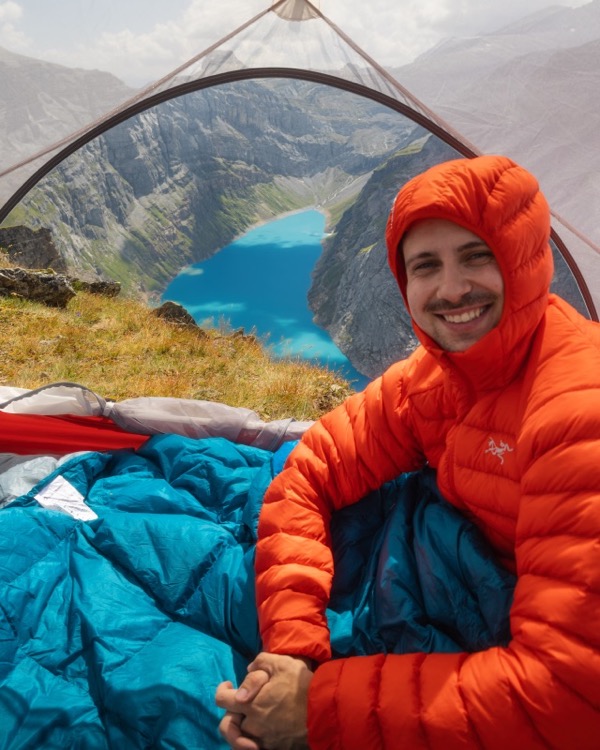
Leon Helg
Swiss filmmaker and software developer. Spends his free time in the Swiss Alps and maps his favourite spots for Hikebeast. Posts as @leon.helg on Instagram and TikTok.
Sources
- Campingreglement der Gemeinde Bad Ragaz, Verordnung über die Errichtung und den Betrieb von Camping- und Zeltplätzen in der politischen Gemeinde Bad Ragaz, issued by the Gemeinderat on the basis of art. 2 para. 1 of the Baugesetz of 6 June 1972 and art. 61 of the Organisationsgesetz of 29 December 1947, decided by the Gemeinderat on 12 January 1979, publicly displayed 22 May to 20 June 1979 and approved on 30 July 1979. Art. 1 states the purpose as the orderly establishment and operation of camping and tent sites, serving public quiet, hygiene, the interests of nature and heritage protection and the general interests of the spa town. Art. 5 "Camping ausserhalb bewilligter Plätze", para. 1: "Das Aufstellen von Wohnwagen, Mobilheimen oder Zelten ausserhalb bewilligter Plätze ist verboten." Para. 2: "Vom Verbot ausgenommen ist ein kurzfristiges gelegentliches Aufstellen, sofern dieses nicht regelmässig erfolgt, nur einzelne Wohnwagen oder Zelte betrifft und insgesamt die Dauer eines Monats nicht überschreitet." Para. 3: "Dieses kurzfristige Aufstellen bedarf keiner Bewilligung des Gemeinderates. Der Gemeinderat ist jedoch hierüber zu orientieren." Art. 19 "Strafe": "Zuwiderhandlungen gegen diese Verordnung werden gemäss Art. 132 des Baugesetzes mit Haft oder Busse bestraft." Contact: Gemeinde Bad Ragaz, 058 229 54 20. badragaz.ch. ↩
- Schutzverordnung der Gemeinde Bad Ragaz, published as a scan without a text layer and read by OCR. Art. 7 "Naturschutzgebiete" provides that in the Naturschutzgebiete designated in the plan to the Schutzverordnung all activities endangering those areas are to be refrained from, and lists among the impermissible measures "die Nutzung zu Erholungs- und Freizeitzwecken, wie Lagern, Zelten, Campieren und das Anfachen von Feuer, ausser an den dazu bezeichneten Stellen" and "das Verlassen der markierten Wege". The prohibition is therefore zone-bound. Anhang 12, the Verzeichnis der Naturschutzgebiete, names the areas in full: Gitzichrummä, Haldenberg, Herrenboden, Matells, Mutguet, Vadug, Serfinis-Wildboden, Chaspersberg / Gararichti / Freudenberg / Padaduris, Sarelli and Brintschingg. Their descriptions are of Hangmoore, Riede, Magerwiesen and Trockenwiesen in the valley and on the lower slopes. None of them is at or near the Wangsersee. badragaz.ch.
- Gemeinde Vilters-Wangs, Reglemente und Tarife, the complete collection enumerated across all three pages of the register in August 2026: 55 items, containing no Polizeireglement and no Campingreglement. Its Schutzverordnung, Ausgabe 2016 of 24 May 2016, published on the St. Gallen publication platform, contains two camping prohibitions, both zone-bound: in the Naturschutzgebiete, among the impermissible measures, "die Nutzung zu Erholungs- und Freizeitzwecken, wie Lagern, Zelten, Campieren und das Anfachen von Feuer"; and in the water and geotope provisions, additionally to the Naturschutzverordnung, "das Zelten, Campieren, Lagern und Feuern, ausser auf den bewilligten Arealen". The accompanying Plan zur Schutzverordnung at 1:25'000, dated 16 March 2011, whose legend distinguishes Ortsbildschutzgebiet, Biotop, Naturschutzgebiet feucht NFA and NFB, Naturschutzgebiet trocken NTA, Uferschutzgebiet, geschütztes Naturobjekt, Hecke, Landschaftsschutzgebiet, Lebensraum Kerngebiet and Wildruhezone, carries no overlay of any kind at the Wangsersee, while drawing a blue Uferschutzgebiet on the Baschalvasee about 2.5 km to the north-west. publikationen.sg.ch. ↩
- Canton St. Gallen has no camping prohibition of general application. The finding rests on the full consolidated text of eleven cantonal acts being retrieved from the cantonal collection and searched for campieren, Camping, Zelt, Biwak, übernachten and nächtigen: Polizeigesetz (sGS 451.1), Polizeiverordnung (451.11), Übertretungsstrafgesetz (921.1), Planungs- und Baugesetz (731.1), Verordnung zum Planungs- und Baugesetz (731.11), Strassengesetz (732.1), Gesetz über die Jagd (853.1), Jagdverordnung (853.11), Einführungsgesetz zur eidgenössischen Waldgesetzgebung (651.1), Verordnung über den Schutz wildwachsender Pflanzen und freilebender Tiere (671.1) and Einführungsgesetz zur eidgenössischen Umweltschutzgesetzgebung (672.1). None prohibits camping, tenting or bivouacking; the Polizeigesetz's only overnight provision is art. 52bis on the hotel guest register, and the Übertretungsstrafgesetz, the natural home for such an offence, does not mention it. That search was carried out for this site's Gonzen report and is relied on here rather than repeated. gesetzessammlung.sg.ch. ↩
- Official federal geodata, queried 10 August 2026 at LV95 2'751'015 / 1'205'003 (WGS84 46.97891 / 9.42362), terrain surface 2205.3 m via the federal height service. Identify at the pin returns empty for federal game reserves, wildlife rest zones, BLN, floodplains, raised bogs, fens, mire landscapes, dry grasslands and pastures, and parks of national importance; every query ran alongside a deliberately invalid layer id, which returned HTTP 400 while all the real layers returned HTTP 200. Distances measured against the returned polygon geometry: federal game reserve no. 15 "Graue Hörner" 2'083 m to the nearest edge of the part with integral protection provisions and 3'514 m to the part with partial provisions; wildlife rest zone "Valenserberg (Nr. 92.0)" 504 m, R10 Zutrittsverbot, protection period 16.12. to the end of the ski season; "Valeis (Nr. 60.0)" 602 m, R150 Wintersportverbot abseits eingezeichneter Routen, protection period 01.01. to 31.12.; "Dreher-Branggis-Hochrütiwald (Nr. 91.0)" 740 m; BLN site "Taminaschlucht" 4'421 m. Separately, a point query at the Wildsee (SG, Mels), 2.4 km from the Wangsersee, returns game reserve no. 15 "Graue Hörner", type "Gebiet mit integralen Schutzbestimmungen". map.geo.admin.ch. ↩
- Communal boundary determination, queried 10 August 2026 on the swissBOUNDARIES commune layer filtered to the current year. The pin itself returns Bad Ragaz. A ring of probes at 120 m from the pin returns Vilters-Wangs at bearings 0, 30, 60, 270, 300 and 330 degrees and Bad Ragaz at 90, 120, 150, 180, 210 and 240 degrees, and the same split holds at 250 m, so the communal boundary passes through the lake with the northern shore in Vilters-Wangs and the southern shore in Bad Ragaz. The swisstopo gazetteer entry for the lake records both communes for the same reason. map.geo.admin.ch. ↩
- Terrain analysis from the official federal elevation model, queried 10 August 2026 through the federal profile service. A 50 m grid over a 2 km box centred on the lake sampled 1'681 points, 15 of them on the water surface. Of the 690 land cells within 300 m of the water, nine come in under 10 degrees; the flattest is 6.3 degrees at 2'219 m, 71 m from the waterline, followed by 7.5 degrees at 212 m and 7.6 degrees at 158 m. The lake surface was taken as 2205.3 m, the value the model returns for it. geo.admin.ch. ↩
- Reference points from the swisstopo gazetteer, with distances and bearings computed from the lake: Bergrestaurant Pizolhütte 0.5 km at bearing 276 degrees, in Vilters-Wangs; the Pizolhütte to Laufböden ski lift 0.4 km east; the Pizol summit 3.6 km at bearing 231 degrees, in Mels; and the neighbouring lakes of the five-lakes circuit, Schottensee 2.4 km and Baschalvasee 2.5 km. Access is normally by the Pizolbahnen from Wangs and then the five-lakes walk. The Pizolhütte is the Pizolbahnen's mountain restaurant, listed with their restaurants and not with their accommodation, and it has no beds; the nearest summer bed is the Alpenhotel Furt. pizol.com (Pizolhütte), pizol.com (accommodation). ↩