Wild camping at Riffelsee, what is actually allowed
Straight up: it is not allowed, and the fines are high. Here is the law, the real cost, and how to still get the dawn shot without a tent.
What do these mean?
Illegal A specific rule bans it, usually with a fine, and it can be enforced. Sleep somewhere else.
Not allowed No real place to camp here. A gated site, a developed area, or nowhere sensible to lie down, even if no fine is attached.
It depends You can sleep here, but there's a condition first: ask the landowner, book a spot, stay inside a set zone, or use a bivvy instead of a tent. The report says which.
Tolerated No rule clearly allows or bans it, but a single night is accepted in practice and nobody enforces against it. Normal for high bivouacs above the treeline.
Legal Camping one night is fine here. Either a rule allows it, or we checked every law and found nothing against it. Still: pitch late, leave early, no trace.
The rule: Article 43
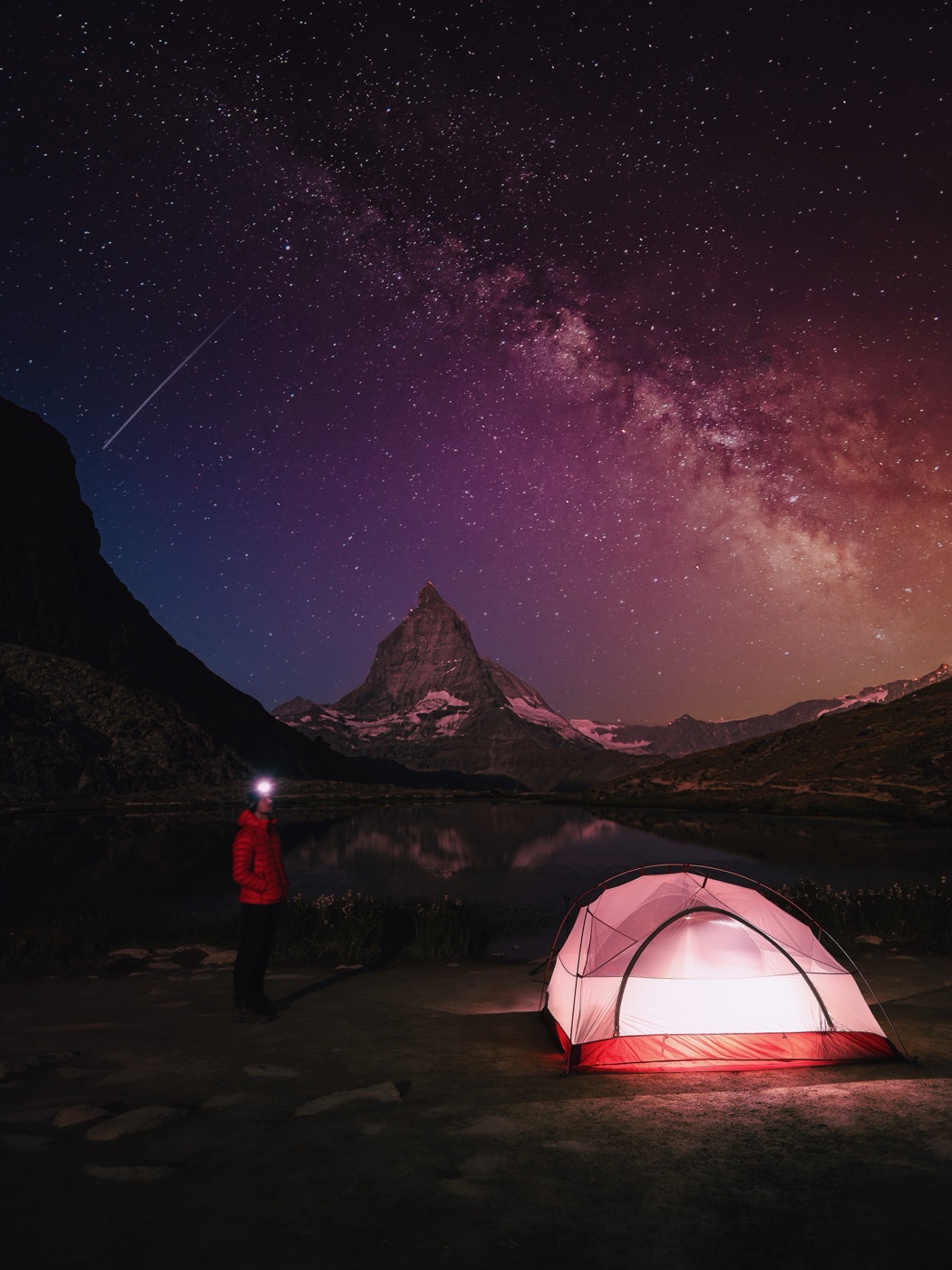
The base for the ban is the police regulation of the municipality of Zermatt. Article 43 prohibits camping on public ground across the whole municipality, and it covers the mountain lakes explicitly1. The definition is deliberately wide: even briefly staying in a tent, camper or similar setup, or just putting one up, counts as camping. Riffelsee is on public ground and there is no written consent from the Burgergemeinde Zermatt as the landowner, so any tent there is unlawful.
What about a bivouac with no tent at all, just a sleeping bag for one night? The wording of Article 43 names tents, campers and similar setups, not the bare sleeping bag. Do not read that as a gap. In Valais police practice a planned overnight without a tent is treated the same way as camping, only the genuine emergency bivouac stands apart7, and Zermatt patrols the lakes accordingly. So the camping-vs-bivouac distinction, which really does change the answer at some Swiss spots, does not change it here.
Switzerland has no single federal camping law, and the Swiss Alpine Club does tolerate a careful one-night bivouac above the treeline, but only where no local rule says otherwise8. At Riffelsee a local rule says otherwise, and the local rule wins. The tolerance argument does not apply here.
Why the lake is protected
Riffelsee is a designated nature reserve. Inside the reserve, swimming in the lake and lighting fires are forbidden alongside camping2. The area is also part of object 1707 "Dent Blanche, Matterhorn, Monte Rosa" of the Federal Inventory of Landscapes and Natural Monuments (BLN), which commits the authorities to keeping the high-alpine landscape and its fragile flora intact.
Right by Rotenboden station is the highest alpine garden in Europe, with over a hundred protected plant species. Small trampling damage can block their regrowth for years, which is why leaving the marked trails is not allowed either3.
The fine, and the bill behind it
The checks are real. The Zermatt regional police, together with local wardens and rangers, patrol the Rotenboden plateau to catch illegal campers. For an unauthorised tent the standard fine is CHF 200 per tent4. Zermatt now issues digital fines with QR codes, and the case is referred on to the responsible police court5.
The fine is not the expensive part. As the Zermatt rangers put it, the amount is not always the same, because in some cases the police operation costs are added, so it runs from several hundred to several thousand francs. The reason is logistics. Riffelsee has no train at night or early morning, so a reported camp is checked by drone, and Zermatt charges the full operation cost to whoever caused it4.
Summer 2026: the campsite is closed
One thing specific to 2026. After a reassessment of the rockfall risk, the municipality ordered a precautionary closure of the only official campsite at the edge of the village, and it stays closed for the whole summer 2026 season6. In an official media release the municipality stated plainly that the closure does not make wild camping tolerated, and that checks at the mountain lakes continue unchanged. So it is not a loophole. If anything, expect more eyes on the lakes, not fewer.
The one exception: a real emergency
There is a genuine legal exception, and it is narrow. A real, unplanned emergency bivouac, forced on you by something you could not foresee such as an injury, a sudden storm, or rockfall on your descent, is allowed everywhere in the Alps, including nature reserves, and is never fined7. What does not count is poor planning. Underestimating the walk, forgetting your headlamp, or deliberately staying out to be at the lake for sunrise is treated as a planned, and therefore illegal, bivouac.
The legal way to get the shot
You can still photograph Riffelsee in the best light without a tent. Three ways:
Sleep at the Gornergrat
The Kulmhotel Gornergrat and the Riffelhaus 1853 are a short walk from the lake, so you are on the shore for dawn or dusk with a real bed behind you.
SAC huts in the Mattertal
Several SAC huts sit around the valley. Check the SAC hut directory for what is open and what fits your route.
The early and late trains
The Gornergrat Bahn runs special sunrise departures and a discounted afternoon ticket from 15:30, which close the gap between the normal timetable and the good light without breaking the rules on the ground3. Walking up from the valley is slow but lets you be at the shore before the first train.
If you came here for the photo, the spot guide has the how and the when: Riffelsee, how to catch the Matterhorn reflection at sunrise. And Riffelsee is one of 141 spots in the Swiss Gems guide, each with its access, best light and a wild camping status, so you know before you go whether a night outside is on the table. That is where they all live.
Frequently asked questions
Is wild camping allowed at Riffelsee?
How much is the fine for camping at Riffelsee?
Can you bivouac at Riffelsee to photograph the sunrise?
Where can you sleep legally near Riffelsee?
Is the Zermatt campsite open in 2026?
Leon Helg
Swiss filmmaker and software developer. 26 years in Switzerland, spends his free time exploring the Swiss Alps and maps his favourite spots for Hikebeast. Posts as @leon.helg on Instagram and TikTok.
Sources
- Municipality of Zermatt, police regulation of 26 January 2022, Article 43: camping on public ground is prohibited, including at the mountain lakes. gemeinde.zermatt.ch. ↩
- Riffelsee, 2,757 m above Zermatt near Rotenboden, a nature reserve within BLN object 1707 "Dent Blanche, Matterhorn, Monte Rosa". valais.ch. ↩
- Gornergrat Bahn: the Riffelsee, the highest alpine garden in Europe at Rotenboden, and the sunrise and afternoon tickets. gornergrat.ch. ↩
- Regional-police practice in the Valais Alps: a standard CHF 200 fine per tent and police operation costs passed on to offenders. 1815.ch; regionalpolizei-leuk-leukerbad.ch. ↩
- Zermatt introduces digital fines with QR codes, referred on to the police court. nau.ch. ↩
- Municipality of Zermatt, media release: the Zermatt campsite stays closed for the summer 2026 season after a rockfall reassessment; the closure does not make wild camping tolerated. gemeinde.zermatt.ch. ↩
- The legal distinction between a forbidden planned bivouac and a permitted, fine-free emergency bivouac. regionalpolizei-leuk-leukerbad.ch; cipra.org. ↩
- Swiss Alpine Club, information sheet "Camping and bivouacking in the Alps": a single considerate bivouac above the treeline is tolerated only where no local rule says otherwise. sac-cas.ch. ↩