Wild camping at the Hundssee
The Hundssee is a small karst tarn at 2'304 m in the upper Sefinental, an hour above the Rotstockhütte and off the Sefinenfurgge path. Lauterbrunnen bans camping outside campsites across the whole commune, but the same article exempts occasional camping on private land, and the bowl is the Sefinen alp. So the night hangs on the alp's yes. One kilometre west, on the pass, the game reserve begins and no yes helps.
What do these mean?
Illegal A specific rule bans it, usually with a fine, and it can be enforced. Sleep somewhere else.
Not allowed No real place to camp here. A gated site, a developed area, or nowhere sensible to lie down, even if no fine is attached.
It depends You can sleep here, but there's a condition first: ask the landowner, book a spot, stay inside a set zone, or use a bivvy instead of a tent. The report says which.
Tolerated No rule clearly allows or bans it, but a single night is accepted in practice and nobody enforces against it. Normal for high bivouacs above the treeline.
Legal Camping one night is fine here. Either a rule allows it, or we checked every law and found nothing against it. Still: pitch late, leave early, no trace.
One communal reglement decides it, and it reaches the Sefinental
Wild camping at the Hundssee is a Lauterbrunnen question. The lake sits at LV95 2'629'608 / 1'154'038 in the upper Sefinental, the side valley that runs west from Gimmelwald up to the Sefinenfurgge, and the whole valley is Lauterbrunnen ground. Lauterbrunnen rewrote its camping rules for the 2025 season, and the reglement is short and blunt.
"Das Campieren ausserhalb von Campingplätzen ist grundsätzlich nicht gestattet. Davon ausgenommen ist das vereinzelte Campieren auf privatem Gelände, zu privaten Zwecken. Der Grundeigentümer hat in diesem Fall dafür zu sorgen, dass die notwendigen hygienischen Einrichtungen zur Verfügung stehen."Camping-Reglement of the Einwohnergemeinde Lauterbrunnen, Art. 3 para. 1, in force since 1 January 2025: camping outside campsites is not permitted as a rule; exempted is occasional camping on private land for private purposes, with the landowner responsible for the necessary hygiene facilities.
Three things follow. The ban is municipality-wide, not limited to public ground or to the valley floor, so 2'304 m and a treeline a kilometre below you change nothing. It applies to vans exactly like tents, because Art. 2 para. 1 defines camping as the temporary staying and overnighting of persons "in Zelten, Wohnwagen, Motorhomes (Camper), Mobilheimen oder ähnlichen Unterkünften". And the sanction is real: Art. 24 para. 2 lets the Gemeinderat fine a breach of Art. 3 with up to CHF 5'000, subsidiary to federal and cantonal criminal law.1
The number people actually quote in the valley is lower. The commune still publishes a 2010 ordinance to the camping reglement, amended in 2012, whose single article sets the fine for camping on public ground at CHF 200. It cites the article numbering of the old 1972 reglement and has never been annotated since the 2025 text came into force, so read it as the commune's published tariff practice, not as a narrowing of the new ban: CHF 200 is what a night has cost, CHF 5'000 is what it can cost.2
Does it reach a tentless bivouac? The definition lists tents, caravans, motorhomes and mobile homes "or similar accommodation". A sleeping bag on the grass is not obviously any of those, and the reglement never uses the word bivouac. That gap is untested in Lauterbrunnen. The commune's back-valley reserve decree shows what a legislator writes when it really means to catch a bivouac, because there it had to grant bivouacs an express exception for high tours.8 If a warden asks, an untested reading of "ähnliche Unterkünfte" is a weak place to stand, and this article does not build on it.
How it is possible here: the Sefinen alp has an owner, and people on it in summer
The exception is not a loophole, it is the text. Occasional camping on private land, for private purposes, is exempted from the ban. The whole question is therefore whose ground the bowl is, and whether that owner says yes.
The cadastre answers the first half. The Hundssee lies on parcel 2855 of Lauterbrunnen, a single 760-hectare parcel in the agricultural zone that covers the whole upper Sefinental from the valley floor to the crest.6 That parcel is the Sefinen alp: the alp inventory records it as a corporation alp of the Alpkorporation Sefinen, owned two thirds by the Einwohnergemeinde Unterseen and one third by private alp rights held in Stechelberg, Gimmelwald and Mürren, farmed by the corporation itself. Its pasture runs from 1'420 m on the valley floor up to 2'580 m at the Wasenegg and, in the inventory's own words, ends in the west at "the rock massifs of the Hundshorn and the Bütlassen", which is exactly the wall above the lake.9 Corporation land is private ground in the sense of the reglement: not a campsite, not public ground of the banning commune. So the exemption is available, and there is a real body to ask.
Who, in practice. The alp is run in three stages, and the top one, Boganggen at 2'040 m, is occupied from the end of July to early September; Oberberg below it from mid June to the end of July and again in the first half of September. The alp buildings on Boganggen stand fifty metres from the Rotstockhütte. In season the people who farm the ground you want to lie on are there, and a yes for one tent for one night is theirs to give. Ask in person the day before or on the way up, not at dusk with the tent already pitched.9
Rotstockhütte, 2'039 m, Skiklub Stechelberg, wardens Simon and Michèle Furrer, +41 33 855 24 64 (June to early October), +41 79 526 52 50 when the hut is closed, mail@rotstockhuette.ch. Open 6 June to 30 September 2026, no winter room. Half board CHF 79, night without half board CHF 28. The hut is not the landowner and publishes no rule on tents, but it shares the Boganggen stage with the alp team and is the phone call you can make before you walk up. It is the right place to ask who to ask, not the consent itself.10
Outside the alp season, or for anything more formal than a nod, the owner is the corporation. Its only published officer is a Bergschreiber named in the 2016 inventory entry, which is ten years old; the reliable door is the majority owner, the Gemeindeverwaltung Unterseen, +41 33 826 19 19, which can say who currently speaks for the alp.9 If you want a permit rather than a private yes, Art. 3 para. 2 lets Lauterbrunnen's Sicherheitskommission grant one on application, with the landowner's and the local tourism association's agreement, and Art. 3 para. 3 says such permits carry conditions on hygiene, cleanliness, quiet and order and are time-limited. Gemeindeverwaltung Lauterbrunnen, +41 33 856 50 50. No form and no fee entry for that permit exist as of September 2026.1
Two honest cautions. First, the exemption puts a duty on the owner, the hygiene clause, and at a tarn at 2'304 m the alp has nothing to offer but the buildings on Boganggen. An owner who does not want that duty will say no, and that is within their rights. Second, consent removes the communal ban and nothing else: no fire, no second night, no group. The reglement's word is "vereinzelt", occasional. We have not found a published fee for pitching on the Sefinen alp and are not inventing one. If the person you ask names a figure, that is the arrangement, settle it with them directly.
One kilometre west the answer flips: the Sefinafurgga is the game-reserve line
This is a boundary spot, and the boundary is the pass everyone crosses. The federal game reserve Kiental (object no. 3, 8'392 ha, an area with partial protection provisions) has its nearest edge 1'054 m from the lake, at bearing 239, and that point is the Sefinafurgga itself: the gazetteer's pass point lies on the reserve line to within a metre. The line runs along the crest from the Hundshore over the pass to the Bütlasse, and it is also the commune boundary between Lauterbrunnen and Reichenbach im Kandertal, 1'057 m west of the lake.3
East of that crest, at the Hundssee, no federal layer applies and a landowner's yes is the whole answer. West of it, on the Kiental side, the federal ordinance on game reserves bans free tenting and camping outright, in partial-protection reserves as in integral ones, and only the canton, never a landowner, can grant an exception.4 The fixed penalty is CHF 150.5 Both continuations from the pass, down to the Griesalp and across to the Gspaltenhornhütte, are inside the reserve from the first step. If the plan was to sleep on the pass or just beyond it, that plan is not this article.
Everything else stops short of the lake. The UNESCO world heritage perimeter Swiss Alps Jungfrau-Aletsch, and with it the communal landscape zone "UNESCO" of the Baureglement, begins 420 m south-east of the pin; it is a management instrument that fines nobody, and it does not reach the bowl anyway.36 The local wildlife rest zone Poganggenflie starts 1'503 m to the north, and its measures are ski, snowboard and paraglider bans from 1 November to 30 June, no camping verb.6 The cantonal Wildschutzgebiet Breithorn is 2.75 km away and carries hunting, dog and motor-vehicle rules only.7 And the nature reserve Hinteres Lauterbrunnental of 1960, the one with the outright tent ban and the high-tour exception, has its nearest edge 4.35 km south-east, on the other side of the Sefinental's mouth. The cadastre lists cantonal nature reserves as not concerning parcel 2855 at all.8
What the ground is: a tarn that dries out, in a karst bowl at 2'304 m
The published pin is the lake's label anchor and sits on the water, or on what is water in June. The Hundssee is an intermittent karst tarn of about half a hectare, 176 m long and 36 m wide, with no visible outflow; on the 2024 orthophoto flight the whole basin is a dry, grey-brown silt floor with a few damp patches, and the elevation model reads a dead-flat 2'304.4 m across it. That floor is the flattest ground in the bowl and it is not a pitch: it is silt, it fills with snowmelt and after rain, and the hazard map marks the bowl as an area of undetermined hazard level.6 Do not count on water at the lake in late summer. Carry it up, or fill at the hut.
The bowl itself is alp grass with limestone pavement and boulders, a dark rock band to the north-east, scree and slab under the Hundsflue to the south-west, no tree or scrub anywhere near. The alp inventory says the steep pasture under the Horn is no longer grazed by cattle and is fenced off as a sheep alp, which by the field names is this bowl: expect sheep and fences.9 The 25 m terrain grid with the basin masked gives four candidates, all in Lauterbrunnen, none within 750 m of the reserve line:
- South-west tip of the basin, 2'629'508 / 1'153'988, 2'307 m: 4.5 degrees, 30 m back from the rim, short grass beside the small wash that feeds the tarn. The only near-shore ground under 8 degrees; fine in a dry spell, wet after rain.
- West bench, 2'629'458 / 1'154'113, 2'312 m: 1.4 degrees, 124 m from the rim, grass with limestone outcrops on the rise between the basin and the path. The honest pitch here.
- North bench, 2'629'558 / 1'154'288, 2'290 m: half a degree, grass at the foot of the Hundshubel knoll beside the gully where the Sefibach rises, more sheltered, no view of the basin.
- East shelf, 2'629'883 / 1'154'038, 2'260 m: 0.8 degrees, a grass bench 44 m below the lake above the drop to the valley floor.
Access: the Sefinenfurgge path, Via Alpina national route 1 on its Lauterbrunnen to Griesalp stage, passes 290 m north-west of the lake at 2'328 m. The Hundssee is off-path, about 300 m of pathless grass down and east from the trail. The Rotstockhütte is 1.4 km away and 265 m lower; the hut gives Rotstockhütte to Griesalp over the pass as four and a half hours.10
What the maps say at the pin, layer by layer
Every federal protection layer queried at the exact point on 13 September 2026 came back empty, with the query's controls passing: no hunting-ban district, no wildlife rest zone, no park of national importance, no BLN landscape, no floodplain, mire or amphibian object, no forest reserve, no military perimeter.3 The cantonal Wildschutzgebiete dataset returns nothing at the pin either; the nearest objects are the Kiental reserve on the crest and Breithorn 2.75 km off.7
The communal layer, read from the official cadastre extract for parcel 2855 with its geometry: the pin lies in the agricultural zone, in a hazard area of undetermined level and in the groundwater protection area Au, a building-law overlay. It is not in the landscape zone, not in the wildlife rest zone, not in any dry-meadow or wet-site object, and the one protected pond object in this part of the valley is a different, 888 m² pool 435 m to the east; the Hundssee itself is not a listed water object. Cantonal nature reserves and groundwater protection zones are listed as not concerning the parcel at all.6
The canton of Bern has no camping norm of general application. Its wildlife protection ordinance bans camping only inside named Wildschutzgebiete of the strictest category, none of which is here; its nature protection, hunting and forest acts contain no camping verb at all.7 What is left is the communal reglement, and the communal reglement is what this article is about. Neither the SAC's above-treeline guidance nor the civil code's right of access changes that: the first yields to a contrary rule, the second is a right to walk across pasture, not to sleep on it.1213
One thing to set straight, because it is what the tourism office says when asked: its FAQ answers "no" to wild camping "in and around Lauterbrunnen" and reasons from the UNESCO world heritage status, "also above the treeline". The reglement is the reason, not UNESCO, and the UNESCO perimeter stops 420 m short of this lake. The FAQ's conclusion is nonetheless right for anyone without a landowner's yes.11
Where you can legally sleep
- Rotstockhütte, 2'039 m, dormitory places and the private "Vogelhiisi" chalet, open 6 June to 30 September, reservation online. The obvious base for the Sefinenfurgge and the Hundssee10.
- On the Sefinen alp with the owner's yes, which is the reglement's own exception and the reason this spot is not a flat no. Boganggen in season, the corporation via Unterseen otherwise.
- Campsites in the valley: the authorised sites in Lauterbrunnen and Stechelberg, at the foot of the Gimmelwald cable car.
- Not on or beyond the Sefinafurgga. The pass is the Kiental game-reserve line; west of it a tent is banned regardless of any owner.
General rules for wild camping
This applies wherever you are genuinely allowed to sleep outside, and at the Hundssee that means on alp ground whose owner said yes. It is not legal text, but decency and common sense, and on a working sheep alp it is also the reason you will get a yes again next year.
- No fire. An open fire has no place in the mountains. A gas stove is enough.
- Pitch late, strike early. Set up towards evening, gone again early. A bivouac is one night, not a base camp.
- Leave no rubbish. Everything you carry up you carry down, organic scraps and toilet paper included.
- At least 50 metres from any water for the big business, so you do not foul what people and livestock drink.
- Stay small and quiet. A small group, no speaker, no drone, dogs on the lead, and the alp staff's word goes.
Disclaimer
This article reflects my research and assessment to the best of my knowledge, as of September 2026. It is based on the publicly accessible and official sources linked below. It does not replace legal advice and is not a binding statement of the current legal situation.
Communal regulations, access rules and enforcement practice change, and Lauterbrunnen has adjusted its camping rules recently. The Alpkorporation Sefinen has published no consent practice; a yes is theirs to give or refuse, and the corporation's 2016 inventory contact may be out of date. The Hundssee can be dry in late summer. Before every tour, check the current sources yourself, check the fire-ban status and follow instructions on site. Without the landowner's consent you are inside the ban. A genuine emergency bivouac in distress is a separate question from a planned camp. Anyone who spends the night outside bears responsibility for their own conduct and any consequences themselves. Hikebeast, Leon Helg and Saftladen GmbH accept no liability for decisions made on the basis of this text, and call on no one to break applicable law.
Frequently asked questions
Is wild camping allowed at the Hundssee?
Who do I ask?
What is the fine if I just pitch anyway?
Is the Hundssee inside a nature reserve or the game reserve?
Is there water at the Hundssee?
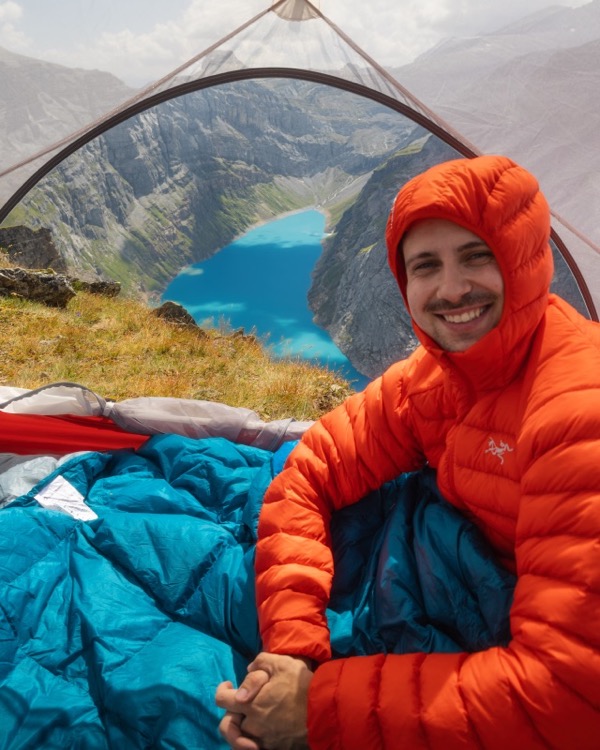
Leon Helg
Swiss filmmaker and software developer. Spends his free time in the Swiss Alps and maps his favourite spots for Hikebeast. Posts as @leon.helg on Instagram and TikTok.
Sources
- Camping-Reglement of the Einwohnergemeinde Lauterbrunnen (ref. 551.4), in force 1 January 2025; approved by the Gemeinderat on 17 July 2023, taken to a facultative referendum, adopted by the Gemeindeversammlung of 17 June 2024, entry into force published 22 August 2024; replaces the reglement of 27 June 1972. Art. 1 para. 2 (supervision by the Sicherheitskommission), Art. 2 para. 1 (definition of camping including caravans and motorhomes), Art. 3 para. 1 (ban outside campsites, private-land exception, landowner's hygiene duty), Art. 3 para. 2 and 3 (exceptional permits, their conditions and time limit), Art. 24 para. 2 (fine up to CHF 5'000), Art. 26 (exceptions), Art. 27 (entry into force). lauterbrunnen.ch. ↩
- Verordnung zum Camping-Reglement of the Einwohnergemeinde Lauterbrunnen (ref. 551.41), approved by the Gemeinderat on 12 July 2010, in force 1 August 2010, Art. 1 amended by Gemeinderat decision of 20 August 2012: "Gemäss Art. 4 Camping-Reglement ist das Campieren auf öffentlichem Gelände und Plätzen verboten. Widerhandlungen werden mit einer Busse in der Höhe von 200 Franken bestraft." Still published in the commune's reglement collection on 13 September 2026 without annotation; it refers to the numbering of the repealed 1972 reglement. lauterbrunnen.ch. ↩
- Official federal geodata, queried 13 September 2026 at LV95 2'629'608 / 1'154'038 (Hundssee, 2'304 m) with tolerance 0 and a passing invalid-layer control: the hunting-ban district, wildlife rest zone, park, BLN, floodplain, mire, amphibian, forest-reserve and military layers return an empty result set at the point. Nearest objects from a 4 km envelope query: federal game reserve no. 3 Kiental (8'392 ha, partial protection) at 1'054 m, bearing 239, its edge coinciding with the Sefinafurgga pass point and the Lauterbrunnen/Reichenbach commune boundary; UNESCO world heritage perimeter at 420 m; wildlife rest zone Lauterbrunnen Poganggenflie no. 2101.00 at 1'503 m. Object sheet no. 3 (2023 revision): "Für das ganze Gebiet gelten die partiellen Schutzbestimmungen." map.geo.admin.ch. ↩
- Verordnung über die eidgenössischen Jagdbanngebiete (VEJ), SR 922.31, art. 5 para. 1 lit. e: "Das freie Zelten und Campieren ist verboten. Vorbehalten bleibt die Benutzung offizieller Zeltplätze. Die Kantone können Ausnahmen bewilligen." The provision carries no integral-or-partial qualifier, whereas lit. d of the same paragraph expressly excepts partial-protection areas, so the camping ban applies in the partially protected Kiental reserve exactly as in an integral one; only the canton can permit an exception. fedlex.admin.ch. ↩
- Ordnungsbussenverordnung (OBV), SR 314.11, Anhang 2 Ziff. 12005: "Freies Zelten oder Campieren in eidgenössischen Jagdbanngebieten", fixed penalty CHF 150, citing JSG art. 18 para. 1 lit. e together with para. 3 and VEJ art. 5 para. 1 lit. e. The CHF 20'000 often quoted for this offence is the ceiling of art. 18 para. 1 of the Jagdgesetz (SR 922.0) in ordinary proceedings and not the amount a camper is charged. fedlex.admin.ch. ↩
- Cadastre of public-law restrictions (ÖREB) of the canton of Bern, extract with geometry for parcel no. 2855 Lauterbrunnen (EGRID CH673524524697, 7'603'492 m²), 13 September 2026: at the pin the agricultural zone, a hazard area of undetermined hazard level and the groundwater protection area Au; the landscape zone "UNESCO" 408 m away, the wildlife rest zone 1'503 m, the nearest protected pond object 435 m east (888 m², not the Hundssee); the themes cantonal nature reserves and groundwater protection zones are listed as not concerning the parcel. Baureglement of the Einwohnergemeinde Lauterbrunnen (approved 5 November 2018), Art. 41 (landscape zones, building and land-use clause), Art. 42 and Annex E (local wildlife rest zones: for WRG 1 Poganggenflie, 1 November to 30 June, ski, snowboard, paraglider and speedflying bans only), Art. 52 (nature reserves governed by their protection decrees). oerebfiles.apps.be.ch. ↩
- Verordnung über den Wildtierschutz (WTSchV) of the canton of Bern, BSG 922.63, as of 1 December 2024, Annex 2: camping and bivouac bans exist only as a category F measure inside named Wildschutzgebiete. Object no. 5 Breithorn (nearest cantonal object, 2'754 m from the pin): hunting restricted to September, dogs on a leash, motor vehicles banned except for farming and forestry, no camping measure. Object no. 28 Latrejenalp, which does carry the camping ban, lies 5.9 km away. The cantonal nature protection, hunting and forest acts (BSG 426.11, 922.11, 921.11) contain no camping provision. belex.sites.be.ch. ↩
- Regierungsratsbeschluss 3804 of 21 June 1960, nature reserve Hinteres Lauterbrunnental (cantonal object no. 39, 2'664 ha): Ziff. 5 lit. e bans fires, camping and tents, Ziff. 7 lit. b exempts bivouacs during the execution of high tours. The canton's published reserve perimeter puts its nearest edge 4'351 m from the Hundssee, bearing 164, at the head of the main valley above Stechelberg. Documented in detail in wild camping in Lauterbrunnen. oerebfiles.apps.be.ch. ↩
- Swiss alp inventory (alporama, SAMI), entry "Sefinen-Alp", Alp Kataster no. 584-17, last updated 16 July 2016: "Korporationsalp der Alpkorporation Sefinen (zu 2/3 der Einwohnergemeinde Unterseen, zu 1/3 Privatrechte nach Stechelberg, Gimmelwald und Mürren), welche die Alp auch bewirtschaftet"; pasture from 1'420 m to 2'580 m, bounded in the west by "die Felsmassive des Hundshornes und der Bütlassen"; stages Firten and Ozen, Oberberg (main) and Boganggen at 2'040 m (end of July to early September); "das steile Weidegebiet 'Unter dem Horn' ... ist als Schafalp ausgezäunt"; Bergschreiber named as of 2016. Corroborated by the Berner Heimatschutz ("Eigentümerin der Alp ist zu zwei Dritteln die Gemeinde Unterseen") and by the commune of Unterseen's own history (alp "Sevinen" held since 1529; Gemeindeverwaltung +41 33 826 19 19). alporama.ch. ↩
- Rotstockhütte, 2'039 m, on the Boganggen stage of the Sefinen alp, owned by the Skiklub Stechelberg (not an SAC hut): wardens Simon and Michèle Furrer, +41 33 855 24 64 (June to early October), +41 79 526 52 50 when closed, mail@rotstockhuette.ch; open 6 June to 30 September 2026, no winter room; half board CHF 79, overnight without half board CHF 28; routes Rotstockhütte to Griesalp over the Sefinenfurgge 4.5 h, to the Gspaltenhornhütte 3.5 h. No tent or bivouac clause in its terms or FAQ. rotstockhuette.ch. ↩
- Lauterbrunnen Tourismus, FAQ (PDF on the Jungfrau Region extranet), consulted 13 September 2026: "Ist wildes Zelten erlaubt? Nein. Wildes Zelten ist in und um Lauterbrunnen nicht erlaubt. Jenseits von Lauterbrunnen ist ein UNESCO-Welterbe und daher ist wildes Zelten, auch oberhalb der Baumgrenze, nicht erlaubt." Tourism guidance, not law; the legal basis is the communal reglement, and the UNESCO perimeter does not reach the Hundssee. Commune contact for the Art. 3 para. 2 permit: Gemeindeverwaltung Lauterbrunnen, +41 33 856 50 50. lauterbrunnen.swiss. ↩
- Swiss Alpine Club SAC, "Campieren und Biwakieren": a single considerate night above the treeline is widely accepted where no contrary rule exists. In Lauterbrunnen a contrary rule does exist, which is why the consent route matters here. Guidance, not law. sac-cas.ch. ↩
- Swiss Civil Code (ZGB), SR 210, Art. 699: access to forest and pasture is open to everyone within customary limits, which is a right of access and not a right to sleep over. It does not override a communal camping ban. fedlex.admin.ch. ↩