Wild camping at the Eisee
One night in a tent at the Eisee is lawful, because Obwalden wrote the permission into its camping act: no permit, and nobody to ask. The catch is the cantonal border, about 250 metres south of the shore, where the same night is fined up to CHF 5'000.
What do these mean?
Illegal A specific rule bans it, usually with a fine, and it can be enforced. Sleep somewhere else.
Not allowed No real place to camp here. A gated site, a developed area, or nowhere sensible to lie down, even if no fine is attached.
It depends You can sleep here, but there's a condition first: ask the landowner, book a spot, stay inside a set zone, or use a bivvy instead of a tent. The report says which.
Tolerated No rule clearly allows or bans it, but a single night is accepted in practice and nobody enforces against it. Normal for high bivouacs above the treeline.
Legal Camping one night is fine here. Either a rule allows it, or we checked every law and found nothing against it. Still: pitch late, leave early, no trace.
Obwalden wrote the yes down, and this lake sits on the Obwalden side
Wild camping at the Eisee does not depend on nobody having got round to banning it. It depends on a sentence somebody deliberately wrote. The act is the Gesetz über das Campieren of 4 December 2014, GDB 971.4, in force since 1 March 2015, and it works in two moves. Art. 6 sets the general rule, and the general rule is a ban:
"Das Aufstellen von Zelten, Wohnwagen und Wohnmobilen zum Campieren ausserhalb behördlich bewilligter Campingplätze ist nicht gestattet."Gesetz über das Campieren, GDB 971.4, Art. 6 "Campieren ausserhalb von Campingplätzen · a. Grundsatz". Setting up tents, caravans and motorhomes to camp outside officially authorised campsites is not permitted.
Then Art. 8 cuts the exception out of it, and the exception is the whole article:
"Zum einmaligen Übernachten darf ein Zelt, ein Wohnwagen oder ein Wohnmobil ohne Bewilligung ausserhalb bewilligter Campingplätze aufgestellt werden, wenn keine öffentlichen oder privaten Interessen beeinträchtigt werden."Same act, Art. 8 "c. Einmaliges Übernachten", para. 1. For a single overnight stay a tent, caravan or motorhome may be set up without a permit outside authorised campsites, provided no public or private interests are impaired. Para. 2 adds: "Das einmalige Übernachten erfolgt auf eigenes Risiko", the night is at your own risk.
Two words do most of the work: "ohne Bewilligung". Without a permit. No form, no counter, no fee, and no landowner whose signature you need. That is what separates Obwalden from the cantons where a night is possible but conditional, and it is why this is graded a plain yes rather than an "it depends". Obwalden and Ticino are the only two cantons that write a one-night right into a statute at all.2
The heading is the limit: "Einmaliges Übernachten", a single overnight stay. This is not a permission to camp, it is a permission to sleep somewhere once. A second night on the same spot is outside Art. 8 and back under the Art. 6 ban, and Art. 11 singles out whoever "wiederholt gegen das Campingverbot ausserhalb eines Campingplatzes verstösst". Note also what Art. 6 prohibits: the "Aufstellen" of a tent, caravan or motorhome. A bivvy bag on the ground with nothing over it never reaches the prohibition at all. The tent is the harder case, and the tent is the one the statute expressly allows.2
Now the fine, and be suspicious of any number you read. Art. 11 says only "Busse", and the act fixes no amount at all. Reaching a ceiling means leaving the act entirely, through art. 4 of the cantonal criminal act GDB 310.1 and on to art. 106 of the Swiss criminal code, the ordinary contravention ceiling for everything. The Obwalden fixed-penalty catalogue was read line by line and has no camping entry, so there is no on-the-spot ticket here. If a page quotes you francs for wild camping in Obwalden, it is invented or it is the wrong number: Art. 10 of the same act names Fr. 100 to Fr. 1'000, and that is the fee for processing a permit application, not a penalty for sleeping out.2
The other place Swiss camping rules hide is the commune, and here there is nothing. Giswil's register of communal acts was enumerated in full, all 31: no Polizeireglement, no camping or tent regulation of any kind. The cantonal act only lets communes add rules about "den Betrieb von Campingplätzen", the operation of campsites, so there is no delegation a Giswil ban could rest on. GDB 971.4 is the entire law at this lake.42
The canton says the same in its own words. Its annual reminder about camping in protected areas opens by restating the permission: "Im Kanton Obwalden ist es grundsätzlich erlaubt, ein Zelt, einen Wohnwagen oder ein Wohnmobil für eine einmalige Übernachtung ausserhalb bewilligter Campingplätze aufzustellen." Then it names where that stops: the Glaubenberg mire landscape, the Seewensee, the Rickhubel, the federal game reserves, nature protection zones and floodplains. The Eisee appears in none of it, in any year's edition, and the Glaubenberg perimeter is 1.59 km from this basin.8
One hedge, because this permission now has a shelf life. On 26 March 2026 the cantonal parliament accepted a postulate on GDB 971.4 by 48 votes to 2. It targets campervans, but the government's answer widened it: "Im Rahmen einer allfälligen Gesetzesanpassung soll jedoch auch die Regelung der einmaligen Übernachtung mit dem Zelt überprüft und mitgedacht werden." Art. 8 stands as written today, but the most permissive camping provision in the country is formally under review, so re-check it before a trip planned a year out. For contrast: Gurtnellen in Uri adopted a camping ordinance in 2023 that reads like a photocopy of this one, down to the lettering of the exceptions, and has no equivalent of Art. 8.32
The cantonal border is 250 metres south, and it reverses the answer
This is the most useful thing in the article, so it comes before the pitch. The Eisee sits in a wedge of Obwalden that is generous to the north and east and very thin to the south. Measured by bisection against the federal commune layer, filtered to the current year:
- Bern, Schwanden bei Brienz: about 250 m south of the lake's south shore, and about 500 m due south of the recommended pitch. That is the crest you would walk up for the view over the Brienzersee.
- Lucerne, Flühli: 750 to 900 m west-north-west, beyond the lift station.
- The federal Tannhorn game reserve: about 3'300 m west, measured against the resolved polygon rather than pin to pin.
North and east there is over a kilometre of Obwalden in every direction, so the good ground carries no boundary risk at all. South, you can lose the permission on a ten minute walk uphill.1
What is on the other side is not a milder version of the same rule, it is the opposite rule. The Polizeireglement of Schwanden bei Brienz does three things Obwalden's act does not. Its art. 3 lit. c defines Campieren to include the tentless bivouac, so the bivvy-bag reading that works in Obwalden is closed off before it starts. Its art. 10 para. 1 prohibits it on public ground. Its art. 18 sets the fine at up to CHF 5'000. Same mountain, same night, same tent, and the answer flips at a line nobody has painted on the grass. The Bernese side in full: wild camping on the Brienzer Rothorn.6
Which gives one instruction: sleep in the basin, not on the ridge above it. Go up for the view in the evening, come back down to sleep. The third line is worth naming even though it is far off, because it is the one place here where nothing helps you: inside a federal game reserve, art. 5 para. 1 lit. e of the VEJ (SR 922.31) bans free tenting and camping outright, no landowner can consent and cantonal law does not reach it. That starts 3.3 km west, which is to say not here.1
Where to pitch, and the one patch to stay off
Start by ignoring the map pin. The gazetteer point for the Eisee sits 13.8 m inside the lake polygon, on open water, checked by point in polygon rather than assumed. The height it reports, about 1'895 m, is the water surface, because elevation models flatten water into a plane. All the slope work below was run with the lake masked out.1
The basin is steep and the flat ground is concentrated in one place. On land within 200 m of the shoreline, well over half is steeper than 25 degrees. The gentle ground is the north-east and east shore, a grazed alpine terrace at essentially lake level with a farm track along it and cattle visible on it in the imagery.
The pitch: 46.79280 / 8.06824, LV95 2'648'070 / 1'182'597, 1'899 m. Slope 1.4 degrees, about 55 metres back from the waterline, roughly 300 m north-east of the pin. Verified individually: commune Giswil OW, base zone Alpwirtschaftszone, outside the wildlife rest zone, outside the S1 and S2 water protection zones, outside the red hazard zone, empty across every federal inventory queried. Above the treeline, on grazed grass.15
Now the patch to stay off, and it matters more than the pitch does. The Eisee is a drinking-water catchment. The protection zone regulation of 21 January 2016 draws zone S1, the Fassungsbereich, 404 square metres, about 190 to 205 m south-west of the lake centre, right by the water. Inside it, under section 2.3.1 lit. a, only works serving the water supply itself are permitted. Nothing else. The same section requires the zone to be fenced and signposted, so if you find a small fenced, marked enclosure on the south-west shore, that is what it is, and it is the one square of ground here to keep out of. Zone S2 begins about 113 m south-west of the centre and S3 about 80 m, both over the south to south-west shore band. The pin and the pitch sit in a different and far weaker zone, the outer S3 of the separate Emmensprung catchment, whose regulation contains no camping wording at all.5
There is exactly one sentence in either water regulation a camper needs, and it is a good one. The S3 rules ban digging soakaway latrines by name, "Bau- und Zeltlagerlatrinen mit Sickergruben". Read the practical rule straight off it: do not dig anything at this lake. Carry it out, or go well beyond fifty metres from any water and bury shallow.5
One last reason the south side is the wrong side: it is mapped as a hazard zone of significant hazard, which fits the scree and rockfall apron coming off the Arnihaaggen above it. That is building law and does not regulate people, but it is a free safety read, and the orthophoto agrees. Steep, shaded, rocky, and no reason to sleep there when a flat grazed bench sits opposite.5
The proviso has real content here, and it is whose lake this is
Art. 8 permits the night "wenn keine öffentlichen oder privaten Interessen beeinträchtigt werden". In most places that clause is abstract, a safety valve nobody has to think about. At the Eisee it is not, because the interests are named in official documents and they are easy to trip over.
The lake and its entire shore are one parcel, and it belongs to somebody specific. Giswil parcel no. 1229 covers the water, all of its shores, the north meadow and the north-east bench in a single 99.4 hectare holding, and its owner is the Alpgenossenschaft Gummen, 3858 Hofstetten bei Brienz: a Bernese public-law alp corporation owning the Obwalden ground under this lake, across the ridge from its own valley. That is not a rumour, it is written into two official protection-zone documents fourteen years apart, the Emmensprung regulation of 11 January 2002 and the Eisee one of 21 January 2016, which the owner signed off. The same document says what the ground is for: "Die Schutzzonen befinden sich im Sömmerungsgebiet", the zones lie in summer grazing land. This is a working alp with stock on it, and the imagery shows cattle on the very bench this article recommends.5
The fishing right is private too, and that is the clearest signal of who runs this shore. Obwalden holds the fishery as a cantonal regal, but art. 35 para. 1 of the cantonal fishing act GDB 651.211 carves five waters out of it by name, the Melchsee, the Tannensee, the Blausee, the Seefeldsee and the Eisee, and requires a special patent from the holder of the fishing right. The Fischer-Freunde Eisee sell it at CHF 33 plus a CHF 5 statistics fee, online or over the counter at the Berghaus. A lake you cannot fish on a cantonal patent is a lake with a private controller. Section 5.6 of the water protection regulation adds a third party, putting supervision of the catchment on Bergbahnen Sörenberg AG, which also runs the lifts and the Berghaus.95
Here is the honest reading, and it is the point of this section. You need none of their consent. Art. 8 grants the permission directly, and treating "all land is owned, so private interests are always impaired" as the test would make the article a dead letter, which is not how the canton explains its own rule. What the proviso does is set a standard of behaviour with teeth. Pitch in the middle of a grazed meadow, block the farm track, leave a fire ring, let a dog loose among stock, and you have handed somebody a live interest to point at, at which point the lawful night stops being lawful. So take it as a practical rule rather than a legal caveat: behave like a guest on somebody's working alp, because that is what you are. Arrive late, camp small, keep off the track and the good grass, take everything out, and if the Älpler or anyone from the Berghaus asks you to move, move. At this lake that is not politeness dressed up as law. It is the condition the statute imposes.
The Berghaus is the natural first call, and also the alternative to the tent. Berghaus Eisee, run by Bergbahnen Sörenberg AG, +41 33 951 40 14. 41 beds, season 13 June to 25 October, half board around CHF 85 to 140. There is nothing to buy and no obligation to ring: no camping fee was ever asked of anybody as far as this research can tell. But it sits on the west flank about 55 m above the water, roughly 530 m across the basin from the pitch, so they will be looking at your tent. A phone call is cheap.9
What is actually up there, and the things nobody can tell you
The lift will not take you out. Getting up is easy: cable car from Schönenboden to the Brienzer Rothorn, a walking tunnel of about 350 m through the ridge, then the chairlift down the far side into Obwalden. The morning is the problem, because the last chairlift off the Eisee is 16.30, the season runs 13 June to 25 October, and the operator says plainly that it is not started earlier for the sunrise trips. Whoever sleeps here walks out, either back over the ridge to the Rothorn for the afternoon cable car or down on foot. That changes the plan more than the law does, so plan it first.9
Now the honest negative, and it is a clean one. All ten trip reports for the lake recoverable through the web archive were scanned word by word for tent, bivouac and overnight terms, with zero hits, and the same search ran across the mapping and touring platforms, the walking forums, Reddit, Instagram, YouTube, TikTok and the fishing forums. The result is nothing in either direction: no customary fee, no account of anybody being moved on, and no account of a night here that went fine either. The legal position is solid, the word of mouth does not exist, and inventing it would be dishonest. If you go, you are probably early rather than following somebody.10
There is no prohibition sign at the Eisee, and the signs people have seen are somewhere else. Image searches, the photo sets on the touring platforms, trip reports and reviews turn up nothing reading Camping verboten, Zelten verboten or Feuerverbot at the lake, at the chairlift station or on the Rothorn. There are camping-prohibition signs in this massif, but they stand about 2 km west on the Bernese Brienzergrat, across the cantonal border, and the only documentation of them is an unofficial advocacy site that cites no norm. Read them as climate rather than law, and as being where they actually are. The one marked, fenced thing you might genuinely meet here is the S1 water zone.105
Expect the word "Naturschutzgebiet" attached to this lake, and expect it to be wrong. One tourism page tags the Eisee as a nature reserve, with no legal basis whatsoever: the same site's other record for the same lake omits it, the cadastral extract for parcel 1229 shows no nature protection zone, and the cantonal map service returns empty across all five Obwalden nature and landscape layers, with the query controls passing. It is a marketing category chip, inconsistent between two records of one lake.105
One genuine zone is nearby, and it is a winter rule. Wildruhezone no. 11, Nesslenstock, has its nearest edge 351 m north-north-west of the lake. Its regulation carries a path requirement under art. 3, and it runs from 1 December to 30 April. It contains no camping provision at all. In summer it is not in force and does not touch the pitch. In winter, stay on the marked route and out of it, and note that the Obwalden fixed-penalty catalogue carries a CHF 200 line for disregarding marked wildlife zones, which bites only where the marking is on the ground.7
The same statutory yes covers a very different night 20 km east: wild camping on the Hochstollen, a summit at 2'481 m where the constraint is a rest-zone boundary 38 metres from the top. For how Obwalden compares with the other 25 cantons: wild camping in Switzerland.
Where you can legally sleep
- The north-east bench at 46.79280 / 8.06824, 1'899 m, for one night, no permit and nobody to ask. Flat grazed grass 55 m back from the water, above the treeline, clear of every zone21.
- Not a second night in the same place. Art. 8 covers a single overnight stay; night two falls back under the Art. 6 ban, and Art. 11 names repeat offending expressly2.
- Not the south-west shore. That is the drinking-water catchment: zone S1, fenced and signposted, 404 square metres, where only waterworks are permitted, with S2 and S3 around it5.
- Not south over the crest. About 250 m south of the shore you are in Schwanden bei Brienz, canton Bern, where camping is defined to include a tentless bivouac, banned on public ground and fined up to CHF 5'0006.
- Not the Tannhorn game reserve, 3.3 km west, where the federal ban on free tenting and camping applies whoever owns the ground1.
- The Berghaus Eisee, 41 beds, 13 June to 25 October, is the indoor answer and the number to ring if you would rather ask than wonder9.
General rules for wild camping
This list matters more where the answer is yes than where it is no. Obwalden's permission is narrow, one night long, and conditional on not impairing anybody's interest, and at this lake the interests have names and addresses. Every item below is a way of keeping that condition true.
- No fire. An open fire has no place in the mountains. A gas stove is enough.
- Pitch late, strike early. Set up towards evening, gone again early. A bivouac is one night, not a base camp.
- Leave no rubbish. Everything you carry up you carry down, organic scraps and toilet paper included.
- At least 50 metres from any water for the big business, so you do not foul what people and livestock drink.
- Stay small and quiet. A small group, no speaker, no drone, dogs on the lead, and the alp staff's word goes.
Disclaimer
This article reflects my research and assessment to the best of my knowledge, as of September 2026. It is based on the publicly accessible and official sources linked below. It does not replace legal advice and is not a binding statement of the current legal situation.
The verdict rests on an express cantonal permission for a single overnight stay, subject to the statutory condition that no public or private interests are impaired. That condition is open-textured and has not been tested for a night at this lake. The verdict covers the north-east shore of the Eisee in Giswil, canton Obwalden, and one night. It does not cover a second night, the drinking-water protection zones on the south-west shore, the ground south of the crest in canton Bern, or the federal game reserve to the west. The act is also formally under review in Obwalden, so check the current text before a trip planned far ahead.
Frequently asked questions
Can I wild camp at the Eisee?
Do I need a permit, or anyone's permission?
What is the fine if I get it wrong?
Where exactly do I pitch?
Is the Eisee a nature reserve?
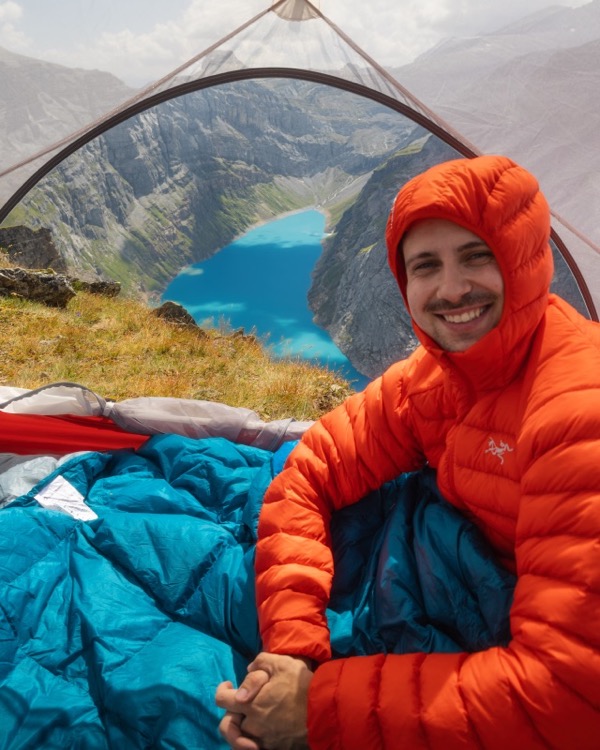
Leon Helg
Swiss filmmaker and software developer. Spends his free time in the Swiss Alps and maps his favourite spots for Hikebeast. Posts as @leon.helg on Instagram and TikTok.
Sources
- Official federal and cantonal geodata, queried 1 September 2026. Pin: LV95 2'647'845 / 1'182'397, WGS84 46.791023 / 8.065275, commune Giswil, canton Obwalden, on the federal commune layer filtered to the current year. The pin lies 13.8 m inside the mapped lake polygon, and the height service returns a near-constant 1'894.9 to 1'895.7 m across the water, which is the surface and not ground, so all slope work was run with the lake masked out. Lake about 344 m east to west by 395 m north to south, 4.42 ha. Recommended pitch LV95 2'648'070 / 1'182'597, WGS84 46.79280 / 8.06824, 1'899 m, slope 1.4 degrees on a 25 m grid, about 55 m back from the waterline, about 300 m north-east of the pin. Cantonal boundaries by bisection against the same commune layer: Schwanden bei Brienz (BE) about 250 m south of the lake's south shore and about 500 m south of the pitch, Flühli (LU) 750 to 900 m west-north-west. Federal game reserve Tannhorn, object no. 5, integral protection, nearest boundary 3'297 m west, measured against the resolved polygon; Verordnung über die eidgenössischen Jagdbanngebiete (VEJ), SR 922.31, Art. 5 para. 1 lit. e: "Das freie Zelten und Campieren ist verboten." Empty at the pin and at four further test points: federal game reserves, wildlife rest zones, BLN, floodplains, fens, raised bogs, mire landscapes, amphibian sites, dry meadows, Ramsar and Emerald sites, forest reserves and parks of national importance. Controls: a deliberately invalid layer id returned HTTP 400 on every run, and a positive control on the biosphere layer 1.2 km west on Lucerne ground hit as it should. ↩
- Kanton Obwalden, Gesetz über das Campieren, GDB 971.4, of 4 December 2014, in force since 1 March 2015, first version with no amendments, recorded as not repealed on 1 September 2026, full text read. Art. 6 "a. Grundsatz": "Das Aufstellen von Zelten, Wohnwagen und Wohnmobilen zum Campieren ausserhalb behördlich bewilligter Campingplätze ist nicht gestattet." Art. 8 "c. Einmaliges Übernachten" para. 1: "Zum einmaligen Übernachten darf ein Zelt, ein Wohnwagen oder ein Wohnmobil ohne Bewilligung ausserhalb bewilligter Campingplätze aufgestellt werden, wenn keine öffentlichen oder privaten Interessen beeinträchtigt werden." Para. 2: "Das einmalige Übernachten erfolgt auf eigenes Risiko." Art. 5 para. 1 delegates to communes only "zusätzliche Bestimmungen über den Betrieb von Campingplätzen". Art. 10 sets a charge of Fr. 100 to Fr. 1'000 for permits and rulings, an administrative fee and not a penalty. Art. 11 punishes breaches "mit Busse" and names repeat offending expressly, but fixes no amount: the route to a ceiling runs through art. 4 of the cantonal criminal act GDB 310.1 to art. 106 of the Swiss criminal code, and the Obwalden fixed-penalty catalogue GDB 310.41 was read in full and carries no camping entry. The predecessor ordinance GDB 971.41 of 25 February 1977, which limited the one-night rule to travellers in transit, was repealed with effect from 1 March 2015 and is still quoted online. Also read for comparison: the Gurtnellen (UR) camping ordinance of 2023, whose art. 2 mirrors Obwalden's art. 6 and whose art. 3 repeats the same lettering, with no equivalent of art. 8. Fetch note: gdb.ow.ch/app/de/texts_of_law/971.4 is a JavaScript shell that returns nine characters to a plain fetch; the served text is at gdb.ow.ch/api/de/texts_of_law/971.4, and lexfind.ch/tolv/221168/de carries the same act. ↩
- Postulat 53.25.05, "Anpassung Campinggesetz (GDB 971.4), Steuerungsmöglichkeit der einmaligen Übernachtung", published in the Amtsblatt of 11 December 2025, accepted by the Obwalden Kantonsrat by 48 votes to 2 on 26 March 2026. The postulate targets motorhomes, but the Regierungsrat's answer widens it: "Im Rahmen einer allfälligen Gesetzesanpassung soll jedoch auch die Regelung der einmaligen Übernachtung mit dem Zelt überprüft und mitgedacht werden." The act is unchanged as of 1 September 2026. ↩
- Gemeinde Giswil, complete register of communal acts, enumerated 1 September 2026: 31 reglemente, the full systematic collection. There is no Polizeireglement and no act regulating Campieren, Zelten, Biwakieren or Nächtigen. The eight that could plausibly reach an overnight stay were downloaded and text-scanned with word-boundary matching, including the Bau- und Zonenreglement of 23 November 2012 in the 2018 version, the Gemeindeordnung, the Strassenreglement, the Erschliessungsreglement, the Feuerwehrreglement, the Wasserbaureglement, the Gebührenreglement and the dog regulation. The only camping hits are in art. 19 of the building and zoning regulation, the valley Camping- und Badezone at the Usser Allmend, plus a stale footnote citing the repealed GDB 971.41. No document in the set was a scan, so the silence is real silence. The cantonal police act GDB 510.1 and its implementing provisions were also read in full and contain no camping, tent, bivouac or overnighting term. ↩
- Cadastral restrictions extract for parcel Giswil no. 1229, EGRID CH590477063689, read with geometry on 1 September 2026: a single 993'548 m² holding covering the lake, all its shores, the north meadow and the north-east bench, with 19 restrictions all in force. Base zone at the pitch Alpwirtschaftszone; parts of the shore Übriges Gebiet; the south shore mapped as Gefahrenzone erhebliche Gefährdung. Schutzzonenreglement Grundwasserfassung Eisee of 21 January 2016, section 1.3 "Eigentumsverhältnisse": "Parz-Nr. 1229 · Eigentümer: Öffentl.-rechtl. Körperschaft Alpgenossenschaft Gummen, 3858 Hofstetten", use given as "Seeufer, Überflutungszone, See, Wiesland, Weide, Berghang", and: "Die Schutzzonen befinden sich im Sömmerungsgebiet und im Winter am Rand / neben Skipisten." Zone S1, the Fassungsbereich, 404 m², about 190 to 205 m south-west of the lake centre and about 12 m from the water: under section 2.3.1 lit. a only works serving the water supply are permitted, and lit. b requires it to be marked and fenced. S2 from about 113 m south-west, S3 from about 80 m. Section 2.1.2 for S3: "Die Versickerung von Abwasser sowie das Erstellen von Bau- und Zeltlagerlatrinen mit Sickergruben sind verboten." Section 5.6 places supervision of the catchment on Bergbahnen Sörenberg AG. Ownership independently confirmed by the Schutzzonenreglement Quellwasserfassung Emmensprung of 11 January 2002, which lists parcel 1229 as "Alpgenossenschaft Gummen, Brienz, 3858 Hofstetten" and parcel 1228 as "Korporation Schwendi, 6063 Stalden". Both regulations are scans and were recovered by rendering at 300 dpi and running optical character recognition; the ownership table was additionally read from the page image rather than trusted to the recognition output. The separate Emmensprung S3, which covers the pin and the recommended pitch, contains no camping wording at all. ↩
- Polizeireglement der Gemeinde Schwanden bei Brienz, canton Bern, the commune whose territory begins about 250 m south of the Eisee's south shore. Art. 3 lit. c defines Campieren so as to include an overnight stay without a tent, which closes the bivouac reading that works on the Obwalden side; art. 10 para. 1 prohibits camping on public ground; art. 18 provides for a fine of up to CHF 5'000. Same massif, opposite rule. ↩
- Regierungsratsbeschluss über die kantonalen Wildruhezonen, GDB 651.150, of 21 January 2014 in the version of 1 August 2021, recorded as in force, with its Reglement and zone list. Art. 3 imposes a path requirement inside the zones, art. 4 an aircraft take-off and landing ban together with a leash requirement, both from 1 December to 30 April for the zones numbered above 7. There is no camping provision anywhere in the Reglement. The zone here is no. 11, Nesslenstock, Giswil, nearest edge 351 m north-north-west of the pin, so the recommended pitch is outside it. The Obwalden fixed-penalty catalogue GDB 310.41 item 2.4 sets CHF 200 for "Missachten von markierten Wildruhezonen, Wildschutzzonen und Jagdbanngebieten"; note "markierten", which limits it to zones actually signed on the ground. ↩
- Kanton Obwalden, annual notice "Campierverbot in Schutzgebieten", issued by the Amt für Wald und Landschaft and the Kantonspolizei, editions from 2023 to August 2026 read. The permissive baseline in the canton's own words: "Im Kanton Obwalden ist es grundsätzlich erlaubt, ein Zelt, einen Wohnwagen oder ein Wohnmobil für eine einmalige Übernachtung ausserhalb bewilligter Campingplätze aufzustellen, solange keine öffentlichen oder privaten Interessen beeinträchtigt werden." The exception: "In Schutzgebieten jedoch gilt ein absolutes Campierverbot. Hier sind das Campieren, Biwakieren sowie das Abstellen von Wohnmobilen ausdrücklich untersagt." The areas named across the editions are the Moorlandschaft Glaubenberg with the Mittagsgüpfi, the Seewensee and the Rickhubel, the federal game reserves, nature protection zones such as the Wichelsee and protected floodplains such as the Aue Laui. The lists are expressly open-ended. Neither the Eisee nor the Brienzer Rothorn, the Arnihaaggen or the Eiseesattel appears in any edition, and the Glaubenberg perimeter is 1.59 km from this basin. No franc figure is given in any edition. The only request the authorities make is mild: "Wir bitten alle Campierenden, keine Abfälle zu hinterlassen." ↩
- Berghaus Eisee, Bergbahnen Sörenberg AG and the Eisee fishery, read 1 September 2026. The Berghaus is a self-service mountain restaurant with accommodation at about 1'950 m on the west flank above the lake, telephone +41 33 951 40 14, 41 beds, season 13 June to 25 October, half board about CHF 85 to 140. Lifts: cable car Schönenboden to Brienzer Rothorn, then a walking tunnel of about 350 m, then the Sesselbahn Eisee down into Obwalden; the chairlift season is 13 June to 25 October and the last ride off the Eisee is 16.30, with the operator stating that it is not started earlier for the sunrise trips. Fishery: the Obwalden fishing act GDB 651.211 art. 35 para. 1 carves the Melchsee, Tannensee, Blausee, Seefeldsee and Eisee out of the cantonal regal and requires a special patent from the holder of the fishing right; the Fischer-Freunde Eisee sell it at CHF 33 plus a CHF 5 statistics fee, online or at the Berghaus, with the catch to be shown at the Berghaus. Who exactly holds the fishing right, and who holds the building right on the Berghaus parcel, could not be established and is not asserted here. ↩
- Ground truth, searched twice and reported as found. All ten trip reports for the Eisee recoverable through the web archive were scanned with word-boundary matching for Zelt, Biwak, campier and übernacht, with zero real hits, alongside searches on the mapping and touring platforms, the walking and summit-book sites, the national route portal, Reddit, Instagram, YouTube, TikTok and the fishing forums. No report of a tent or bivouac at the Eisee, no customary fee, no account of anybody being moved on, and no account of a successful night either. No camping prohibition sign was found at the lake, at the chairlift station or on the Rothorn; the camping-prohibition signs in this massif are about 2 km west on the Bernese Brienzergrat, across the cantonal border, and are documented only on an unofficial advocacy site that cites no norm. The destination's own pages for the Eisee and the Brienzer Rothorn were read in full and contain no camping, bivouac, wildlife-zone or "please refrain" wording of any kind, and the summer brochure likewise. One of those pages carries a "Naturschutzgebiet" category chip: it has no legal basis, the same site's other record for the same lake omits it, the cadastral extract shows no nature protection zone on parcel 1229, and the cantonal map service returns empty across all five Obwalden nature and landscape layers with the query controls passing. ↩