Wild camping at the Seewlisee
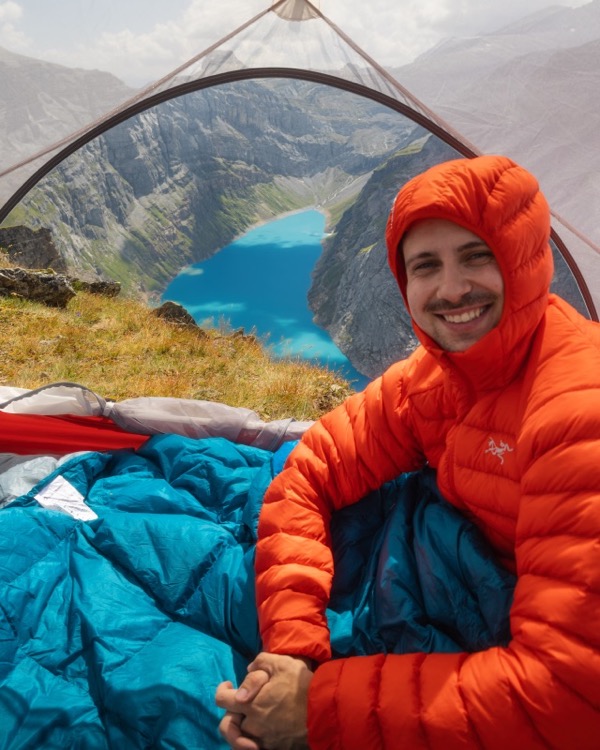
A night at the Seewlisee is possible, but only with prior permission. The rule comes from the landowner, Korporation Uri, and you book permission for CHF 20 per person through seewlisee.ch. It covers the assigned area behind the lake and nothing else.
What do these mean?
Illegal A specific rule bans it, usually with a fine, and it can be enforced. Sleep somewhere else.
Not allowed No real place to camp here. A gated site, a developed area, or nowhere sensible to lie down, even if no fine is attached.
It depends You can sleep here, but there's a condition first: ask the landowner, book a spot, stay inside a set zone, or use a bivvy instead of a tent. The report says which.
Tolerated No rule clearly allows or bans it, but a single night is accepted in practice and nobody enforces against it. Normal for high bivouacs above the treeline.
Legal Camping one night is fine here. Either a rule allows it, or we checked every law and found nothing against it. Still: pitch late, leave early, no trace.
The law says yes, which is not the end of it
The federal layers are empty. Queried on 16 August 2026 at the Seewlisee, 2'697'424 / 1'185'201 in LV95, 46.810833 N / 8.715131 E, at 2'026.4 metres: no federal game reserve, no wildlife rest zone, no BLN landscape, no mire landscape, no fen, no raised bog, no amphibian site, no dry meadow, no park of national importance, no forest reserve, and no building zone. An invalid layer name returns HTTP 400 rather than an empty list, so the emptiness is an answer and not a silent failure. Canton Uri, commune Silenen, from current-year records.1
As at most mountain tarns, the map pin is on the water. Slope reads 0.0 degrees because the point sits inside the lake polygon, so the real question was always which piece of shore, not the pin.1
Canton Uri does not ban camping. Its Polizeigesetz (RB 3.8111), its Polizeireglement (RB 3.8127) and its Gesetz über den Natur- und Heimatschutz (RB 10.5101, about 428'000 characters) contain no camping provision at all. The one place camping appears in Uri law is the Ordnungsbussenreglement (RB 3.9223), whose Anhang Art. A1-1 Ziff. 2.1 fines "Lagern, Zelten oder Campieren in Schutzzonen" with 150 francs. That provision hangs on art. 34 al. 1 lit. a of the cantonal nature-protection act "in Verbindung mit dem jeweiligen Reglement", which means it needs a protection zone with a regulation behind it. At this lake there is none.2
On the statute, then, this reads exactly like the Fisetenpass and the Bälmeten, two other Uri spots where the same chain produced a clean legal. Here it does not, and the reason is not in any law book.
The land belongs to the Korporation Uri, the old corporate landowner that holds much of the canton's alpine ground. It publishes a standing, unusually generous position: "Auf Gebiet der Korporation Uri ist das Campieren somit grundsätzlich erlaubt und muss nicht angemeldet werden", camping on Korporation Uri land is in principle allowed and does not have to be registered. You are asked to respect protection-zone rules, to get permission for private roads, to speak to the alp farmers if you are near their operation, to inform the Korporation in advance if you stay longer than three nights or come with more than ten people, to bag your rubbish and carry it to the next collection point, and to leave the site tidy.3
Then it names two exceptions, and this lake is one of them. Alongside Göschenen, where wild camping is prohibited and the official campsite is the answer, the Korporation writes: "Im Gebiet rund um den Seewlisee ist das Wildcampieren grundsätzlich verboten. Eine Ausnahme ist ausschliesslich mit vorgängiger Bewilligung möglich." The commune of Silenen states it just as plainly on its own tourism page: "Wildcampieren verboten, Ausnahme nur mit Bewilligung", and "Campieren nur mit vorgängiger Bewilligung erlaubt", calling the Seewlisee a sensitive nature and alpine area.34
This is a property rule rather than a criminal one. It is not backed by a fixed-penalty ticket, it is backed by the fact that somebody owns the ground you are standing on and has told you no.
How to get the night anyway
Unusually for a spot with a ban on it, the lawful route here is not a phone call to a stranger and a hopeful conversation. It is published, priced and bookable, which is why this article ends in it depends rather than illegal.
Book through the Seewlialp's own site. Permission is granted per night through seewlisee.ch, the booking system run for the alp, and the Korporation Uri handles questions about it.4
You do not get to choose your pitch. The condition is explicit: "Wildcampen ist ausschliesslich auf der zugewiesenen Fläche hinter dem See erlaubt", camping is permitted exclusively on the assigned area behind the lake. That is the whole permission. A tent on the nearest attractive shore is not covered by it.4
The price is CHF 20 per person per night, and CHF 30 for the first night if you arrive after 18:00. The booking is binding: no cancellation, no rebooking of dates, no refunds. Plan the weather in, because the money does not come back.4
It only exists in summer. The Älplerschaft is responsible for enforcing the rules during the alp season, roughly 15 June to 15 September. Outside that period wild camping at the lake is prohibited, so the shoulder seasons that are attractive elsewhere in Uri are simply closed here.4
If you would rather have a roof, the Seewlialp at about 2'021 metres has a hut, "uf de Biele", with dormitory space for around twenty people, and the alp serves refreshments. That is the fallback when the camping area is booked out or the season is over.4
Getting there. The usual approach from Silenen is the cable car to Chilcherberge, then about two and a half hours on a marked mountain hiking trail to Seewli. The lake is the largest and deepest of Uri's natural mountain lakes, roughly nine hectares and twenty metres deep, sitting under the Gross Windgällen.4
The ground, and why the assigned area is not a hardship
A water-masked slope scan ran over the 400 metres around the lake, stepping outwards in eight rings and twenty-four directions, discarding every sample that fell inside a water polygon. Of 115 dry samples, 43 sit at or under 10 degrees, so this is not a basin where flat ground is scarce.1
The closest flat ground is south and southeast of the lake: 6.3 degrees at 90 metres, then a distinctly better shelf at 120 metres, 3.2 degrees at 2'028.5 m to the southeast and 3.3 degrees at 2'030.3 m south-southeast. Further out, the flattest reading of the whole scan is 1.8 degrees at 2'026.6 m, 200 metres due north, with more easy ground northeast at 3.8 and 4.1 degrees.1
Two things follow. First, the assigned area behind the lake is not a punishment pitch: there is comfortable ground all around this basin, and the alp has simply picked which of it you may use. Second, and more useful, none of these numbers give you a right to any of them. The whole basin is Korporation Uri ground under the same named prohibition, so a flatter reading on this page is not an argument you can make to an Älpler.13
There are nine buildings within 1.2 kilometres, the nearest 402 metres away. This is a working alp, not an empty cirque. In practice that means somebody will very likely see your tent, which is the practical reason the booking matters more here than the legal one.1
General rules for wild camping
You are a paying guest on a working alp at just over 2'000 m, on ground the owner closed and then reopened on conditions. That asks for more care than usual:
- No fire. An open fire has no place in the mountains. A gas stove is enough.
- Pitch late, strike early. Set up towards evening, gone again early. A bivouac is one night, not a base camp.
- Leave no rubbish. Everything you carry up you carry down, organic scraps and toilet paper included.
- At least 50 metres from any water for the big business, so you do not foul what people and livestock drink.
- Stay small and quiet. A small group, no speaker, no drone, dogs on the lead, and the alp staff's word goes.
Disclaimer
Everything here is a journalistic assessment as of August 2026, from the sources linked below, and it is not legal advice.
The prohibition at this lake is a landowner's rule, not a criminal prohibition with a published tariff. Do not read that as it being weaker. It means the consequence is being asked to leave private ground you were told not to use, and there is no fixed-penalty ticket to argue about afterwards.
The cantonal cadastre of public-law restrictions could not be read for this point. The federal service advertises the Uri endpoint as prozessor-oereb.ur.ch, which does not respond, and the alternative host does not answer either. The findings above therefore rest on the federal layers, the cantonal statutes and the landowner's own published rules, all linked below, and not on a parcel extract.
Prices, season dates and booking conditions are the operator's and can change. Check them on the booking page before you rely on the numbers here.
Frequently asked questions
Is wild camping allowed at the Seewlisee?
What does it cost?
Can I pitch anywhere at the lake once I have booked?
Is there a fine if I just camp anyway?
What about outside the summer?
Is there an indoor alternative?
Leon Helg
Swiss filmmaker and software developer. Spends his free time in the Swiss Alps and maps his favourite spots for Hikebeast. Posts as @leon.helg on Instagram and TikTok.
Sources
- Official federal geodata and the national height model, queried 16 August 2026 at the Seewlisee, WGS84 46.810833 N / 8.715131 E, LV95 2'697'424 / 1'185'201, 2'026.4 m. The game-reserve, wildlife-rest-zone, BLN, mire-landscape, fen, raised-bog, amphibian, dry-meadow, park and forest-reserve layers and the building-zone layer all return an empty result set, verified with an invalid-layer control returning HTTP 400. Canton Uri, commune Silenen, current-year records only. The pin lies inside a water polygon, which is why the slope reads 0.0 degrees and why the analysis concerns the shore. Water-masked slope scan over 400 m in eight rings and 24 directions, water samples discarded: 115 dry samples, 43 at or under 10 degrees; nearest flat ground 6.3 degrees at 90 m south, better at 3.2 degrees and 2'028.5 m at 120 m southeast and 3.3 degrees at 2'030.3 m, flattest overall 1.8 degrees at 2'026.6 m, 200 m north. Nine buildings within 1.2 km, the nearest at 402 m. map.geo.admin.ch. ↩
- Canton Uri legislation, read in full on the cantonal Rechtsbuch. Polizeigesetz RB 3.8111 and Polizeireglement RB 3.8127: no camping provision. Gesetz über den Natur- und Heimatschutz RB 10.5101, about 428'000 characters: no occurrence of Zelt, Zelten, campieren, Camping, Biwak or Lagern in the camping sense, checked with word-boundary matching and control terms that count normally. Ordnungsbussenreglement RB 3.9223, Anhang Art. A1-1 Ziff. 2.1, fines "Lagern, Zelten oder Campieren in Schutzzonen" with 150 Fr., a provision expressly based on art. 34 Abs. 1 lit. a of the cantonal nature-protection act "in Verbindung mit dem jeweiligen Reglement", so it requires a designated protection zone with its own regulation. No such zone applies at the Seewlisee. rechtsbuch.ur.ch. ↩
- Korporation Uri, "Wildcampieren", the landowner's published rules for camping on its territory, read 16 August 2026. General position: "Auf Gebiet der Korporation Uri ist das Campieren somit grundsätzlich erlaubt und muss nicht angemeldet werden." Conditions: protection-zone rules to be observed, permission required on private roads, contact with the alp farmers where relevant, advance notice to the Korporation "Ist der Aufenthalt länger als 3 Nächte oder mit mehr als 10 Personen", rubbish to be bagged in charged bags and carried to the next collection point, and the site to be left tidy. Named exceptions: Göschenen, where wild camping is prohibited and the official campsite applies, and the Seewlisee: "Im Gebiet rund um den Seewlisee ist das Wildcampieren grundsätzlich verboten. Eine Ausnahme ist ausschliesslich mit vorgängiger Bewilligung möglich." Korporation Uri, Gotthardstrasse 3, 6460 Altdorf, 041 874 70 90. korporation.ch. ↩
- Seewlialp booking conditions at seewlisee.ch and the Gemeinde Silenen tourism page for the Seewlisee, both read 16 August 2026. Silenen: "Wildcampieren verboten, Ausnahme nur mit Bewilligung" and "Campieren nur mit vorgängiger Bewilligung erlaubt", describing the Seewlisee as a sensitive nature and alpine area, with the Seewlialp at 2'021 m. Booking conditions: "Wildcampen ist ausschliesslich auf der zugewiesenen Fläche hinter dem See erlaubt", a permit required per night, CHF 20 per person per night and CHF 30 for the first night on arrival after 18:00, and "Die Buchung ist verbindlich und kann nicht storniert werden. Umbuchungen von Buchungsdaten und Rückerstattungen sind ausgeschlossen." "Die Älplerschaft ist während der Alpzeit, vom ca. 15. Juni bis 15. September, für die Einhaltung der Regeln zuständig", with wild camping prohibited outside that period. The hut "uf de Biele" offers dormitory space for about twenty. Access from Silenen by the Chilcherberge cable car, then about two and a half hours on a marked mountain hiking trail. silenen.ch. ↩