Wild camping at the Lago di Leit
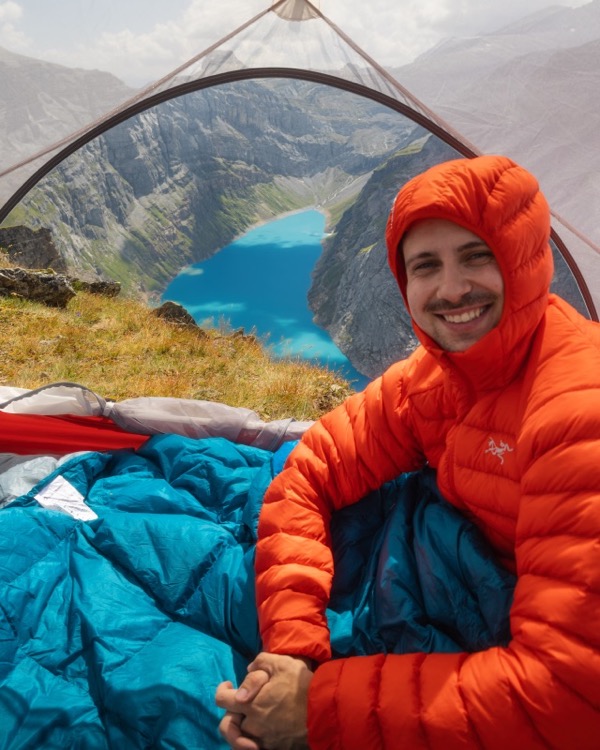
A bivouac at the Lago di Leit is expressly allowed. The Ticino camping act permits camping only in authorised areas, and it exempts pitching for the purpose of a bivouac in the mountains. At 2'260 metres above the treeline that is your night.
What do these mean?
Illegal A specific rule bans it, usually with a fine, and it can be enforced. Sleep somewhere else.
Not allowed No real place to camp here. A gated site, a developed area, or nowhere sensible to lie down, even if no fine is attached.
It depends You can sleep here, but there's a condition first: ask the landowner, book a spot, stay inside a set zone, or use a bivvy instead of a tent. The report says which.
Tolerated No rule clearly allows or bans it, but a single night is accepted in practice and nobody enforces against it. Normal for high bivouacs above the treeline.
Legal Camping one night is fine here. Either a rule allows it, or we checked every law and found nothing against it. Still: pitch late, leave early, no trace.
The rare canton that legislated the exception instead of leaving it to custom
Wild camping at the Lago di Leit is decided by a cantonal statute, which by itself makes Ticino unusual. In most cantons the question falls to communal police regulations, and the answer changes every time you cross a boundary. Ticino legislated it once, for the whole canton.
"È possibile campeggiare unicamente nelle aree autorizzate destinate a campeggio. Fa eccezione al principio di cui al cpv. 1 l'attendamento a scopo di bivacco in montagna."Legge sui campeggi of 26 January 2004, Art. 2 paras. 1 and 2, in force since 1 June 2004, consolidated text as at 1 January 2024: camping is possible only in authorised camping areas, and an exception to that principle is pitching for the purpose of a bivouac in the mountains.
Read the second sentence carefully, because two words in it do a lot of work.
"Attendamento" means pitching, from tenda, a tent. The exception is not limited to sleeping in the open with nothing over you. A small tent, put up for a bivouac, is what the word describes. That is more generous than the wording in most cantons, where a norm bans "Zelten" and the tentless case survives only as an untested gap. Here the tent is inside the exception rather than outside the ban.
"A scopo di bivacco in montagna" is the limit, and it is a real one. The exception attaches to the purpose and the place: a bivouac, in the mountains. One night as part of being out in the terrain. It is not a holiday pitch next to where you parked, it is not a week in the same spot, and it is not a group camp. Stretch it and you are outside the exception and inside Art. 2 para. 1, where Art. 27 lets the Municipio fine between CHF 50 and CHF 10'000.1
At the Lago di Leit none of that is a close call. The lake sits at 2'260 metres in the Campolungo group, well above the treeline, reached on foot. If the phrase "bivacco in montagna" means anything, it means here.
How it is possible: nothing to do, and here is what we checked
There is no consent route because none is needed, no permit, no booking, no fee and no season. What there is instead is a chain of three layers that all have to come back clean, and this is what each one actually said.
The commune of Quinto. Quinto absorbed Prato Leventina in April 2025, so the current commune covers both sides of the ground here, and its published law collection is the one that counts. It runs to thirteen regolamenti and twenty-four ordinanze: cemeteries, waste, drinking water, sewers, school fees, video surveillance, dental clinic, parking levies, snow and ice, heat. Not one regulates camping. We also read the Regolamento del Comune di Quinto in full rather than trusting the titles. Its public-order chapter, Art. 42 to 46, covers emergency duties, a general competence clause for the Municipio, noise, festive and night work, and the heat alarm. The word "tende" appears twice and both times means awnings on buildings, not tents.2
The canton. Covered above. The one thing to add is that the Legge sui campeggi is the operative instrument and it is current: consolidated as at 1 January 2024, most recently amended 18 September 2023.1
The federal layer. Queried at the exact point, with controls. The hunting-ban district, wildlife rest zone, mire, floodplain, amphibian and national-park layers all return genuinely empty. We proved that means something by running the same query at a lake known to be inside a reserve, which returned the reserve, and by querying a deliberately misspelled layer id, which returned an error rather than an empty result. That second control matters: a bad layer name silently looks like an absence if you do not check.3
What is present is a BLN listing, object Campolungo, Campo Tencia and Piumogna. This gets misread constantly. Under Art. 5 and 6 of the federal nature and heritage act, an inventory entry binds the authorities when they perform a federal task, such as assessing a permit. It creates no offence for a person sleeping out.4
The place, and the one thing that would change the answer
The lake: LV95 2'698'528 / 1'146'791, 2'260 metres, commune of Quinto, canton Ticino, in the Campolungo group above the Leventina.
The thing to watch is not a boundary here, it is the wording. The exception in Art. 2 para. 2 is the whole basis for this verdict, and it is attached to a purpose. Everything that makes a stay look less like a bivouac and more like camping erodes it: arriving by vehicle and pitching next to it, staying a second and third night in the same place, a large group, a fixed camp standing through the day, a fire. None of those is separately banned by a norm we found at this lake, and all of them push you out of the exception the canton wrote and back under Art. 2 para. 1.
The practical version is the one every alpinist already knows: up in the evening, gone in the morning, small, quiet, no trace. That is what "a scopo di bivacco" describes, and it is why the exception has survived in the statute for more than twenty years.
One honest gap, stated rather than papered over: we have not found any Quinto ordinance issued since the April 2025 merger that would touch camping, and the commune's published index is our evidence for that. If Quinto issues one, this article is out of date and the cantonal exception would still stand behind it, since a commune cannot ban what the cantonal statute expressly exempts without its own legal basis.2
Where you can legally sleep
- At the lake, for one night, as a mountain bivouac, which is exactly the case Art. 2 para. 2 exempts1.
- Capanna Campo Tencia and the other SAC huts in the group, if the weather turns or you would rather have a roof.
- Authorised campsites in the Leventina, down in the valley, for anything that is not a bivouac: a vehicle, a group, more than one night.
- Not as a base camp. The exception is written around a bivouac and stops being available the moment the stay stops looking like one.
General rules for wild camping
Ticino is one of the very few cantons that wrote a yes into a statute. That yes has survived since 2004 because the people using it have behaved. The rules below are not law, they are the reason the law still says what it says.
- No fire. An open fire has no place in the mountains. A gas stove is enough.
- Pitch late, strike early. Set up towards evening, gone again early. A bivouac is one night, not a base camp.
- Leave no rubbish. Everything you carry up you carry down, organic scraps and toilet paper included.
- At least 50 metres from any water for the big business, so you do not foul what people and livestock drink.
- Stay small and quiet. A small group, no speaker, no drone, dogs on the lead, and the alp staff's word goes.
Disclaimer
This article reflects my research and assessment to the best of my knowledge, as of July 2026. It is based on the publicly accessible and official sources linked below. It does not replace legal advice and is not a binding statement of the current legal situation.
The exception relied on here is limited to pitching for the purpose of a bivouac in the mountains. Whether a given stay falls inside it is a question of the facts on the day, and a Municipio takes a different view of a tent standing for three days than of one struck at dawn. Communal ordinances change and Quinto merged with Prato Leventina in 2025. Before every tour, check the current sources yourself and follow instructions on site. A genuine emergency bivouac in distress is a separate question again. Anyone who spends the night outside bears responsibility for their own conduct and any consequences themselves. Hikebeast, Leon Helg and Saftladen GmbH accept no liability for decisions made on the basis of this text, and call on no one to break applicable law.
Frequently asked questions
Is wild camping allowed at the Lago di Leit?
Does the exception cover a tent, or only sleeping in the open?
What is the fine if I fall outside the exception?
Does the BLN listing ban camping at the lake?
Do I need to ask the commune or a landowner?
Leon Helg
Swiss filmmaker and software developer. Spends his free time in the Swiss Alps and maps his favourite spots for Hikebeast. Posts as @leon.helg on Instagram and TikTok.
Sources
- Canton Ticino, Legge sui campeggi of 26 January 2004, in force 1 June 2004, consolidated text as at 1 January 2024 with the most recent amendment of 18 September 2023: Art. 2 para. 1 ("È possibile campeggiare unicamente nelle aree autorizzate destinate a campeggio"), Art. 2 para. 2 ("Fa eccezione al principio di cui al cpv. 1 l'attendamento a scopo di bivacco in montagna"), Art. 27 (breaches punished by the Municipio with a fine from CHF 50 to CHF 10'000). m3.ti.ch, Raccolta delle leggi del Cantone Ticino. ↩
- Comune di Quinto, complete published law collection consulted 29 July 2026: thirteen regolamenti and twenty-four ordinanze, none of which regulates camping, tents, bivouac or overnight stays. The Regolamento del Comune di Quinto was read in full: its public-order chapter, Art. 42 to 46, covers emergency duties, the Municipio's general competence for public order, noise, festive and night work and the heat alarm, and Art. 50 sets the fine procedure for breaches of communal instruments. The two occurrences of "tende" in the text refer to awnings on buildings. Quinto absorbed Prato Leventina in April 2025. tiquinto.ch. ↩
- Official federal geodata, queried 29 July 2026 at LV95 2'698'528 / 1'146'791 (2'260 m): hunting-ban districts, wildlife rest zones, mire, floodplain and amphibian inventories, parks of national importance and building zones all return a genuinely empty result set. Verified with a positive control at the Bachalpsee, which returns hunting-ban district no. 4 Schwarzhorn, and with an invalid-layer control, which returns an HTTP error rather than an empty result, so an empty answer here is a real absence and not a misspelled layer id. Present at the pin: BLN object Campolungo, Campo Tencia and Piumogna. Commune at the pin: Quinto, gde_nr 5079, current for 2026. map.geo.admin.ch. ↩
- Federal Act on the Protection of Nature and Cultural Heritage (NHG), SR 451, Art. 5 and 6: an inventory listing such as the BLN binds the authorities when a federal task is performed, it does not create a camping offence for an individual. fedlex.admin.ch. ↩
- Ticino Turismo, "Campeggio e bivacco nelle montagne svizzere": the cantonal tourism position that camping is possible only in authorised areas, with the mountain bivouac as the exception, and the standing advice to check locally with the commune concerned. Guidance restating the statute, not an independent norm. ticino.ch.
- Swiss Alpine Club SAC, "Campieren und Biwakieren": a single considerate night above the treeline is widely accepted where no contrary rule exists. In Ticino it is better than accepted, it is written into the camping act. Guidance, not law. sac-cas.ch.
- Swiss Civil Code (ZGB), SR 210, Art. 699: forest and pasture are accessible to everyone within customary limits. An access right and not a right to sleep over; the basis for this verdict is the cantonal exception, not Art. 699. fedlex.admin.ch.