Wild camping at Lac d'Emosson: legal on one side of an invisible line
A camp at 2,263 metres above a turquoise reservoir, in a commune whose police reglement never mentions camping. 150 metres north the fine reaches CHF 10'000; the dam parkings below get morning patrols since 2024. Everything here hangs on lines you cannot see. This is where they run.
What do these mean?
Illegal A specific rule bans it, usually with a fine, and it can be enforced. Sleep somewhere else.
Not allowed No real place to camp here. A gated site, a developed area, or nowhere sensible to lie down, even if no fine is attached.
It depends You can sleep here, but there's a condition first: ask the landowner, book a spot, stay inside a set zone, or use a bivvy instead of a tent. The report says which.
Tolerated No rule clearly allows or bans it, but a single night is accepted in practice and nobody enforces against it. Normal for high bivouacs above the treeline.
Legal Camping one night is fine here. Either a rule allows it, or we checked every law and found nothing against it. Still: pitch late, leave early, no trace.
Valais has no ban, Finhaut has no rule, Salvan has one
Wild camping at Lac d'Emosson starts with a sentence every second blog repeats: wild camping is banned throughout Valais. It is folklore. The rule behind it dates from 1977 and is absent from the canton's in-force collection of law; what the LHR actually regulates are commercial camping offers, not your tent1. The building ordinance wants a permit only past three weeks or twelve tents2. And the cantonal Plan directeur hands the question down: the communes "fixent les prescriptions relatives au camping sauvage", they set the wild-camping rules themselves3.
"Le camping, le caravaning et ce qui leur est assimilable sont interdits en dehors des emplacements autorisés expressément désignés comme tels par l'Autorité."Règlement de police intercommunal du Salentin (Salvan), 21 March 2018, Art. 57 ch. 2: camping, caravaning and anything comparable are banned outside expressly designated authorized sites. Fine up to CHF 10'000 (Art. 82 ch. 1). From the camp, this sentence begins about 150 metres north.
One word in that Salvan sentence deserves a second look: "assimilable", anything comparable to camping and caravaning. A one-night bivouac is exactly the kind of thing a court could read into it, so do not bet a night on the Salvan side on the tent-vs-bivvy distinction; there the line on the map is the answer, not the kit on your back.
South of the line, nothing comparable exists. I read Finhaut's Règlement de police of 1996, the one in force, from first article to last: noise, animals, public order, not one word about camping4. What remains is ZGB Art. 699, access to forest and pasture: passage, not a bed. So the camp stands on legal ground: no norm bans it, which is what makes the night legal, though nobody owes it to you, and next door Salvan wrote down the opposite answer5.
How it is possible: stay high and stay south
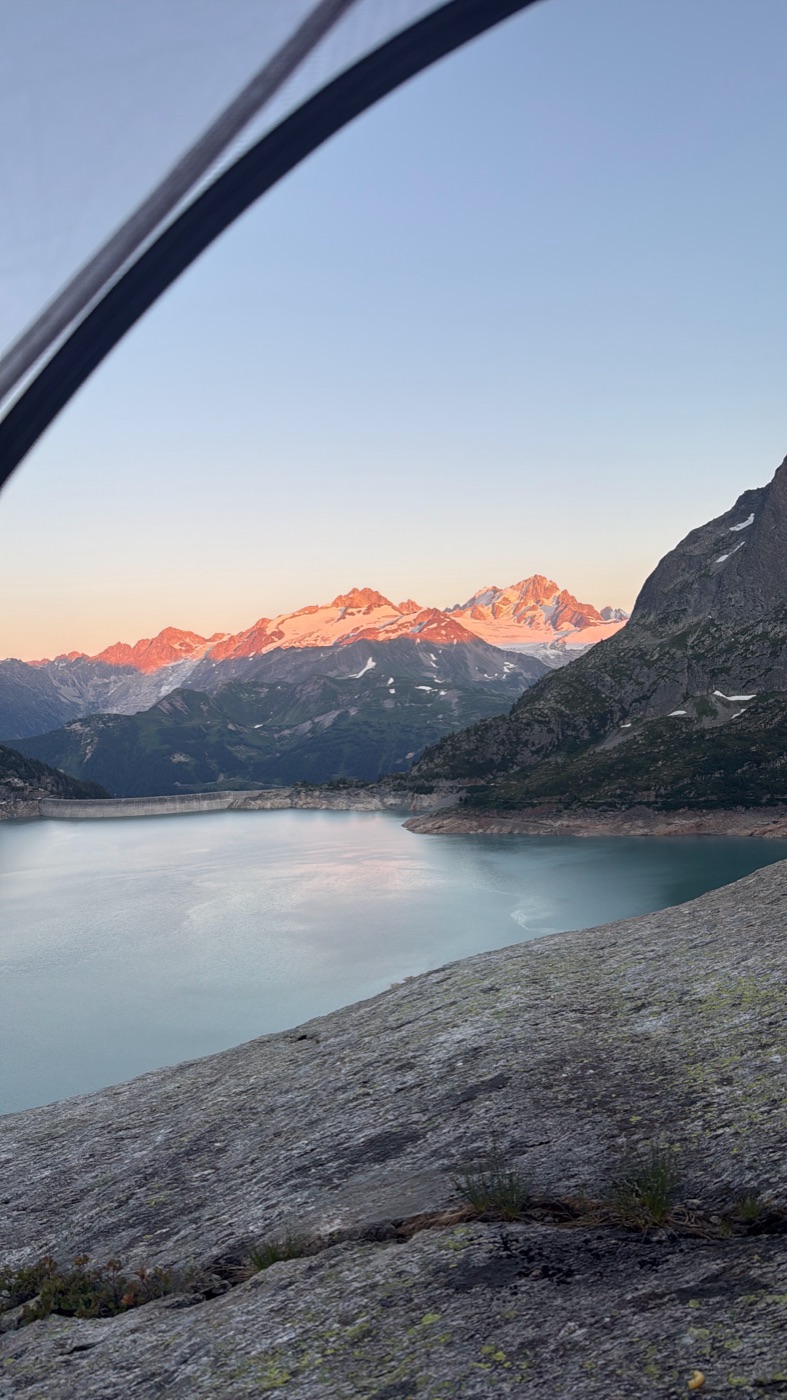
The camp this article means is not the shore. It is the grassy shoulder at 2,263 metres above the western side of the lake, far above the treeline, on Finhaut ground, south of the Salvan line. The shore itself is the one place I would never pitch: Nant de Drance runs the lake as pumped storage, the level "can rise and fall at any time", and the banks are unstable7. Full pool is 1,930 metres; the shoulder keeps a good 330 metres above that.
Up there, the usual alpine arithmetic applies: above the treeline and outside every protected zone, the SAC line is the reference, a single discreet night of a small group is normally unproblematic where nothing contrary is in force9. Nothing contrary is in force here.
Up towards evening, gone early, one tent, one night, no fire, every litre of water carried. Stay south of the commune line, the flatter ground further north is Salvan, and never move the night down to the dam parkings.
If the weather argues, the Cabane du Vieux Emosson takes the night, 2,205 metres, guarded in season.
The two hard lines: the Salvan border and the dam
Line one crosses the slope 150 to 200 metres north of the pitch: the border to Salvan. Beyond it the Règlement de police intercommunal du Salentin has been in force since 2018, Art. 57 bans camping and caravaning outside expressly designated sites, Art. 82 lets the fine climb to CHF 10'0005. Drift north for a flatter pitch and you trade a commune without a rule for one with a five-figure ceiling.
Line two is vertical. Overnighting at the dam parkings below is banned since June 2024, vehicles and tents alike: the former free camper area was closed on the canton's order, patrols come in the morning, and fines around CHF 150 are reported6. The dam road is open roughly May to mid-October, which is also the realistic season for the camp.
What the maps say
I checked the pitch point by point on the official geodata: no federal hunting-ban district, no wildlife rest zone, no cantonal wildlife zone, no BLN landscape, no biotope inventory8. What the map shows instead is the Parc naturel régional de la Vallée du Trient, a park label that binds the member communes and imposes nothing on a camper8.
That emptiness is no accident, it is the Valais system: the canton keeps no camping layer of its own and leaves the matter to the communes3, which is why a commune border and a parking sign decide everything here. How the federal, cantonal and communal layers stack across the country is in our national overview.
Where you can legally sleep
- The shoulder at 2,263 metres itself: Finhaut ground, south of the line, one tent, one night, water carried.
- Cabane du Vieux Emosson, 2,205 m, guarded in season, reservation via cabaneduvieux.ch.
- The apartments at the Restaurant du Barrage d'Emosson, the bed right at the dam, emossonresto.com.
- Camping du Peuty in Trient, the simple valley base.
- Camping des Marécottes and Camping de Van d'en Haut, the designated answers on Salvan ground6.
General rules for wild camping
This applies wherever you may genuinely sleep outside, on the Emosson shoulder more than anywhere: a tolerance without a written rule survives on conduct alone.
- No fire. Open fire has no place up here, and there is nothing to burn anyway. A gas stove is enough.
- Pitch late, strike early. Set up towards evening, gone again early. A bivouac is one night, not a base camp.
- Leave no rubbish. Everything you carry up you carry down, organic scraps and toilet paper included.
- At least 50 metres from any water for the big business, so you do not foul what people and livestock drink.
- Stay small and quiet. A small group, no speaker, no drone, dogs on the lead, and the word of the people who work this land goes.
Disclaimer
This article reflects my research and assessment to the best of my knowledge, as of July 2026. It is based on the publicly accessible and official sources linked below. It does not replace legal advice and is not a binding statement of the current legal situation.
Communal reglements, enforcement practice and operator rules change: Salvan's ban dates from 2018, the parking ban at the dam from June 2024, and a lake run as pumped storage moves its shoreline daily. Before every tour, check the current sources yourself and follow signs and instructions on site. Anyone who spends the night outside bears responsibility for their own conduct and any consequences themselves. Hikebeast, Leon Helg and Saftladen GmbH accept no liability for decisions made on the basis of this text, and call on no one to break applicable law.
Frequently asked questions
Is wild camping allowed at Lac d'Emosson?
Is wild camping banned everywhere in Valais?
What happens on the Salvan side?
Can I sleep in my van at the Emosson dam parking?
Where can I sleep legally instead?
Leon Helg
Swiss filmmaker and software developer. Spends his free time in the Swiss Alps and maps his favourite spots for Hikebeast. Posts as @leon.helg on Instagram and TikTok.
Sources
- Canton of Valais, LHR (RS/VS 935.3), Art. 3 al. 1: the law covers camping as a commercial accommodation offer. The in-force RS/VS collection contains no cantonal wild-camping ban; the 1977 camping ordinance still cited for one is not part of it. Negative finding as of July 2026. lex.vs.ch. ↩
- Canton of Valais, Ordonnance sur les constructions (RS/VS 705.100), Art. 17 al. 2 let. a: camping installations need a building permit only beyond three weeks or more than twelve tents. lex.vs.ch. ↩
- Plan directeur cantonal du Valais, fiche B.3 Camping: the communes "fixent les prescriptions relatives au camping sauvage dans leur règlement de police ou autre règlement communal", they set the wild-camping rules themselves. vs.ch. ↩
- Commune de Finhaut, Règlement de police of 1996, in force: read in full, contains no camping article and no overnight rule of any kind. Negative finding as of July 2026. finhaut.ch. ↩
- Règlement de police intercommunal du Salentin, 21 March 2018, in force on Salvan ground: Art. 57 ch. 2 (camping and caravaning banned outside expressly designated authorized sites), Art. 82 ch. 1 (fine up to CHF 10'000). salvan.ch. ↩
- Vallée du Trient tourism office, "Camper sur la commune de Salvan": camping only at the designated sites, Camping des Marécottes and Camping de Van d'en Haut; context of the regional crackdown in which the free camper area at the Emosson dam was closed in June 2024 on the canton's order, with morning checks at the parkings since. valleedutrient.ch. ↩
- Nant de Drance SA, safety information for Lac d'Emosson and Lac du Vieux Emosson: pumped-storage operation, the water level can rise and fall at any time, unstable banks, keep your distance from the shore. nant-de-drance.ch. ↩
- Official geodata checks at the camp (2,263 m above the western shore): the layers hunting-ban districts, wildlife rest zones, cantonal wildlife zones, BLN and the biotope inventories all return nothing; the point lies in the Parc naturel régional de la Vallée du Trient, a park label that binds the member communes and imposes no rules on campers. The 1983 protection decision for the dinosaur tracks at Vieux-Emosson (RS/VS 451.117) guards the track site 3 to 4 km southwest and contains no camping rule. map.geo.admin.ch, lex.vs.ch. ↩
- Swiss Alpine Club SAC, "Campieren und Biwakieren": a single overnight stay by a small number of people in the mountains above the treeline is normally unproblematic where nothing contrary applies; consideration toward wildlife and terrain. Guidance, not law. sac-cas.ch. ↩