Wild camping at the Klöntalersee
No norm prohibits camping at the Klöntalersee, but the shore belongs to Gemeinde Glarus, and a tent needs the owner's consent. The requested point also sits on the water, with the nearest dry land 320 metres to the south. Fire on the wooded shore carries a fine up to CHF 20'000.
What do these mean?
Illegal A specific rule bans it, usually with a fine, and it can be enforced. Sleep somewhere else.
Not allowed No real place to camp here. A gated site, a developed area, or nowhere sensible to lie down, even if no fine is attached.
It depends You can sleep here, but there's a condition first: ask the landowner, book a spot, stay inside a set zone, or use a bivvy instead of a tent. The report says which.
Tolerated No rule clearly allows or bans it, but a single night is accepted in practice and nobody enforces against it. Normal for high bivouacs above the treeline.
Legal Camping one night is fine here. Either a rule allows it, or we checked every law and found nothing against it. Still: pitch late, leave early, no trace.
The ban that everyone cites and nobody wrote
Wild camping at the Klöntalersee is the clearest case I have found of a prohibition that exists in public communication and not in law. Two sources will tell you it is banned. Here is what each one actually is.
The commune's own page, under its parking section, says: "Das Campieren auf den Parkplätzen ist untersagt. Das Campieren ist ausschliesslich auf den Campingplätzen Güntlenau und Vorauen erlaubt." Read it closely. The first sentence is about the car parks, which is what the page is for. The second generalises, and it cites no legal basis at all: no reglement, no article, no decision. It is an administrative information page, and it is not in the commune's collection of enactments.2
The cantonal tourism organisation goes further. Its wild camping page is laid out in three columns headed Rechtsgrundlage, Verbote im Kanton Glarus, and Empfehlungen, and "Klöntal (Ufergebiete und entlang der Strasse)" sits in the Verbote column. That is an assertion that a prohibition exists for exactly this location. Its own legal-basis column cites nothing but Art. 699 of the Civil Code, which is the provision that grants access rather than restricting it. I should note that our own earlier research recorded that list as recommendations; that was wrong, and it is worse than we described, because it is presented as a ban.6
Now the actual law. Rather than guess at keywords, I pulled the complete corpus of both official collections and searched every act. On the cantonal side that is all 487 enactments, including the Polizeigesetz, the Polizeiverordnung, the Strassengesetz, the building act and ordinance, the forest act, the hunting act and the introductory act to the Civil Code. On the communal side, all 119 Erlasse of Gemeinde Glarus. Neither collection contains a camping, tenting or bivouac prohibition.12
"Übertretungen des kantonalen Rechts werden nach dieser Verordnung in einem vereinfachten Verfahren mit Ordnungsbusse geahndet, sofern sie in den Artikeln 12 bis 16 aufgeführt sind."Kantonale Ordnungsbussenverordnung, GS III F/1/1, Art. 1 para. 1. I read the whole Art. 12 to 16 catalogue. There is no camping, tenting or bivouac offence in it.
That is the finding that settles it. The catalogue is the exhaustive list of what can be punished by an on-the-spot fine under cantonal law, and camping is absent from it. Combine that with the communal side, where the Gemeindeordnung requires any punishable offence to be defined in an enactment before a control body may fine it, and there is simply no mechanism. In canton Glarus, as things stand, nobody can fine you for sleeping at the Klöntalersee.12
And the canton clearly knows how to write the ban when it wants one. It has nine landscape and nature decrees, and eight of them carry the same standing clause prohibiting "das Zelten und Campieren", one of them for a lakeshore. The more recent ones, from 2023 and 2025, even add "das Lagern", which would catch a bivvy bag with no tent. The decree covering the head of this valley, Hinter Klöntal, is the only one of the nine without any such clause. It bans buildings, driving, leaving marked paths in its core zone and lighting fires there, and it never mentions camping. The pin is 627 metres outside its perimeter in any case, measured against the coordinate list in the decree's own annex.4
How a camping ban is actually made in Glarus, and how to read a sign
This is the part worth carrying to other spots, because canton Glarus does have camping prohibitions. They are just made in a way most people would not recognise, and they are made by landowners rather than by parliaments.
The route is a richterliches Verbot, a court prohibition under Art. 258 of the Civil Procedure Code. A landowner applies to the Kantonsgericht, the court issues a prohibition binding on everyone, and it is published in the cantonal Amtsblatt. The introductory act to the Civil Code in Glarus spells out that this is the route: whoever wants a prohibition with a fine attached must go to the Kantonsgericht, which sets the fine and orders publication.5
It has been used, twice in the last two years, for exactly the situation people imagine at the Klöntalersee. In December 2024 the Kantonsgerichtspräsident prohibited camping, bivouacking and flying drones on two named parcels around the Muttenchopf, on the application of the power company and Gemeinde Glarus Süd, fine up to CHF 2'000. Six months earlier the same court did it for land above 2'200 metres near Elm, that one with a permit route through the commune. There is even one from a private family foundation on an alp that expressly catches sleeping "unter freiem Himmel".5
For the Klöntalersee the Amtsblatt archive holds nothing. Not for the lake, not for the shore, not for the road. The only such prohibitions anywhere in Gemeinde Glarus cover two small parcels around former munitions magazines on the approach to the valley, obtained by a private association. Applying the Muttenchopf order here would be wrong twice over: wrong commune, and wrong parcels.5
So when you meet a sign, read it properly. A genuine court prohibition names the court, carries a date and a case number, and states a franc amount. That is enforceable, though only where the sign is actually posted, only on the landowner's complaint, and it can be defeated by a written objection to the court within thirty days. A sign without those things is the owner telling you consent is refused. That is not a fine, but it is still a no, and ignoring it moves you from a legal question to a trespass one.5
Which brings us to why this article says "it depends" rather than "legal". The cadastre puts the parcels either side of the pin, the south shore and the north shore, in the ownership of Gemeinde Glarus; the road corridor belongs to the canton; the lake bed itself is a single 365 hectare private parcel connected to the power company. Glarus forest law states affirmatively that forest is open to the public and even forbids installations that restrict access, and both usable shore strips are legally forest. But an access right is a right to walk, not a right to sleep, and a tent has always needed the landowner's agreement on top. Here the landowner is the commune, and the commune has published its answer: the campgrounds. No norm, no fine, and still a no from the person entitled to give one.24
One more piece of context that shows how boxed in the valley's management is. In January 2026 the Regierungsrat held that an entry fee for driving into the Klöntal would be inadmissible, because road use is toll-free and because of free forest access and the general right of access. What remains available to the authorities is parking charges on public ground. That is precisely why everything here is built out of parking law.3
What the maps say, the one real prohibition, and the tree line
The requested point: LV95 2'715'629 / 1'209'052, WGS84 47.022434 / 8.959670. Official cadastral land cover there returns standing water, and the national terrain model returns 840.6 metres and stays at exactly 840.6 for a kilometre in every direction, which is a modelled water surface rather than ground. The nearest dry land is 319.8 metres away, closed forest on the south shore at 47.019855 / 8.961552.7
So the honest thing is to answer for the shore. Querying the canton's own open zoning service with real point-in-polygon tests rather than eyeballing a map: both shore strips are Übriges Gebiet with a Gewässerraum overlay, they flip to Wald about fifteen metres inland, and both sit inside the surveyed forest perimeter. Not a nature protection zone, not a landscape protection zone, not a tourism zone. Every nature and landscape protection zone in this valley is at its western end: the nearest is 1'572 metres away, the nearest landscape one 1'781 metres, and the nearest national biotope 541 metres.7
Federal inventories are empty here too, checked with an invalid-layer control so that an empty answer means absence rather than a failed request: no game reserve within 4'254 metres, no wildlife rest zone within 7'468 metres, no BLN object at the pin with the nearest 3'100 metres off, no mire, floodplain or amphibian object.7
"Das Feuern im Wald ist verboten."Einführungsgesetz zum Bundesgesetz über den Wald, GS IX E/1/1, Art. 26 para. 1. Exceptions in para. 2 cover clearing work and fireplaces the forest owner has authorised. Art. 37 para. 1 lit. b: a fine up to CHF 20'000 for lighting a fire in forest unlawfully.
That is the one named, real, finable prohibition at this shore, and it is the opposite of the one everybody worries about. Both usable shore strips are inside the forest perimeter, so a campfire there is prohibited by cantonal forest law with a ceiling of CHF 20'000, and unlike camping it is in the on-the-spot fines catalogue, at CHF 200. The layer of official fireplaces returns none anywhere in the Klöntal. If you take one thing from this article, take that: the fire is the offence, not the tent.14
And now the part that decides whether we would send you here at all. The Klöntalersee lies at 840 metres, on the floor of a valley, with a cantonal road along its shore, a reservoir dam at one end and two licensed campgrounds within one and three and a half kilometres. That is a long way below the tree line. Our own first filter, before any statute, is whether a reasonable person would sleep somewhere at all, and a wooded shore strip fifteen metres from a public road on communal grazing and forest ground is not that place. You would be visible, you would be on someone's working land, and the nearest legal pitch is a short walk away. The law here is genuinely permissive and the answer is still: use the campground.
For completeness, two corrections to our own earlier record on this spot. We wrote that Gemeinde Glarus "has never enacted" a camping ban; in fact it enacted one, for the Buchholz vehicle pitch in Glarus town, roughly ten kilometres from the lake, and even that one carries no fine, only eviction under house rules. And we described the cantonal tourism list as recommendations when the Klöntal entry sits under prohibitions. Both are fixed above.26
Where you can legally sleep
- Camping Vorauen, at the west end of the lake, about 1.1 kilometres from the requested point and the closest legal pitch to it by a wide margin.
- Camping Güntlenau, 3.4 kilometres along the valley, the other of the two sites the commune's own zoning sets aside for camping.
- Ask Gemeinde Glarus if you want the shore itself. It owns both strips at the pin, no norm stops it saying yes, and its published position is that camping belongs on the campgrounds. Asking is the difference between a permitted night and a trespass.
- No fire, anywhere on the wooded shore. Cantonal forest law prohibits it with a ceiling of CHF 20'000, there are no official fireplaces in the valley, and this is the one thing here that can be fined on the spot.
- If you are driving, note the parking zones cap you at 72 hours and the valley is closed to motor vehicles on the last Sunday of June, July and August from 07:00 to 19:00, with overnight campground guests exempt.
General rules for wild camping
This applies wherever you are genuinely allowed to sleep outside, and at this lake the law does not stand in your way, which makes the conduct part matter more rather than less. It is not legal text, but decency and common sense, and it is the reason a place with no camping ban still has one worth keeping.
- No fire. An open fire has no place in the mountains. A gas stove is enough.
- Pitch late, strike early. Set up towards evening, gone again early. A bivouac is one night, not a base camp.
- Leave no rubbish. Everything you carry up you carry down, organic scraps and toilet paper included.
- At least 50 metres from any water for the big business, so you do not foul what people and livestock drink.
- Stay small and quiet. A small group, no speaker, no drone, dogs on the lead, and the alp staff's word goes.
Disclaimer
This article reflects my research and assessment to the best of my knowledge, as of July 2026. It is based on the publicly accessible and official sources linked below. It does not replace legal advice and is not a binding statement of the current legal situation.
A negative finding is only as current as the collection it was read from, and this one is a snapshot: a court prohibition can be obtained by a landowner in weeks and published in the Amtsblatt, and the commune could enact a camping rule at any assembly. Before every tour, check the current sources yourself, read any sign on site properly, and follow instructions given to you there. A genuine emergency bivouac in distress is a separate question from a planned camp. Anyone who spends the night outside bears responsibility for their own conduct and any consequences themselves. Hikebeast, Leon Helg and Saftladen GmbH accept no liability for decisions made on the basis of this text, and call on no one to break applicable law.
Frequently asked questions
Is wild camping allowed at the Klöntalersee?
The commune's website says camping is only allowed at the two campgrounds. Is that not a ban?
What is actually banned at the Klöntalersee?
How would a camping ban here be created, and how do I recognise one?
Does anything here catch a bivouac without a tent?
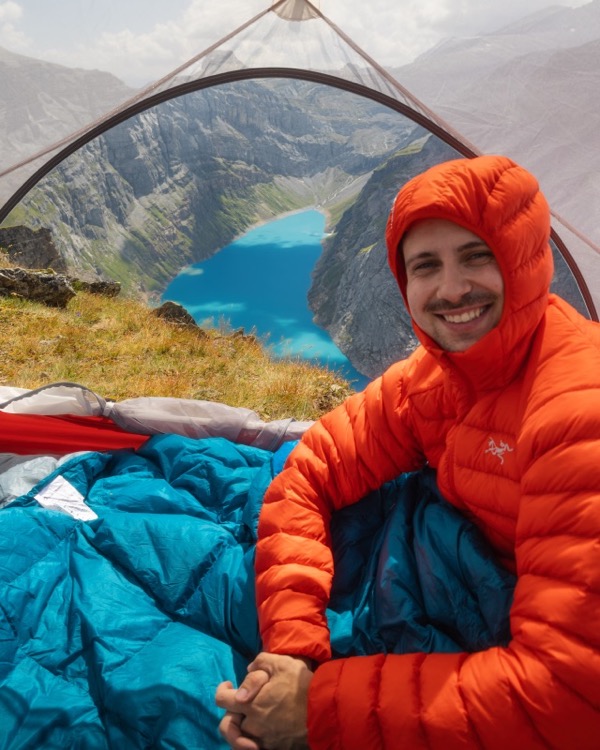
Leon Helg
Swiss filmmaker and software developer. Spends his free time in the Swiss Alps and maps his favourite spots for Hikebeast. Posts as @leon.helg on Instagram and TikTok.
Sources
- Gesetzessammlung des Kantons Glarus, complete corpus read 30 July 2026 via the collection API, all 487 enactments searched for Campieren, Zelten, Biwakieren, Nächtigen, Übernachten, Lagern and vehicle variants. No camping provision in the Polizeigesetz (GS V A/11/1), Polizeiverordnung (V A/11/2), Strassengesetz (VII C/11/1), EG SVG (VII D/11/1), Raumentwicklungs- und Baugesetz (VII B/1/1), Bauverordnung (VII B/1/2), EG Waldgesetz (IX E/1/1), hunting act and ordinance, or EG ZGB (III B/1/1). Decisive: Kantonale Ordnungsbussenverordnung GS III F/1/1, Art. 1 para. 1 with the Art. 12 to 16 catalogue read in full, contains no camping offence, so no on-the-spot camping fine exists in the canton. EG Waldgesetz GS IX E/1/1 Art. 10 para. 1 (forest open to the public), Art. 26 para. 1 (fire in forest prohibited), Art. 37 para. 1 lit. b (fine to CHF 20'000); the CHF 200 on-the-spot figure is Ordnungsbussenverordnung Art. 14. gesetze.gl.ch. ↩
- Erlass-Sammlung der Gemeinde Glarus, complete corpus read 30 July 2026, all 119 Erlasse searched. No Polizeireglement, no camping reglement, no Klöntal use or protection reglement. Parkierungsverordnung SRS 7.7-1 (in force 30 November 2018) Art. 2 para. 1 and Vollzugsreglement SRS 7.7-1.1 (current version in force 1 January 2025) Art. 2, zones 901 Güntlenau and 902 Vorauen, 72 hours maximum, CHF 3 per hour then CHF 15 per day, surcharge CHF 90 to 160 under Art. 4 para. 2 in connection with Art. 16 of the Parkierungsverordnung. Bauordnung SRS 7.1.4-1 Art. 24 para. 3 zones the two campgrounds; Art. 41 and 42 restrict buildings and installations only. Gemeindeordnung SRS 1.1-1 Art. 37 para. 3 requires a punishable offence to be defined in an enactment before a control body may fine it. The commune does write camping bans when it means to: Stellplatzordnung Multifunktionsplatz Buchholz SRS 7.7-2 Art. 2 para. 2, "Campieren und Zelten ist nicht gestattet", roughly ten kilometres from the lake and sanctioned only by eviction. The camping sentence quoted in this article is from the commune's parking-management page, read via a 10 March 2026 archive snapshot because glarus.ch serves 403 to non-browser clients. glarus.tlex.ch. ↩
- Cantonal traffic instruments for the valley: EG SVG GS VII D/11/1 Art. 5a para. 1, motor vehicles banned in the Klöntal on the last Sunday of June, July and August from 07:00 to 19:00, and the Vollzugsverordnung GS VII D/11/7 (in force 1 January 2026) Art. 2 para. 2 lit. b exempting overnight hotel and campground guests, Art. 4 naming the closure points. The Klöntaler- und Richisauerstrasse is a cantonal road per the Strassenverzeichnis GS VII C/11/2. On the January 2026 Regierungsrat position that an entry charge for the valley is inadmissible while parking charges remain available, the primary newsroom page returns 403 to non-browser clients and this rests on regional press reporting of 16 and 18 January 2026, so treat it as secondary. ↩
- Cantonal protection and ownership. Beschluss über den Schutz des Auengebietes Hinter Klöntal, GS IV G/5/4, read in full: it prohibits buildings and installations, driving, leaving marked paths in forest and shrub in Zone I and lighting fires there, and contains no camping, tenting or Lagern clause. It is the only one of the canton's nine comparable decrees lacking that clause; eight carry a standing prohibition on "das Zelten und Campieren", and the more recent ones, GS IV G/5/9 in force since 2023 and GS IV G/5/10 since 2025, add "das Lagern". The penalty chain for all of them runs through NHG GL (GS IV G/1/1) Art. 20 para. 1, imprisonment or a fine to CHF 20'000 imposed by a judge, and none of these decrees appears in the on-the-spot fines catalogue. Distance computed from the 29 explicit coordinate vertices in the decree's own Annex 1: the requested point lies 627 m outside the perimeter, whose easternmost point is at 715010 / 208950 in the old national grid. Ownership from the cantonal cadastre layers: south shore parcel 2166 and north shore parcel 2132 are registered to Gemeinde Glarus, the Klöntalstrasse parcel 2211 to the canton, and the lake itself is a single 365 ha parcel absent from all public-body ownership layers. gesetze.gl.ch. ↩
- How a camping ban is made in Glarus. EG ZGB GS III B/1/1 Art. 146 para. 3, under the heading on the right of access and defence under Art. 699 ZGB: whoever wishes to issue a prohibition must apply to the Kantonsgericht, which establishes it with a penalty provision and orders publication in the Amtsblatt. Court prohibitions under Art. 258 ZPO found in the cantonal Amtsblatt archive: ZG.2024.00752, decided 16 December 2024 and published 8 January 2025, prohibiting camping, bivouacking and drones on parcels 772 and 779 of the Linthal land register around Muttenwändli, Muttenalp, Muttenkopf and Muttenwand on the application of Kraftwerke Linth-Limmern AG and Gemeinde Glarus Süd, fine up to CHF 2'000, enforceable only where signposted and only on complaint, and defeated by a written objection within 30 days; ZG.2024.00524 of 10 July 2024 for land above 2'200 m near Elm, with a communal permit route; ZG.2024.00482 of 26 June 2024 on Alp Oberblegi, which expressly catches sleeping "unter freiem Himmel". A search of the archive returns no camping prohibition of any kind for the Klöntalersee; the only ones in Gemeinde Glarus cover two small parcels at Büttenen and Löntschtobel in the Riedern land register. amtsblatt.gl.ch. ↩
- Glarner Tourismus wild camping page, raw HTML inspected 30 July 2026: the page is a three-column block headed Rechtsgrundlage, Verbote im Kanton Glarus and Empfehlungen, and the entry "Klöntal (Ufergebiete und entlang der Strasse)" appears in the Verbote column, while the Empfehlungen column contains only advice to ask locally. Its legal-basis column cites only Art. 699 para. 1 ZGB, which grants access rather than restricting it. Secondary source, and it overstates the law for this location. glarnerland.ch. ↩
- Geodata, queried 30 July 2026. At LV95 2'715'629 / 1'209'052 the cadastral land-cover layer returns standing water and the terrain model returns 840.6 m, unchanged for a kilometre in every direction; nearest dry land 319.8 m south at 2'715'778 / 1'208'769, closed forest. Communal zoning read from the cantonal open WMS and WFS as GeoJSON with point-in-polygon tests in EPSG:2056: both shore strips are Übriges Gebiet with a Gewässerraum overlay, flipping to Wald about 15 m inland, and both fall inside the surveyed forest perimeter. Nearest Naturschutzzone 1'572 m, nearest Landschaftsschutzzone 1'781 m, nearest Tourismuszone 1'047 m at Vorauen, nearest national biotope 541 m, nearest cantonal Auen perimeter 626 m. Federal inventories empty at the point: nearest game reserve 4'254 m, nearest wildlife rest zone 7'468 m, nearest BLN object 3'100 m, no mire, floodplain or amphibian object. Each query ran alongside an invalid-layer control returning HTTP 400, so an empty answer is a real absence. map.geo.gl.ch. ↩