Wild camping at the Hornseewli
Wild camping at the Hornseewli is prohibited. The lake sits inside the federal Schwarzhorn game reserve, where free tenting carries a CHF 150 fixed penalty and only the canton may grant an exception. Grindelwald bans tents across the whole municipality too.
What do these mean?
Illegal A specific rule bans it, usually with a fine, and it can be enforced. Sleep somewhere else.
Not allowed No real place to camp here. A gated site, a developed area, or nowhere sensible to lie down, even if no fine is attached.
It depends You can sleep here, but there's a condition first: ask the landowner, book a spot, stay inside a set zone, or use a bivvy instead of a tent. The report says which.
Tolerated No rule clearly allows or bans it, but a single night is accepted in practice and nobody enforces against it. Normal for high bivouacs above the treeline.
Legal Camping one night is fine here. Either a rule allows it, or we checked every law and found nothing against it. Still: pitch late, leave early, no trace.
The federal reserve is the decisive norm, and the number is CHF 150
Wild camping at the Hornseewli is settled by the strongest kind of norm in this series, a federal one, and it settles it before any communal question arises.
The lake sits at LV95 2'650'962 / 1'170'236, 2'146.3 m, in the commune of Grindelwald, and it lies inside the federal hunting-ban district Schwarzhorn. Inside one of these districts, free tenting and camping are prohibited outright by the federal game-reserve ordinance, VEJ art. 5 para. 1 lit. e.1
Get the number right, because the internet usually does not. The figure a camper actually faces is a fixed penalty of CHF 150. The federal fixed-penalty schedule tariffs "Freies Zelten oder Campieren in eidgenössischen Jagdbanngebieten" at exactly that amount, citing the Hunting Act together with the game-reserve ordinance. The CHF 20'000 you will sometimes see quoted is the ceiling of the Hunting Act in ordinary proceedings, not what happens to somebody with a tent.2
The part that matters more than the amount. The last sentence of art. 5 para. 1 lit. e reserves exceptions to the canton. That single clause closes every route people normally look for: the landowner cannot wave you through, the alp cannot, the commune cannot, and a permit from any of them would be worth nothing here. This is the difference between a game reserve and almost every other restriction in this series, where the way forward is usually somebody's phone number.1
Grindelwald bans it a second time, everywhere in the municipality
Even if the reserve did not exist, the answer would be the same, because the commune wrote its own ban and wrote it wide.
"Das Aufstellen von Zelten, Wohnwagen etc. zum Campieren ausserhalb behördlich bewilligter Campingplätze ist grundsätzlich nicht gestattet."Camping-Reglement der Einwohnergemeinde Grindelwald, art. 9 "Grundsatz". Putting up tents, caravans and the like for camping outside officially authorised campsites is in principle not permitted.
There is no altitude exception and no above-the-treeline carve-out. The prohibition runs across the whole municipality, which is why the neighbouring reports in this series for the Bachalpsee and for First reach the same conclusion. Breaches are punished by the local police authority with fines of up to CHF 1'000, and the regulation says explicitly that they are punishable whether committed deliberately or negligently.3
Two honest notes on the wording, because this series reads the verbs. First, art. 2 defines Campieren as temporarily staying and overnighting in tents, caravans, mobile homes, cars or similar movable shelters. On the literal text a tentless bivouac, a bag on the ground and nothing else, is arguably outside that definition. Second, art. 10 does allow the local police authority to grant exceptions on application with the landowner's agreement, for tent camps outside authorised sites.36
Neither of those helps you here, and it is worth being clear why. The communal regulation is the second layer, not the first. The federal reserve ban is what actually decides this lake, its exceptions belong to the canton alone, and the communal act itself defers where federal or cantonal penal provisions apply. So the bivouac reading and the art. 10 permit route are real features of Grindelwald law that matter elsewhere in the municipality, and at this particular lake they change nothing.23
Where the reserve boundary actually runs
The useful question for anyone already up there is not whether the ban exists but how far it reaches, and the answer is: further than you would guess.
Every federal inventory was queried at the pin and at four points 200 metres out to the north, south, east and west. All five returned the same single hit, Jagdbanngebiet Schwarzhorn, and nothing else at all: no wildlife rest zone, no BLN landscape, no UNESCO site, no mire, no floodplain, no dry meadow, no park of national importance. A deliberately invalid layer id returned an HTTP error in every run and a control point in the Kiental returned its own reserve, so the single hit and the empty rest are both real.4
Then the boundary itself, bisected on twelve bearings:
- South-south-west: 1'940 m. The nearest edge in any direction.
- South 3'067 m, south-south-east 3'261 m, north-north-east 3'564 m, east-south-east 3'709 m.
- North 4'031 m, west-south-west 4'574 m, north-north-west 4'994 m, west-north-west 5'366 m.
- East 6'274 m and west 7'072 m, the deepest directions.
That is what makes this different from a spot that sits on a line. There is no ten-metre fix and no "walk to the far shore" answer. Whichever way you go from this lake, you are inside a federal game reserve for at least the next two kilometres, and on the far side of that boundary you are still in Grindelwald, where art. 9 is waiting.43
Where the lake actually is. The Hornseewli sits on the high ground north-east of the Grosse Scheidegg, which is 2.84 km to the south, with Grindelwald First 4.60 km to the west-south-west and the Faulhorn 8.12 km west. Its closest neighbour is the Hagelseewli, 1.47 km away, which has its own report in this series and the same answer for the same federal reason.5
Where you can legally sleep
- Berghotel Faulhorn, 2'671.8 m, 8.1 km west of the lake. A bed at 2'672 m is the closest thing to sleeping out up here that is actually lawful5.
- An authorised campsite in the Grindelwald valley. Art. 9 permits camping on authorised sites and nowhere else in the municipality3.
- Not at the lake, and not 500 m from it. Jagdbanngebiet Schwarzhorn, CHF 150 fixed penalty, nearest boundary 1'940 m24.
- Not at the Hagelseewli either, 1.47 km away. Same reserve, same answer4.
- Not by asking a landowner. Inside the reserve only the canton can permit an exception1.
General rules for wild camping
This is a short list because the answer is short. The list below is not law, it is what the two prohibitions actually rest on, and the reason neither of them has a door in it here.
- No fire. An open fire has no place in the mountains. A gas stove is enough.
- Pitch late, strike early. Set up towards evening, gone again early. A bivouac is one night, not a base camp.
- Leave no rubbish. Everything you carry up you carry down, organic scraps and toilet paper included.
- At least 50 metres from any water for the big business, so you do not foul what people and livestock drink.
- Stay small and quiet. A small group, no speaker, no drone, dogs on the lead, and the alp staff's word goes.
Disclaimer
This article reflects my research and assessment to the best of my knowledge, as of August 2026. It is based on the publicly accessible and official sources linked below. It does not replace legal advice and is not a binding statement of the current legal situation.
The verdict rests on two prohibitions that are independent of each other, so it does not depend on either one being read generously. The Grindelwald camping regulation was read by optical character recognition from a scan, so if a wording matters to your plans, ask the commune for the current text. Before every tour, check the current sources yourself and follow instructions on site. A genuine emergency bivouac in distress is a separate question from a planned camp, and the federal ordinance is about free camping rather than an emergency. Anyone who spends the night outside bears responsibility for their own conduct and any consequences themselves. Hikebeast, Leon Helg and Saftladen GmbH accept no liability for decisions made on the basis of this text, and call on no one to break applicable law.
Frequently asked questions
Is wild camping allowed at the Hornseewli?
What does it actually cost if I get caught?
Can I just ask the landowner or the commune for permission?
How far would I have to walk to get out of the reserve?
Does the ban cover a bivvy bag without a tent?
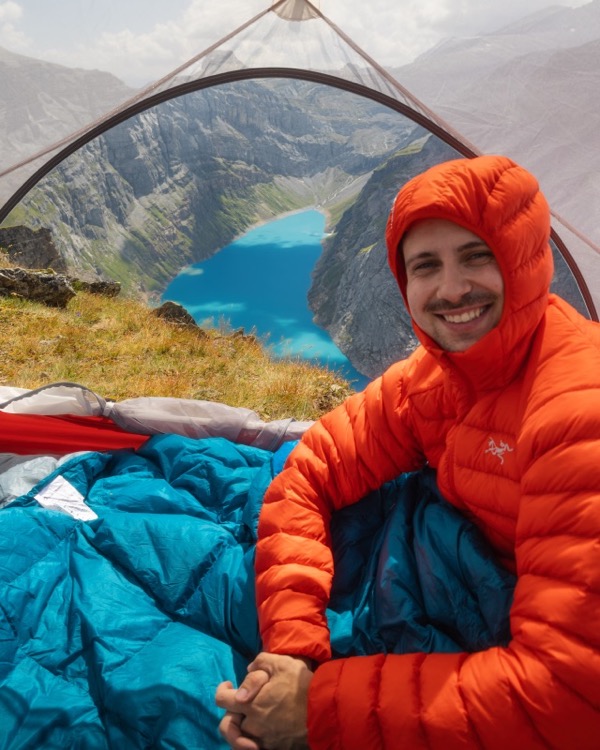
Leon Helg
Swiss filmmaker and software developer. Spends his free time in the Swiss Alps and maps his favourite spots for Hikebeast. Posts as @leon.helg on Instagram and TikTok.
Sources
- Verordnung über die eidgenössischen Jagdbanngebiete (VEJ), SR 922.31, art. 5 para. 1 lit. e. Inside a federal game reserve, free tenting and camping are prohibited. The final sentence of the provision reserves exceptions to the canton, which is why no landowner's consent, no alp agreement and no communal permit can authorise a tent inside the perimeter. This is the decisive norm at the Hornseewli, and it applies independently of anything the commune does or does not write. fedlex.admin.ch. ↩
- Ordnungsbussenverordnung (OBV), SR 314.11, Anhang 2, Ziff. 12005. The federal fixed-penalty schedule tariffs "Freies Zelten oder Campieren in eidgenössischen Jagdbanngebieten" at CHF 150, citing JSG art. 18 para. 1 lit. e together with VEJ art. 5 para. 1 lit. e. That citation chain is also what answers the occasional argument that the Hunting Act never reaches a tent: the Confederation wrote the chain out itself. The CHF 20'000 figure that circulates online is the ceiling of JSG art. 18 para. 1 in ordinary proceedings and is not what a camper faces. fedlex.admin.ch. ↩
- Camping-Reglement der Einwohnergemeinde Grindelwald, of 30 May 1980 in the version current to December 2016, consulted 25 August 2026. Art. 9 "Grundsatz": "Das Aufstellen von Zelten, Wohnwagen etc. zum Campieren ausserhalb behördlich bewilligter Campingplätze ist grundsätzlich nicht gestattet." Art. 2 defines Campieren as "das vorübergehende Verweilen und Uebernachten von Personen in Zelten, Wohnwagen, Mobilheimen, Wohnautos, Autos, Wohnbusse oder ähnlichen beweglichen Unterkünften". Art. 10 allows the Ortspolizeibehörde to grant exceptions on application with the landowner's agreement, for tent camps outside authorised sites. The penal provision punishes deliberate or negligent breaches with fines up to CHF 1'000 imposed by the Ortspolizeibehörde, expressly "sofern nicht eidgenössische oder kantonale Strafvorschriften anwendbar sind", so the communal fine yields precisely where the federal reserve provision bites. The regulation is published as a scan whose extractable text layer is 13 characters long and was read here by optical character recognition at 300 dpi. gemeinde-grindelwald.ch. ↩
- Official federal geodata, queried 25 August 2026 at the Hornseewli pin LV95 2'650'962 / 1'170'236 and at four points 200 m out to the north, south, east and west. All five points return exactly one hit, Jagdbanngebiet Schwarzhorn, and empty result sets for wildlife rest zones, BLN, UNESCO natural world heritage, raised and lowland mires, moor landscapes, floodplains, dry meadows and pastures, and parks of national importance. Verified with an invalid-layer control returning HTTP 400 in every run and a positive control at 2'626'000 / 1'154'500 returning the Kiental reserve. The reserve boundary was then bisected on twelve bearings from the pin: nearest edge 1'940 m at 210 degrees (SSW), then 3'067 m S, 3'261 m SSE, 3'564 m NNE, 3'709 m ESE, 4'031 m N, 4'574 m WSW, 4'994 m NNW, 5'366 m WNW, 6'073 m ENE, 6'274 m E and 7'072 m W. map.geo.admin.ch. ↩
- Position and neighbours, from the national gazetteer and height model, 25 August 2026. Hornseewli, a lake in the commune of Grindelwald, LV95 2'650'962 / 1'170'236, 2'146.3 m. Distances and bearings from the lake: Grosse Scheidegg 2.84 km south (1'962.4 m), Schwarzhorn Klettersteig 2.57 km west, Grindelwald First 4.60 km west-south-west (2'168.9 m), Faulhorn 8.12 km west (2'680.7 m), Berghotel Faulhorn 8.08 km west (2'671.8 m), Grindelwald village 8.35 km south-west (970.9 m). Nearest named water: Hagelseewli 1.47 km away, which carries its own report in this series and the same federal reason. Immediate surroundings: Hundsschepf 212 m, Band 234 m, Ufem Blatti 264 m, Gipfel Cheerhubel 386 m, Gipfel Bandspitz 836 m. map.geo.admin.ch. ↩
- Swiss Alpine Club SAC, Merkblatt "Campieren und Biwakieren in den Schweizer Bergen". The leaflet's general line, that a single considerate night by a small group above the treeline is usually unproblematic, is exactly the guidance that does not apply here, because it is guidance rather than law and it yields to an actual prohibition. The leaflet's own definitions are what make the wording note in this article precise: Biwakieren is a night without a tent under the open sky, Campieren is a night in a small tent outside official campsites. Read alongside ZGB SR 210 art. 699, which opens forest and pasture to everyone within customary limits: a right of access, never a right to spend the night, and it does not survive a federal reserve provision either. sac-cas.ch. ↩