Wild camping at the Guraletschsee
You may sleep at the Guraletschsee without a tent. Vals bans camping across the whole commune, then writes the bivouac on a mountain tour out of that ban in the same article. A pitched tent still needs a permission, and this is who you ask for it.
What do these mean?
Illegal A specific rule bans it, usually with a fine, and it can be enforced. Sleep somewhere else.
Not allowed No real place to camp here. A gated site, a developed area, or nowhere sensible to lie down, even if no fine is attached.
It depends You can sleep here, but there's a condition first: ask the landowner, book a spot, stay inside a set zone, or use a bivvy instead of a tent. The report says which.
Tolerated No rule clearly allows or bans it, but a single night is accepted in practice and nobody enforces against it. Normal for high bivouacs above the treeline.
Legal Camping one night is fine here. Either a rule allows it, or we checked every law and found nothing against it. Still: pitch late, leave early, no trace.
One communal article decides everything here
Wild camping at the Guraletschsee is settled by a single page of communal law from 1974. That is unusual. Most of the lakes we research need three or four layers untangled, federal reserve, cantonal ordinance, communal reglement, sometimes a landowner's court order. Here the federal and cantonal levels are silent and one article does all the work, and it is the same article that decides the neighbouring Selvasee one basin to the west.
The instrument is the Polizeiverordnung der Gemeinde Vals, adopted by ballot on 20 May 1973 and in force since 1 May 1974, published in a version dated 1 August 2010. Its Art. 7 is headed simply "Camping".
"Ausserhalb dieser Plätze ist auf Gebiet der Gemeinde Vals auf öffentlichem und privatem Boden ohne Bewilligung des Gemeinderates jedes Kampieren verboten. Dieses Verbot bezieht sich nicht auf das Biwak im Rahmen von einzelnen Bergtouren."Polizeiverordnung der Gemeinde Vals, Art. 7 para. 2: outside the designated places, all camping on the territory of the commune of Vals is forbidden on public and private ground without a permission from the Gemeinderat. This prohibition does not extend to the bivouac in the course of individual mountain tours.
Read the first sentence carefully, because two words in it are doing more than people expect. "Privatem Boden" means the ban reaches private land as well as public. That closes the door that opens at several other Swiss spots: at the Fälensee or the Seealpsee the legal route is the landowner's consent, because the rule there is built around the owner's yes. Here the owner's yes is not enough, because the commune has prohibited camping on his ground too. The only key is a Bewilligung des Gemeinderates.
And "ausserhalb dieser Plätze" refers back to Art. 7 para. 1, which lets the Gemeinderat designate places for camping with tents and caravans, provided they are reachable by motor vehicle and have proper sanitary installations and drinking water. A lake at 2'409 metres with no road, no building within a kilometre and no tap is definitionally not one of those places and never could be.
The fine sits in a different article, which is worth saying because the two get confused. Art. 7 sets no penalty at all. Art. 18, in the ordinance's chapter on Strafbestimmungen, does: breaches of the police ordinance are punished with fines from CHF 50 to CHF 500, and up to CHF 1'000 on repetition. That is a real chain with a named norm behind it, unlike several places where a "ban" turns out to rest on a sentence from a tourism page with nothing at all underneath.1
But nobody up there can write you a ticket, and that is worth being precise about. Switzerland's on-the-spot fine system runs on published offence catalogues, and camping is not in any catalogue that reaches this lake. Graubünden has no general fixed-penalty act at all: only three such ordinances exist in the whole canton, for hunting, for fishing and for the Swiss National Park, and the cantonal police list of general public-order offences runs to exactly four lines, none of them camping. Vals has never set up a communal catalogue of its own either. So a fine under Art. 18 is not something a passing officer can issue; it takes a formal decision by the Gemeinderat sitting as the communal police court, with a right of appeal. And the bivouac was written out of the prohibition before any of that machinery starts.8
The ordinance is still in force. The commune publishes it as current, it carries a maintained repeal annotation on a different article, and the 2012 communal constitution repeals only decisions that conflict with it. Nothing in the collection replaces it.4
Nothing above the commune adds to it, and that is a checked statement rather than an assumption. The entire Graubünden statute book was pulled and searched. Three acts mention camping at all. One governs camping while hunting and says so in its first four words. One is the campsite operator's registration duty. And one is the National Park ordinance, which is the interesting one.8
Graubünden knows exactly how to ban a bivouac, and did it once. The National Park ordinance forbids, in so many words, "zu biwakieren", and the canton's fixed-penalty list prices it at CHF 200. That is the vocabulary, deployed deliberately, in one place ninety kilometres east of here. Nowhere else in Bündner law is a bivouac prohibited. When a canton has the words and uses them precisely once, the silence everywhere else is a drafting choice rather than an oversight, and it makes the Vals carve-out read as exactly what it appears to be.8
How a night here is actually possible
This is the section the question was really about, and Vals gives it an unusually clean answer.
Without a tent, you need nothing from anyone. The final sentence of Art. 7 is not interpretation, it is text: the prohibition does not extend to the bivouac in the course of individual mountain tours. There is no altitude limit in it and no geographic limit; it is keyed to the activity. A bivvy bag on a genuine tour, up towards evening and gone in the morning, is outside the prohibition entirely. It does not need a permission, it cannot trigger Art. 18, and the landowner question never arises. At 2'409 metres, on a lake that only makes sense as part of a full day's mountain walk, "im Rahmen von einzelnen Bergtouren" is exactly what you are doing.
With a tent, you need the Gemeinderat. Art. 7 para. 1 defines the banned conduct as "Kampieren mit Zelten und Wohnwagen" and then contrasts it with "das Biwak". On the ordinance's own internal contrast, a pitched tent falls on the camping side and needs the communal permission.
Who to ask, in this order. The permission is the commune's to give: Gemeinde Vals, Gemeindehaus, Furra 121, 7132 Vals, 081 920 77 02, gemeinde@vals.ch. Then the people whose pasture and cattle you are actually walking into, the alp crew on Klein and Gross Guraletsch below the lake, worked in summer by the tenant Felix Tanner with cattle, sheep, goats and horses. They are not the legal gatekeeper here, since the commune holds that role and the alp is leased from an Alpgenossenschaft rather than owned by anyone at the lake, but they are the ones up there, and telling them beats surprising them.6
The honest middle, which the text does not resolve. A lightweight tent on a real multi-day tour sits between the two sentences. It is a tour, which points at the exception, and it is a tent, which points at the ban. I have found no Vals practice or decision that settles it, so I am not going to pretend the wording does. If that is your plan, the phone call costs nothing and turns a grey zone into a yes or a no.
What I could not find, said plainly: any fee. No source anywhere names a figure for pitching at the Guraletschsee or on a Valsertal alp. No honesty box, no "ask the Senn for twenty francs", nothing. At other spots we publish the word-of-mouth rate because one genuinely exists; here inventing one would be worse than useless.
One thing that is not optional: no fire. Art. 9 of the same ordinance bans open fire in forest and on dry meadows and pastures, and it extends the ban expressly to cooking. On top of that the commune has published absolute fire bans outside settlement areas in dry summers. Carry a gas stove and check the current fire warning before you go.14
What the maps say, and where to actually sleep
The lake sits at 2'409 metres in a broad basin below the Guraletschhorn, a natural lake and not a reservoir, with the two Guraletsch alps on the benches below it and the marked three-lake path passing close by. The published coordinate, 46.56104 / 9.13755, is the gazetteer's label point; the ground you want is the drier grass on the north to east side of the water, not the scree that climbs to the Guraletschhorn and not the boggy shore itself.2
This is open alpine ground above the treeline, which is the whole point. At 2'409 metres you are on flowering alpine meadow, moor and scree, well above the last trees, on a lake that is not next to a road, a hut or a village, the nearest overnight roof being the Berggasthaus Zervreila more than two hours back down. That is exactly the setting the Alpine Club has in mind when it calls a considerate single night above the treeline unproblematic. Common sense does not cap this spot the way it caps a lake with a car park on its shore, because there is nothing developed here to walk away from. One caveat the maps make clear: the immediate shore is moorland, cotton grass and frogs, so sleep on the drier grass a little back from the water rather than on the wet ground.9
Every protection layer came back empty, and I made the emptiness mean something. No federal hunting-ban district, no wildlife rest zone, no BLN object, no mire landscape, raised bog, fen, floodplain or amphibian site, no dry-grassland object, no forest reserve, no park of national importance. Each of those queries ran alongside a deliberately invalid layer id, which returns an HTTP error, so an empty result is a genuine absence rather than a failed request. The commune is Vals and the canton is Graubünden at the point, both confirmed against the current-year boundary layers.2
Two cantonal wildlife rest zones sit near the lake, and neither reaches it, and both are winter closures anyway. Graubünden's binding Wildruhezonen layer holds a zone "Zervreila" (Gemeindebeschluss 2001) and a zone "Schwarzflua" (Gemeindebeschluss 2023), both in Vals, both with a closed season of 20 December to 15 April, an access ban on foot in winter and nothing about summer or camping. Point-in-polygon against the cantonal geometry puts the lake outside both: the nearer edge, Schwarzflua, is about 700 metres away, and Zervreila about 1'700 metres. A summer night is outside their season and outside their boundary twice over.4
One official fact about the lake, in case you fish. Unlike the neighbouring Selvasee, which is a private-right water, the Guraletschsee is an ordinary cantonal patent water: the cantonal fishing ordinance lists it as Guraletschsee, Gemeinde Vals, water 1016, so you may fish it on the normal patent. It changes nothing about camping, but it is the one place the two lakes differ on paper.3
Two near-misses that get quoted as camping bans and are not. The commune's Strassenpolizeigesetz forbids leaving cars and trailers, caravans included, overnight on public ground and in publicly accessible car parks. Its object is vehicles, it says nothing about people or tents, and the Guraletschsee has no vehicle access at all. Separately, the Baugesetz makes laying out a campsite and permanently siting a caravan subject to a building permit. That is infrastructure, not a hiker's night. Neither reaches this lake, and the vehicle rules at the Zervreila car park are a different question from the one this article answers.5
One currency flag. The Vals police ordinance dates from 1974 in a 2010 version, and communal instruments get revised. The camping article has been stable for fifty years and the cantonal wildlife zones nearest this basin are winter closures that do not touch a summer night, but if you are reading this well after August 2026, the Vals collection is the place to re-check.4
Where you can legally sleep
- At the lake, without a tent. This is the one the ordinance hands you outright. On grass on the north to east side, back from the inflow and outflow, on a genuine tour, one night1.
- At the lake with a tent, after a phone call. Gemeinde Vals, 081 920 77 02. Ask for a Bewilligung under Art. 7 of the Polizeiverordnung and say where and for how long1.
- The valley station car park at Vals, which is the only place in the commune where campers and caravans may stay overnight, summer only, with power, water and sanitary facilities.
- Not on the boggy shore. The waterline is moorland and cotton grass. Sleep on the drier grass a little back, off the scree that rises to the Guraletschhorn.
- Berggasthaus Zervreila or Vals village, if the weather turns. Zervreila is the trailhead with rooms; the three-lake round from there past the Guraletschsee is a full day, about 12.7 km7.
General rules for wild camping
This applies wherever you are allowed to sleep outside, and at this lake, without a tent, you are. It is not legal text, it is decency and common sense, and it is the reason exceptions like the one Vals wrote still exist.
- No fire. An open fire has no place in the mountains. A gas stove is enough.
- Pitch late, strike early. Set up towards evening, gone again early. A bivouac is one night, not a base camp.
- Leave no rubbish. Everything you carry up you carry down, organic scraps and toilet paper included.
- At least 50 metres from any water for the big business, so you do not foul what people and livestock drink.
- Stay small and quiet. A small group, no speaker, no drone, dogs on the lead, and the alp staff's word goes.
Disclaimer
This article reflects my research and assessment to the best of my knowledge, as of August 2026. It is based on the publicly accessible and official sources linked below. It does not replace legal advice and is not a binding statement of the current legal situation.
Communal ordinances change, and the Vals police ordinance dates from 1974 in a version published in 2010. The cantonal wildlife rest zones Zervreila and Schwarzflua lie in this area but do not reach the lake and are winter closures. Before every tour, check the current sources yourself, check the fire warning, and follow instructions on site. A genuine emergency bivouac in distress is a separate question from a planned camp. Anyone who spends the night outside bears responsibility for their own conduct and any consequences themselves. Hikebeast, Leon Helg and Saftladen GmbH accept no liability for decisions made on the basis of this text, and call on no one to break applicable law.
Frequently asked questions
Is wild camping allowed at the Guraletschsee?
Does the landowner's permission help at the Guraletschsee?
Is there a fee for camping at the Guraletschsee?
Is the Guraletschsee inside any protected area?
How do I get to the Guraletschsee?
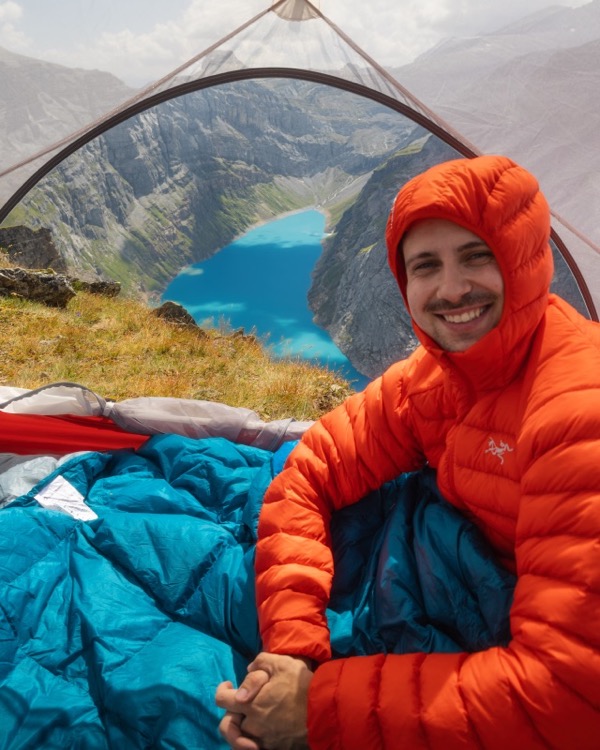
Leon Helg
Swiss filmmaker and software developer. Spends his free time in the Swiss Alps and maps his favourite spots for Hikebeast. Posts as @leon.helg on Instagram and TikTok.
Sources
- Polizeiverordnung der Gemeinde Vals, adopted by Urnenabstimmung 20 May 1973, in force since 1 May 1974, version dated 1 August 2010: Art. 7 (camping, the designation of places requiring motor-vehicle access and sanitary installations, the municipality-wide ban on public and private ground, and the express exception for the bivouac in the course of individual mountain tours), Art. 9 (fire police, open fire banned in forest and on dry meadows and pastures, extending to cooking), Art. 18 (fines from CHF 50 to CHF 500, up to CHF 1'000 on repetition). gemeinde-vals.ch. ↩
- Official federal geodata, queried August 2026 at the lake, WGS84 46.56104 / 9.13755, LV95 2'730'261 / 1'158'050, elevation 2'409.2 m via the federal height service. Identify returns no object on the hunting-ban district (ch.bafu.bundesinventare-jagdbanngebiete, empty at the pin and at a 50-pixel tolerance), the federal wildlife rest zone (ch.bafu.wrz-wildruhezonen_portal, empty at the pin and at 50 pixels), BLN, mire landscape, raised bog, fen, floodplain, amphibian, dry grassland, forest reserve and national-park layers. Every query ran with an invalid-layer control (ch.bafu.NONSENSE returns HTTP 400), so an empty result is a genuine absence rather than a failed request. The commune layer (ch.swisstopo.swissboundaries3d-gemeinde-flaeche.fill), filtered to the current year, returns Vals, and the canton layer returns Graubünden. The point is above the treeline, on grass, slabs and scree in the basin below the Guraletschhorn. map.geo.admin.ch. ↩
- Fischereibetriebsvorschriften des Kantons Graubünden 2026, water register: the Guraletschsee is listed as an ordinary cantonal patent water, "Guraletschsee, Gemeinde Vals (1016)", fishable on the normal patent, in contrast to the neighbouring Selvasee (1017), which Art. 7 lists as a water with a private fishing right, and the Zervreilasee (1015), which is also an ordinary patent water. So the Guraletschsee carries no private interest of the kind a fishing club builds infrastructure around. gr.ch, Amt für Jagd und Fischerei. ↩
- Collection of the commune of Vals, Online-Schalter, consulted August 2026, and the cantonal Graubünden wildlife rest zone layer. There is no separate Camping-Reglement and no ordinance on the use of public ground; the Polizeiverordnung of 1974 is the only communal instrument on camping, and the Baugesetz (communal ballot 2 April 1989, cantonal approval 10 September 1990) contains no camping provision, its only camping word being Art. 91's building-permit duty for laying out campsites and permanently siting caravans. The binding cantonal Wildruhezonen layer holds two zones in Vals near this basin, "Zervreila" (Gemeindebeschluss 2001) and "Schwarzflua" (Gemeindebeschluss 2023), both with a closed season of 20 December to 15 April and a winter access ban on foot. Point-in-polygon against the cantonal geometry puts the lake outside both, the nearer edge (Schwarzflua) about 700 m away and Zervreila about 1'700 m; both are winter measures and neither mentions camping. The commune also publishes an absolute fire ban outside settlement areas in dry summers. gemeinde-vals.ch. ↩
- Two Vals instruments that are frequently mistaken for camping bans and do not reach this lake. Strassenpolizeigesetz der Gemeinde Vals: leaving cars and trailers, caravans included, overnight on public ground or in publicly accessible car parks is prohibited; its object is vehicles rather than persons or tents, and there is no vehicle access to the Guraletschsee at all. Baugesetz der Gemeinde Vals: building-permit duty for laying out and operating campsites and for caravans permanently sited outside campsites, which is infrastructure and not a hiker's night. gemeinde-vals.ch. ↩
- Ground truth and administration. Weid- und Flurordnung der Gemeinde Vals, approved by ballot 27 November 2011: the Allmenden on communal territory are the commune's property and are administered by the Gemeinderat, which may lease them on six-year contracts, with a Weidchef granting case-by-case permissions. Klein and Gross Guraletsch sit on opposite sides of the stream on the benches below the lake, around 2'000 m, worked in summer by the tenant Felix Tanner, on the alp since 1998 and leaseholder since 2011, with roughly 45 cattle plus sheep, goats and Icelandic horses; the alp belongs to an Alpgenossenschaft rather than to the commune. No published camping fee or word-of-mouth arrangement was found for this lake or for the Valsertal alps. Contacts: Gemeinde Vals, Furra 121, 7132 Vals, 081 920 77 02, gemeinde@vals.ch; Visit Vals AG, 081 920 70 70. gemeinde-vals.ch. ↩
- Access and terrain. The Guraletschsee lies at 2'409 m below the Guraletschhorn, above the Guraletsch alps at the head of the Valsertal, a natural lake and the middle stop of the classic three-lake round from the Zervreilasee (a Kraftwerke Zervreila reservoir) with the Ampervreilsee and the Selvasee, about 12.7 km with 856 m of ascent and 673 m of descent, roughly 5.5 hours on marked white-red-white mountain paths, and can also be reached and returned from Zervreila in about two and a quarter hours each way. Vals village is reached by postbus up the Valsertal, and the Zervreila trailhead at about 1'840 m by the road and Berggasthaus above it, where there are rooms; the Peiltal hiking bus back to Vals on the three-lake round needs registration on 081 935 16 49. The nearest serviced SAC hut, the Läntahütte (Sektion Bodan, 2'090 m, +41 81 935 17 13), sits in a different valley arm and is not a short connection from the lake. The ground is open alpine meadow, moor and scree above the treeline, snow-free roughly from July into October. wandersite.ch. ↩
- Canton Graubünden has no camping or bivouac prohibition of general application, established by enumeration: the complete cantonal collection was searched. Only three acts mention camping: the hunting operations ordinance (BR 740.025) art. 13, whose scope is set by its own opening words "Für die Ausübung der Jagd"; the National Park ordinance (BR 498.200) art. 5 lit. a, which forbids "zu biwakieren" and is the only bivouac prohibition in the entire Bündner Rechtsbuch, roughly 90 km east of here, priced at CHF 200 in the National Park fixed-penalty list; and the innkeeping implementing provisions, which bind the campsite operator. The planning ordinance (KRVO, BR 801.110) never uses a camping word in any language; the closest it comes is art. 40 para. 1 no. 7, which exempts igloos, tipi tents and the like for overnight stays in ski areas and at farms from the building-permit duty, a tent-related exemption rather than a camping provision. Outside the National Park, there is no camping or bivouac offence in any Graubünden fixed-penalty catalogue: only three such ordinances exist in the canton, for hunting, fishing and the National Park, and the general public-order list in the police ordinance runs to four lines covering fireworks, indecent behaviour, soiling property and begging. Vals has set up no communal catalogue, so a fine under the Vals police ordinance Art. 18 requires a formal decision by the Gemeinderat sitting as the communal police court. The Polizeigesetz PolG BR 613.000 and the Natur- und Heimatschutzgesetz KNHG BR 496.000 contain no camping, tent or bivouac provision for the public. gr-lex.gr.ch. ↩
- Swiss Alpine Club SAC, Merkblatt "Campieren und Biwakieren in den Schweizer Bergen", 2026 edition: "Ansonsten ist eine einzelne Übernachtung einer kleinen Anzahl Personen im Gebirge oberhalb der Waldgrenze in der Regel unproblematisch, wenn sie rücksichtsvoll erfolgt. Zudem ist ein Notbiwak grundsätzlich erlaubt." In short, a single considerate night above the treeline is normally unproblematic and an emergency bivouac is allowed outright. The leaflet also asks you not to sleep too close to huts and grazed alps, or to ask first. Guidance and courtesy, not law, but the standard worth following at a lake like this. sac-cas.ch. ↩