Wild camping at Fronalpstock
Tenting on the Fronalpstock is possible, but only in the designated tent area by the hotel, booked on +41 41 820 27 26. No Schwyz rule fines you at the viewpoint itself, but that viewpoint is a gravel apron in front of the restaurant.
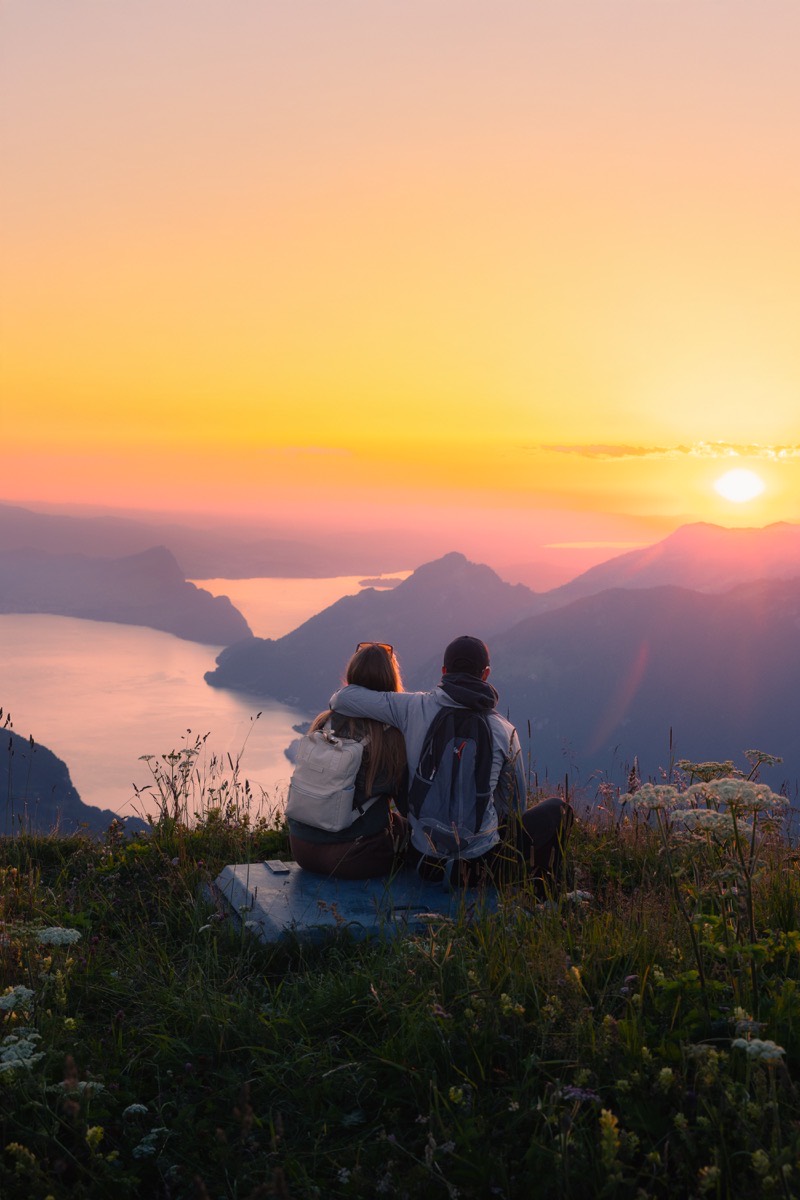
What do these mean?
Illegal A specific rule bans it, usually with a fine, and it can be enforced. Sleep somewhere else.
Not allowed No real place to camp here. A gated site, a developed area, or nowhere sensible to lie down, even if no fine is attached.
It depends You can sleep here, but there's a condition first: ask the landowner, book a spot, stay inside a set zone, or use a bivvy instead of a tent. The report says which.
Tolerated No rule clearly allows or bans it, but a single night is accepted in practice and nobody enforces against it. Normal for high bivouacs above the treeline.
Legal Camping one night is fine here. Either a rule allows it, or we checked every law and found nothing against it. Still: pitch late, leave early, no trace.
The Schwyz rule, the zone 40 metres south, and why this is a booking question
Wild camping at Fronalpstock starts from a quiet legal position and ends on the ground, not in the statute book. Canton Schwyz has no general ban on a single night outside. It prohibits camping only inside named reserve perimeters, and none of them is here, so at the exact pin no cantonal norm fines you for lying down.1
The canton also has no wildlife-rest-zone legal basis at all. Where other cantons carry Wildruhezonen with a keep-to-the-path rule and a fixed penalty, Schwyz decided by government resolution (RRB 841/2022) not to create the legal footing for them, so that whole category is simply absent from this canton. The nearest recommended wildlife-rest area, Chruteren-Bawangli, is a voluntary "empfohlen" designation 3'370 metres east, carrying no binding rule and no fine.1
The rule that does reach this ground is communal, and it is close, though it never says the word camping. The commune of Morschach has a Schutzverordnung, its nature and landscape protection ordinance under the current land-use planning, and its Naturschutzzone carries two prohibitions that catch a night on the grass without ever naming a tent.
"Verbot von Bauten und Anlagen. [...] Verbot des Betretens ausserhalb der markierten Wege."Schutzverordnung der Gemeinde Morschach, art. 6 (Naturschutzzone), the use restrictions in Abs. 1: lit. b prohibits structures and installations, and lit. f prohibits leaving the marked paths, apart from maintenance and upkeep. The word Campieren, Biwakieren, Zelt or Feuer appears nowhere in the ordinance.
Neither prohibition names a tent, and together they still settle it. Pitching a tent means placing a structure, which lit. b forbids, and lying down anywhere on the grass shoulder means leaving the marked path, which lit. f forbids. So a night on that ground is not lawful, and that is the effect of the two rules rather than an express camping ban. The nearest Naturschutzzone polygon, best identified as the roughly 6.5-hectare "Halbtrockenwiese, Fronalpstock", starts about 38 metres south of the pin, with further patches along the Gratweg towards the Klingenstock at roughly 670, 753, 863, 1'046 and 1'219 metres and two forest patches 757 and 812 metres north-north-east. That matters here because the only gentle, campable grass anywhere near the summit is that same south shoulder, which is exactly where the zone lies. Breaches are penalised under art. 16, Haft oder Busse, and a negligent (fahrlässig) breach is punishable too.36
A second overlay sits even closer, and it does not ban anything you do in a sleeping bag. A Landschaftsschutzzone under art. 8 of the same ordinance begins 27 metres from the pin and covers ridge sections; its aim is the undiminished preservation of the characteristic landscape. We read it to the end: it carries building and terrain rules only, no conduct rule against a tent or a sleeper. It is a chip on the map, not a prohibition, and it should not be quoted as one.3
The federal landscape inventory runs through the summit, and it binds nobody who is only sleeping. BLN object 1606, "Vierwaldstättersee mit Kernwald, Bürgenstock und Rigi", has a boundary that runs through the summit area; the pin sits in a small excluded pocket around the summit infrastructure, with the inventory 65 metres west, 100 metres south and 300 metres north. An inventory object binds authorities under art. 6 NHG and imposes no rule on a camper. It is a reason the landscape is protected, not a reason you can be fined.2
And the honest part, because the mountain has an official answer. The Hotel Fronalpstock, Stoos-Muotatal Tourismus and the Stoosbahnen all publish that wild tenting is not allowed here. None of them names a law, so treat those as house rules rather than a legal prohibition. The hotel's own booking page says it plainly: "Wildes Zelten ist auf dem Fronalpstock nicht erlaubt." What actually binds is the protection zone about 40 metres south. And what those house rules do is point you at the designated tent area, which is a real, bookable answer, and the reason this comes out as a condition rather than a flat no.9
The sign on the ridge, and what it can actually do
There is a sign about a hundred metres before the summit ridge proper, at the junction where the yellow signpost splits for Stoos one way and Fronalpstock the other and the Chänzeliweg branches off. It carries a crossed-out tent and two lines.
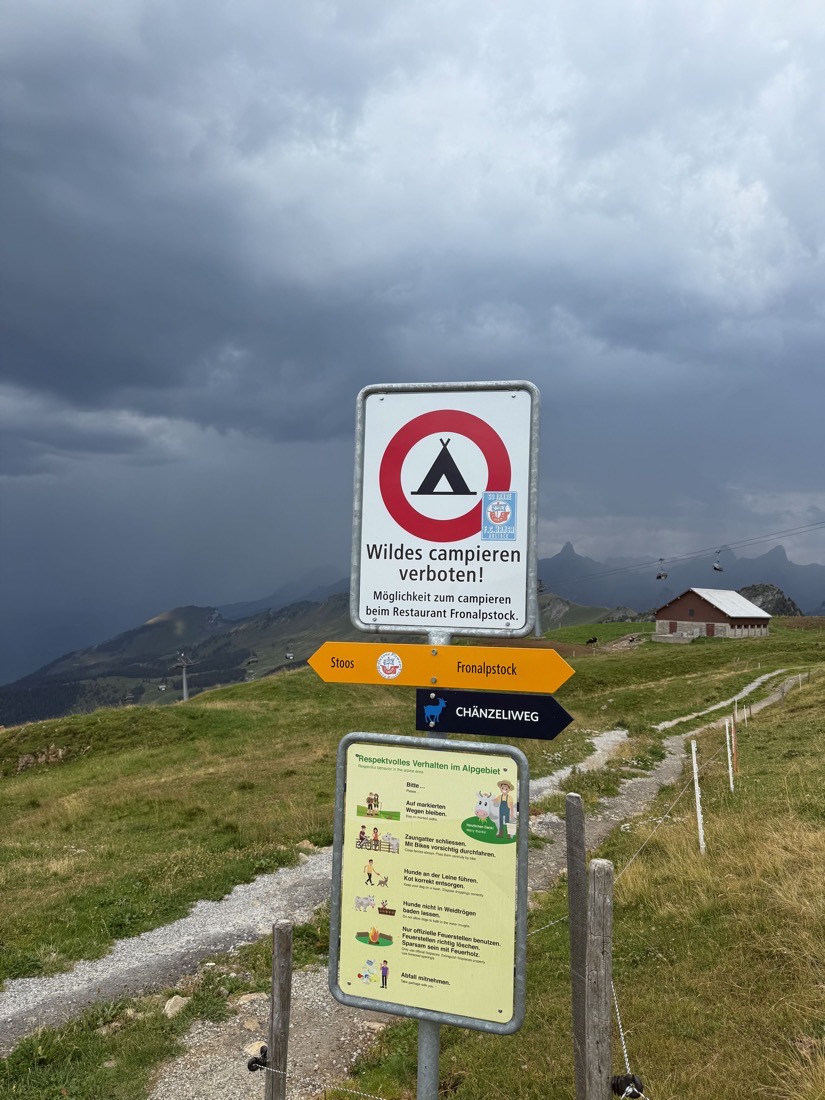
"Wildes campieren verboten! Möglichkeit zum campieren beim Restaurant Fronalpstock."Wild camping forbidden. Camping is possible at the Restaurant Fronalpstock. Photographed on the ridge below the summit, August 2026.
So is that a legal verdict, and can they fine you? The honest answer is no to the first and almost always no to the second, and it is worth knowing why, because in Switzerland three quite different things look identical from ten metres away and only one of them carries a public-law fine.10
The one that does is a judicial prohibition under art. 258 of the Civil Procedure Code. Someone with a right in rem over the land asks a court to prohibit interference, and a breach is then punished on application with a fine of up to 2'000 francs. Art. 259 requires that such a prohibition be publicly announced and posted on the land in a clearly visible place, which is exactly why you meet them as signs. Because they must be posted, they must also be readable as what they are: the deciding court, the date, the case number and the amount of the threatened fine.10
This sign has none of those. No court, no date, no case number, no franc amount. A pictogram, one line of prohibition, one line of alternative and a football sticker. That makes it the landowner's or the operator's own sign, in the same family as the hotel's website line and the tourism office's listing, and nothing on it can be turned into a fine.10
Which does not make it decoration. It does two things that matter. First, it is the landowner's consent, refused in writing, on the ground it covers, so the "just ask" route is closed there before you start; behind it stand the owner's right to see off interference and, since 1 July 2026, a new court order under art. 260a of the same code, decided within five days, that clears an indeterminate group off a property. That is removal, not a penalty, but it is not nothing.10
Second, it stands next to a rule that does carry a penalty. Not the sign, the ordinance. Article 16 of the Morschach Schutzverordnung punishes any breach of that ordinance with detention or a fine, negligence included, and the art. 6 prohibitions in the Naturschutzzone, no structures and no leaving the marked path, are what a tent on the grass runs into. That zone starts about 38 metres south of the pin, which is the same gentle grass anyone would pick. So there is a real fine here; it just is not the one on the sign, and it depends on which ground you are standing on rather than on whether you walked past a pictogram.33
And the second line on the sign is the honest part. It points at the Restaurant Fronalpstock, which is where the bookable tent area is. The sign is not the source of the answer, but it is telling you the right one.
The board bolted underneath it is the alp's own courtesy list: stay on the marked paths, close the gates, dogs on the lead, only official fire places, take your rubbish with you. No fine attaches to that one either. Worth reading anyway, because "stay on the marked paths" is the same sentence the Schutzverordnung makes binding inside the protection zone, and up here that is the sentence that actually decides it.3
No game reserve here, and who runs this summit
There is no federal game reserve near this pin, which is worth stating because people assume the opposite on a big Alpine summit. The nearest integral-protection game reserve is Mythen, object 8, 6'659 metres north-north-east across the valley, far out of reach. There is no VEJ tent ban to trip over here, and no CHF 150 federal fixed penalty for a tent in a reserve, because there is no reserve.2
The Stoos descent side carries its own protected ground, and the same communal restrictions follow it in. On the way down towards Stoos an SV overlay marks the "Nationales Schutzgebiet Teufböni", and the federal inventories add a Flachmoor, fen object 2680, about 1'808 metres east-north-east, and a Hochmoor, raised bog object 454, about 1'920 metres east-north-east. Where those overlap a Morschach Naturschutzzone, the same art. 6 no-structures and no-off-path rules bite just as they do on the south shoulder. None of them is at the summit pin, but they are the reason the wider basin is not an open free-for-all either.3
Whose summit this is, is simple: it is a run resort. The Fronalpstock is served by the Stoosbahnen chairlift from the car-free village of Stoos, itself reached by the steepest funicular in the world, at a gradient up to 110 percent. The summit carries a Berggasthaus with a restaurant terrace, the viewpoint apron, a children's playground and a petting zoo, and the ridge onward to the Klingenstock is the classic panorama walk. This is infrastructure, staff and opening hours, not a lonely bivouac ledge.69
There are two proper ways to tent up here, and both go through one phone number. The reachable door is the Hotel and Berggasthaus Fronalpstock on +41 41 820 27 26. First, there is an official designated tent area near the hotel where you pitch your own tent, booked and priced through the hotel. Second, the hotel's Panorama-Zelt in the summer season: a tent with a built-in sleeping mat that you pitch yourself in a marked spot, CHF 65 per person including breakfast, plus CHF 40 for a three-course dinner, showers and toilets included, bring your own sleeping bag. Both are booked pitches, not wild camping. Stoos-Muotatal Tourismus is clear that official tenting here is only in that designated area by the hotel, and that wild camping and bivouacking are generally not permitted in the region. So this is not a "nowhere to sleep" spot, it is a "not a wild spot" spot, and in high season the designated area gets busy.99
And the part you will actually see up there. The booked area is not the only ground with tents on it. On summer nights there are regularly a good number of tents pitched out along the ridge behind the restaurant, roughly 300 metres beyond it, on the open grass. That ground sits outside the area the hotel books, so nothing about the arrangement covers it, and what speaks against it there is the operators' house rule quoted above rather than a norm you could look up: the commune's mapped Naturschutzzone patches along the Gratweg towards the Klingenstock begin further out than that, at roughly 670 metres and beyond. We write that down because it is what this summit looks like on a July Saturday, not as a recommendation. The bookable area is the answer we stand behind, and it is the one that leaves you owing nobody an explanation in the morning.
No fire, and no drone, as a baseline anywhere on a developed summit like this. On bare pasture and gravel by a restaurant there is nowhere a fire belongs, and the summer fire situation in Central Switzerland tightens fast in dry spells, so check the current cantonal fire warning before you count on any flame at all. Fly nothing here either: this is a busy lift-served viewpoint with families on it all day.6
The reason for the verdict: the ground at the pin is not yours to pick
Start with the question that decides this one, and it is not a legal question. If sleeping here were entirely lawful, would anybody put a sleeping bag down on this exact ground? The measurements answer it. The pin is the built viewpoint itself, a bench enclosure on bare trampled earth. The panorama path runs 9 metres away. The nearest building is 65 metres off. The chairlift top station is 150 metres away. And the restaurant terrace, the children's playground and the petting zoo are just up the ridge.6
This is a developed summit, not open mountain. Stoos is a car-free resort village, the Fronalpstock above it is a lift-served viewpoint, and the last chairlift down runs in the evening. Put a tent on the viewpoint apron and you are lying on gravel in front of a restaurant, in sight of the top station, and you will be seen at both ends of the night. The whole scene is built for day visitors who go back down, not for someone bedding down where they stood.9
The only gentle ground is the ground you are not allowed to use. The one stretch of soft, campable grass near the summit is the shoulder running south, and that shoulder is inside the Naturschutzzone where art. 6 of the Morschach Schutzverordnung forbids placing any structure and forbids leaving the marked path, starting about 38 metres from the pin. Between them, a night there is not lawful. So the flat spot that would tempt you is precisely the protected one. There is no lawful, campable ground at the pin: the pin itself is a gravel apron in a resort, and the grass beside it is a no.3
Everything else on the map here is a chip, not a conduct rule. The Landschaftsschutzzone 27 metres away carries building and terrain rules only. The BLN inventory that runs through the summit binds authorities, not walkers. Neither of them reaches a sleeper. The rules that do reach a sleeper on this ground are the two Naturschutzzone prohibitions, and they sit on the exact grass you would want.3
Why the verdict is "It depends" and not "Not allowed". Because there is a genuine, official, bookable way to sleep up here with your own tent, and the law at the pin does not stand in your way. What limits you is a condition rather than a prohibition: the tent goes in the designated area by the hotel, not on the viewpoint apron and not on the protected grass to the south. Whenever we can write down exactly what somebody has to do, call +41 41 820 27 26 and book the tent area, the honest chip is "it depends". We had this one at "Not allowed" until August 2026, and that was the wrong call: it read as "you cannot sleep here" on a summit where people tent every summer weekend.9
Where you can legally sleep
- The designated tent area near the hotel, with your own tent, booked and priced through the Hotel and Berggasthaus Fronalpstock, +41 41 820 27 26. This is the official place to tent up here, so there is a real answer. It is a genuinely pretty spot, and in high season it gets busy, so treat it as a booked pitch rather than a solitary wild night.
- Hotel and Berggasthaus Fronalpstock, Panorama-Zelt, on the summit, same number. A provided tent with a built-in mat in a marked spot, CHF 65 per person including breakfast, plus CHF 40 for a three-course dinner, showers and toilets included, summer season, bring your own sleeping bag.
- Hotel and Berggasthaus Fronalpstock, rooms, if you would rather sleep indoors on the summit, same phone number.
- Down in Stoos, the car-free village below, which has hotels and the funicular back up in the morning, an easy answer if you missed the last chairlift.
- Not the published point, the viewpoint bench on the gravel apron between the chairlift and the restaurant.
- Not the south shoulder either. The one patch of gentle grass by the summit is inside the communal Naturschutzzone, where you may place no structure and may not leave the marked path, so a bivvy bag is caught just as a tent is.
General rules for wild camping
This applies wherever you are genuinely allowed to sleep outside, which above Stoos means the designated tent area by the hotel or the booked Panorama-Zelt, and not the built viewpoint. It is not legal text, it is decency and common sense on a lift-served summit that families use all day.
- No fire. An open fire has no place in the mountains. A gas stove is enough.
- Pitch late, strike early. Set up towards evening, gone again early. A bivouac is one night, not a base camp.
- Leave no rubbish. Everything you carry up you carry down, organic scraps and toilet paper included.
- At least 50 metres from any water for the big business, so you do not foul what people and livestock drink.
- Stay small and quiet. A small group, no speaker, no drone, dogs on the lead, and the alp staff's word goes.
Disclaimer
This article reflects my research and assessment to the best of my knowledge, as of July 2026. It is based on the publicly accessible and official sources linked below. It does not replace legal advice and is not a binding statement of the current legal situation.
Communal protection zones and their boundaries can change, cantonal fire bans come and go through the summer, and the hotel's Panorama-Zelt price and season can be updated, so material written about this area earlier may be out of date. Before every tour, check the current sources yourself, respect the protection zones and the resort's own rules, and follow instructions on site. A genuine emergency bivouac in distress is a separate question from a planned camp. Anyone who spends the night outside bears responsibility for their own conduct and any consequences themselves. Hikebeast, Leon Helg and Saftladen GmbH accept no liability for decisions made on the basis of this text, and call on no one to break applicable law.
Frequently asked questions
Is wild camping allowed at Fronalpstock?
Can you tent on the Fronalpstock summit at all, and what does it cost?
Does a protection zone reach the Fronalpstock viewpoint?
Is there a federal game reserve at Fronalpstock?
Does the ban catch a bivouac without a tent?
Leon Helg
Swiss filmmaker and software developer. Spends his free time in the Swiss Alps and maps his favourite spots for Hikebeast. Posts as @leon.helg on Instagram and TikTok.
Sources
- Canton of Schwyz camping and reserve law. The canton has no general prohibition on a single night outside; camping is banned only inside named reserve perimeters, and none of them lies at the Fronalpstock viewpoint. The Landschafts- und Naturschutzgesetz (SRSZ 721.110) and the Abgeltungsverordnung for the districts and communes provide the framework under which communes designate protection zones; the operative camping prohibition here is communal rather than cantonal. Canton Schwyz also has no wildlife-rest-zone (Wildruhezone) legal basis at all: the government decided by Regierungsratsbeschluss RRB 841/2022 not to create the statutory footing for them, so that category is absent from the canton, and the nearest such area, Chruteren-Bawangli, carries only a recommended (empfohlen) status 3'370 m east with no binding rule and no fine. sz.ch. ↩
- Federal geodata at the pin, WGS84 46.9682209 / 8.6372684. The federal landscape inventory BLN object 1606, "Vierwaldstättersee mit Kernwald, Bürgenstock und Rigi", has a boundary that runs through the summit area; the pin sits in a small excluded pocket around the summit infrastructure, with the inventory 65 m west, 100 m south and 300 m north. A BLN object binds authorities under art. 6 NHG (SR 451) and imposes no conduct rule on a camper. The game reserve, wildlife-rest-zone and mire layers return no integral-protection reserve at the pin: the nearest federal game reserve is Mythen, object 8, 6'659 m north-north-east across the valley, so no VEJ (SR 922.31) tent ban and no CHF 150 federal fixed penalty for a reserve reaches this summit. On the Stoos descent side the federal inventories add a Flachmoor, fen object 2680, about 1'808 m east-north-east, and a Hochmoor, raised bog object 454, about 1'920 m east-north-east. map.geo.admin.ch. ↩
- Schutzverordnung der Gemeinde Morschach (Teilrevision Nutzungsplanung 2016+), the commune's nature and landscape protection ordinance under its current land-use planning. It names no camping verb: the strings Campieren, Biwakieren, Zelt and Feuer do not appear in the document. What reaches the ground is art. 6 (Naturschutzzone), whose use restrictions in Abs. 1 include lit. b, "Verbot von Bauten und Anlagen", a prohibition on structures and installations, and lit. f, "Verbot des Betretens ausserhalb der markierten Wege mit Ausnahme für Pflege- und Unterhaltsmassnahmen", a prohibition on leaving the marked paths apart from maintenance and upkeep. Pitching a tent is placing a structure and lying out on the grass shoulder is leaving the marked path, so a night there is unlawful as the effect of those two prohibitions rather than under an express camping ban. Breaches are penalised under art. 16, "Zuwiderhandlungen": "Mit Haft oder Busse wird bestraft, wer gegen die Vorschriften der Schutzverordnung verstösst. Strafbar sind die vorsätzliche und die fahrlässige Übertretung." The nearest Naturschutzzone polygon, best identified as the roughly 6.5-hectare "Halbtrockenwiese, Fronalpstock", starts about 38 m south of the pin, with further patches at about 670, 753, 863, 1'046 and 1'219 m along the Gratweg toward the Klingenstock and two forest patches 757 and 812 m north-north-east. morschach.ch. ↩
- Morschach Landschaftsschutzzone and further protected ground. A Landschaftsschutzzone under art. 8 of the same Schutzverordnung begins about 27 m from the pin and covers ridge sections; its purpose is "die ungeschmälerte Erhaltung der charakteristischen Landschaftselemente", the undiminished preservation of the characteristic landscape, and it carries building and terrain rules only, with no camping conduct norm, so it is a designation on the map rather than a prohibition against a sleeper. On the Stoos descent side an SV overlay marks the "Nationales Schutzgebiet Teufböni"; where it and the adjacent federal Flachmoor obj. 2680 and Hochmoor obj. 454 overlap a Morschach Naturschutzzone, the art. 6 no-structures and no-off-path restrictions apply as they do on the south shoulder. morschach.ch.
- Baureglement der Gemeinde Morschach, canton Schwyz, downloaded and read; the PDF at this URL is the consultation draft of the Teilrevision Nutzungsplanung 2016+ (2. Öffentliche Auflage). In it, art. 61 (Schutzzonen; Geschützte Bauten und Objekte) is a one-sentence cross-reference: the Schutzverordnung contains the special provisions on preserving the townscape and landscape under § 21 Abs. 2 Bst. b PBG, as well as those on the protection zones and the protected natural objects and buildings. Art. 74 (Strafbestimmungen) is a cross-reference too: the penal provisions of the superordinate law of the Confederation and the canton apply, in particular § 92 of the cantonal Planungs- und Baugesetz. The previous Baureglement of 3 June 1998 covered both points in its own words, in its art. 83 (pointing to the Schutzverordnung and the associated Landwirtschafts-, Schutz- und Wintersportzonenplan, Landschaftsplan 1:5000) and its art. 104 (Haft oder Busse under the Schwyz criminal-procedure ordinance). Under either version the Baureglement contains no camping conduct norm and leaves the protection rules to the separate Schutzverordnung; the restrictions that reach the south shoulder sit there, in art. 6 and art. 16. morschach.ch.
- Terrain and setting at the pin, WGS84 46.9682209 / 8.6372684, about 1'921 m. The pin is the built Fronalpstock viewpoint itself, a stone-bench enclosure on bare trampled earth. The panorama path runs about 9 m away, the nearest building about 65 m, the chairlift top station about 150 m, with the Berggasthaus restaurant terrace, a children's playground and a petting zoo just up the ridge toward the Klingenstock. The only gentle, campable grass near the summit is the shoulder running south, which lies inside the communal Naturschutzzone. Fronalpstock is reached from the car-free village of Stoos by chairlift; Stoos itself is reached by the Stoosbahn, the steepest funicular in the world, at a gradient up to 110 percent. The last chairlift down runs in the evening. This is a developed, lift-served tourist summit, not open mountain. map.geo.admin.ch. ↩
- Stoos and Fronalpstock, general facts. The Stoosbahn funicular runs from the valley near Schwyz up to the car-free village of Stoos at a gradient reaching 110 percent and is described as the steepest funicular in the world; two chairlifts continue up to the Fronalpstock summit, and from the top a ten-minute ridge walk reaches the panorama viewpoint over Lake Lucerne, with a restaurant, a playground and a picnic area near the fenced viewing platform. The classic ridge hike continues from Fronalpstock to the Klingenstock. This confirms the built, day-visitor character of the summit that drives the "would anyone actually sleep here" reasoning. myswitzerland.com.
- Hotel and Berggasthaus Fronalpstock, Stoos, Panorama-Zelt offer, read from the hotel's own booking page. A tent with a built-in sleeping mat that the guest pitches themselves in a marked spot, in the summer season, CHF 65 per person including breakfast; plus CHF 40 per person for a three-course dinner; use of the sanitary facilities, showers and toilets included; sleeping bag not included, bring your own. Phone +41 41 820 27 26. The page states verbatim: "Wildes Zelten ist auf dem Fronalpstock nicht erlaubt." The hotel, Stoos-Muotatal Tourismus and the Stoosbahnen all publish that wild tenting is not allowed here; none of them names a law, so those statements are house rules rather than a legal prohibition. The Panorama-Zelt is a booked pitch, not wild camping, and it is the lawful paid answer for sleeping on this summit. fronalpstock.ch.
- Stoos-Muotatal Tourismus, "Zelten Fronalpstock" listing. It records an official designated tent area near the Fronalpstock hotel and restaurant where you pitch your own tent, booked through the Fronalpstock hotel and restaurant on +41 41 820 27 26, so tenting on this summit has a legitimate home separate from the hotel's provided Panorama-Zelt. The tourism office is clear that official camping here is only possible in that designated area and that wild camping and bivouacking are generally not permitted in the Stoos-Muotatal region; this is a region-level house-rule position and names no statute, so it does not turn the verdict into a legal prohibition. Firsthand, the designated area is a genuinely pretty place to tent but gets busy in high season, so it is a booked pitch rather than a solitary wild night. No exact price for the bring-your-own pitch could be extracted from the tourism site; it is booked and priced through the hotel. Region contact: Stoos-Muotatal Tourismus GmbH, +41 41 818 08 80, info@stoos-muotatal.ch. stoos-muotatal.ch. ↩
- The sign on the ridge, photographed 21 August 2026, at the path junction about a hundred metres below the summit: a crossed-out tent over "Wildes campieren verboten!" and, beneath it, "Möglichkeit zum campieren beim Restaurant Fronalpstock." It names no court, no date, no case number and no amount, so it is not a judicial prohibition. Schweizerische Zivilprozessordnung (ZPO, SR 272), consolidated version in force 1 July 2026, art. 258 para. 1: a person with a right in rem in a property may apply to the court for any interference with possession to be prohibited and for a breach to be punished, on application, "mit einer Busse bis zu 2000 Franken"; art. 259 requires the prohibition to be publicly announced and posted on the land in a clearly visible place; art. 260 allows an objection within 30 days, without reasons, which makes it ineffective against the objector. Art. 260a, inserted by the federal act of 20 June 2025 and in force since 1 July 2026, adds a court order against an indeterminate group of persons for the removal of interference or the return of the property, decided within five days; it orders removal and carries no fine. fedlex.admin.ch. ↩