Wild camping on the Flüela Schwarzhorn
There is nowhere to lie down on the summit of the Flüela Schwarzhorn. The rock falls away on every side, and the first flat ground is about 410 metres lower. Nobody prohibits a night at the top, but the Davos boundary runs 0.8 metres from the cairn.
What do these mean?
Illegal A specific rule bans it, usually with a fine, and it can be enforced. Sleep somewhere else.
Not allowed No real place to camp here. A gated site, a developed area, or nowhere sensible to lie down, even if no fine is attached.
It depends You can sleep here, but there's a condition first: ask the landowner, book a spot, stay inside a set zone, or use a bivvy instead of a tent. The report says which.
Tolerated No rule clearly allows or bans it, but a single night is accepted in practice and nobody enforces against it. Normal for high bivouacs above the treeline.
Legal Camping one night is fine here. Either a rule allows it, or we checked every law and found nothing against it. Still: pitch late, leave early, no trace.
The ground says no before the law gets a chance to
Start with the mountain rather than the statute book, because on this summit the statute book never becomes the deciding factor.
The Flüela Schwarzhorn is a symmetrical pyramid of dark amphibolite between the Flüela valley and the Dischma, two kilometres south of the pass, and at 3'146 m it is the highest point in the Davos region. Everything about it that makes it a good walk makes it a bad bed. The height model was sampled on a 25 metre grid over a 1'400 by 1'400 metre box centred on the top, 3'025 nodes, and then refined to 10 metres around the apex to find the real high point at LV95 2'791'280 / 1'179'110, 3'146.4 m against an official 3'146.2 m.2
- The apex cell reads 12.4 degrees. Treat that with suspicion: it is what a height model does to a point, and no neighbour agrees with it.
- Within 100 metres the flattest ground is 20.9 degrees.
- Within 200 metres, 16.6 degrees.
- Within 500 metres, not one node in several hundred comes in at or under 8 degrees.
- The first genuinely flat ground is 530 m south-south-east at LV95 2'791'800 / 1'178'775, 2'735.9 m, which is 410 vertical metres below the top.
That is a summit block, and this journal has a rule for those. If there is no flat, dry, safe ground within a few minutes of the pin, the answer is no whatever the law says. The Hundstein in the Alpstein is the same shape and gets the same answer. You climb the Flüela Schwarzhorn, you do not sleep on it.
And the summit is a bad place to be caught out anyway. Three thousand one hundred and forty-six metres of exposed rock is where afternoon storms arrive first and where a night wind has nothing to break it. The Chamanna da Grialetsch of the Swiss Alpine Club sits 3.2 km south-south-east at 2'542 m, and the Flüela Hospiz is 1.7 km north-north-east on the pass road. Both of those are the sensible answer to "where do I sleep up here".2
The boundary at the cairn, measured to the decimetre
Now the part that surprised us. The Flüela Schwarzhorn is not in Davos, even though it is the highest point of the Davos region and everybody climbs it from the Flüelapass. The summit point is in Zernez, and the boundary is closer than the summit cairn is wide.
Rays were cast from the top on eight bearings and the commune geometry bisected to sub-metre resolution, filtering the layer to the current year because it also serves historical boundary years:2
- 0.8 m south-west: Davos.
- 1.1 m west: Davos.
- 3.9 m north-west and 4.5 m south-east: Davos.
- 194.9 m south: Davos.
- North, north-east, east and south-east on the ridge: Zernez for more than 600 m.
Eighty centimetres. Nobody is going to survey your groundsheet, and no map you carry resolves that. It matters because the two sides are not the same in law, and because the direction is not symmetrical: the ground falls away to the south and west, so any drift off the top is a drift into Davos.
Davos prohibits it, in one sentence, everywhere in the commune.
"Auf dem Gebiet der Gemeinde Davos ist das Campieren, d.h. das Aufstellen von Zelten, Wohnwagen und Wohnmobilen, ausserhalb von behördlich bewilligten Standorten untersagt."Verordnung über das Campingwesen der Gemeinde Davos, DRB 30.22, art. 1 "Platzpflicht", enacted by the Kleiner Landrat on 10 May 2022, in force since 1 June 2022, current version 1 June 2023.
Read the definition rather than the headline: the ordinance defines Campieren as the erecting of tents, caravans and motorhomes. Art. 8 para. 2 allows a fine of up to CHF 200 and lets the Kleiner Landrat set a fixed penalty, and he has. The catalogue is public and the entry is unambiguous:6
"Campieren ausserhalb von Campingplätzen und bewilligten Standorten (Art. 1 DRB 30.22) · Fr. 100.00"Ordnungsbussenkatalog der Gemeinde Davos, DRB 31.1, no. 20.f.1.
The delegation base is art. 88 para. 4 of the Davos building act, which lets the building authority limit or wholly prohibit the erecting of tents, caravans and motorhomes outside the camping zone. On the strict text an unpitched bivvy bag is not the erecting of a tent, which is the same reading this journal draws at the Jöriseen a few kilometres north. That is a reading, not a plan worth building on with a hundred francs on the table.6
Zernez is three communes in a trenchcoat, and only one of them lets you
The Zernez side needs a paragraph of history before it makes sense. Today's Zernez was formed in 2015 out of Zernez with Brail, Susch and Lavin. The merger message says plainly that until a unified building law is in force the commune applies, under transitional law, the corresponding acts of the former communes. So "what does Zernez prohibit" is the wrong question. The right one is which fraction you are standing in.3
The cadastre answers it. The summit sits on parcel 2492, EGRID CH507766870196, and the Graubünden ÖREB extract for that parcel names the communal act in force by title: Baugesetz Susch. Its camping article is short and it is not a ban:4
"Die Campingzone ist für Campingplätze bestimmt. […] Das ständige Stationieren von Wohnwagen, Wohnmobilen, Zelten und ähnlichen Einrichtungen in der Campingzone bedarf einer besonderen Bewilligung der Baubehörde. […] Zeitlich befristete Zeltlager können vom Gemeindevorstand ausserhalb der Campingzone bewilligt werden."Baugesetz Susch, art. 51 "Campingzone", as named by the Graubünden ÖREB cadastre as the act in force on parcel 2492.
Three things it does not do: it does not prohibit pitching a tent outside the building zone, it regulates only permanent stationing and only inside the camping zone, and its one word about ground outside that zone is a permitting power for organised tent camps. There is no prohibition here to break.
Now the trap, and it is a good one. All 80 published acts of the commune were downloaded and searched. With a German word list, the whole collection reads silent on camping: every hit is "Campingplätze" as a water or wastewater fee class. Search the same files in Romansh and two prohibitions appear at once.5
"Id es in princip scumandä ad excepziun dal militar d'eriger tendas per pernottar o eir inters achampamaints e que sün tuot il territori cumünal."Uorden champester dal cumün da Zernez, adopted by the Gemeindeversammlung on 8 March 1991, art. 7 "eriger tendas / rulottas / auto-rulottas". In English: it is in principle prohibited, except for the military, to erect tents for overnighting or whole camps, and that across the entire communal territory.
That is the Zernez fraction. Art. 19 of the same ordinance sets fines up to fr. 5'000, and its next sentence provides the way out that this journal keeps finding in old rural ordinances: on private ground it is exceptionally permitted to live in tents if the landowner allows it. The Lavin fraction's Uorden champester of 2006 says the same thing in its art. 9, with the military and officially designated camping places as the exceptions.5
Susch never wrote one. Its published collection runs to eight acts and contains no Uorden champester at all. So the summit of the Flüela Schwarzhorn happens to stand in the one of three fractions with no tent ban, on a parcel whose binding building act regulates only a camping zone. That is a genuine gap and this article says so, but it is a gap, not an invitation: the ground still fails.5
The commune does know how to write an access ban with a number. Both Susch and Zernez have a wildlife quiet-zone ordinance, Susch's of 19 August 2010 and Zernez's of 26 June 2009, closing the zones from 1 January to 20 or 30 April with fines of fr. 200 to 1'000 and up to fr. 5'000 on repetition. They are winter measures and the federal rest-zone layer is empty at the summit, so they do not reach a summer bivouac. They are worth naming because they show the silence about tents in Susch is silence, not oversight.5
Where the ground actually works, and what it costs to get it wrong
If you want to sleep out in this basin, go down and go east. The flat ground exists, it is just nowhere near the top.
- The shelf 530 m south-south-east, LV95 2'791'800 / 1'178'775, 2'735.9 m, 1.5 degrees, with 82 nodes at or under 8 degrees in the same distance band. This is Zernez ground and the descent from the summit towards the Fuorcla da Grialetsch passes through it.2
- The broad ground 700 to 1'000 m north-east, around 2'791'850 / 1'179'550, 2'675.3 m, 0.7 degrees. Also Zernez, and on the line back towards the Flüelapass.2
- Not the summit, not the summit ridge, and not the south-west flank. The first two have no flat ground, and the third is Davos.
What getting it wrong costs. On the Davos side it is a fixed penalty of CHF 100, which can be written on the spot without proceedings, with a statutory ceiling of CHF 200 in the ordinance itself. That is a small number as Swiss camping fines go, and it is not the reason to stay off. The reason is that there is nothing to sleep on.6
Two overlays you can set aside. Every federal inventory is empty at the summit and at the Flüelapass: no hunting-ban district, no wildlife rest zone, no BLN object, no national park, no mire, no floodplain, no dry meadow, verified with an invalid-layer control that errors rather than coming back empty. The Swiss National Park is a long way east and does not reach here. Nothing federal is in play on this mountain.1
Courtesy, which is not law. The Alpine Club's leaflet is the standard: a single considerate night by a small group above the treeline is generally unproblematic, an emergency bivouac is always permitted, and you should not sleep close to huts. On a mountain where the nearest flat ground is 400 metres below the top, an emergency bivouac is the realistic scenario, and it is a different question from a planned camp.7
Where you can legally sleep
- The shelf 530 m south-south-east of the summit, LV95 2'791'800 / 1'178'775, 2'736 m, 1.5 degrees, Zernez ground2.
- The broad ground 700 to 1'000 m north-east, around 2'791'850 / 1'179'550, 2'675 m, 0.7 degrees, on the way back to the Flüelapass2.
- Chamanna da Grialetsch SAC, 2'542 m, 3.2 km south-south-east, if you want a roof and a warden2.
- Not on the summit or the summit ridge. No flat ground within 500 m, and the apex reading of 12.4 degrees is a model artefact2.
- Not on the south-west flank. That is Davos: camping outside authorised sites, CHF 100 fixed penalty6.
General rules for wild camping
None of this is law, and on this mountain the law is not what stops you. It is worth reading anyway, because the ground below the summit where you actually will sleep is grazed alp and a wildlife corridor, and the reason the Susch fraction has never needed a tent rule is that the people who go there behave.
- No fire. An open fire has no place in the mountains. A gas stove is enough.
- Pitch late, strike early. Set up towards evening, gone again early. A bivouac is one night, not a base camp.
- Leave no rubbish. Everything you carry up you carry down, organic scraps and toilet paper included.
- At least 50 metres from any water for the big business, so you do not foul what people and livestock drink.
- Stay small and quiet. A small group, no speaker, no drone, dogs on the lead, and the alp staff's word goes.
Disclaimer
This article reflects my research and assessment to the best of my knowledge, as of August 2026. It is based on the publicly accessible and official sources linked below. It does not replace legal advice and is not a binding statement of the current legal situation.
The verdict is a terrain verdict and applies to the summit point. It does not claim that an overnight stay at the summit is unlawful on the Zernez side, and it does claim that one on the Davos side is: the commune boundary runs 0.8 metres south-west of the top and is not marked on the ground. The finding that the Susch fraction has no tent prohibition rests on its published collection and on the cadastre naming the Baugesetz Susch as the act in force; an unpublished act or a later revision would change it. Before every tour, check the current sources yourself and follow instructions on site. A genuine emergency bivouac in distress is a separate question from a planned camp. Anyone who spends the night outside bears responsibility for their own conduct and any consequences themselves. Hikebeast, Leon Helg and Saftladen GmbH accept no liability for decisions made on the basis of this text, and call on no one to break applicable law.
Frequently asked questions
Is wild camping allowed on the Flüela Schwarzhorn?
Which commune is the summit in?
What happens if I pitch on the Davos side?
Is it true that Zernez bans camping?
Where should I sleep instead?
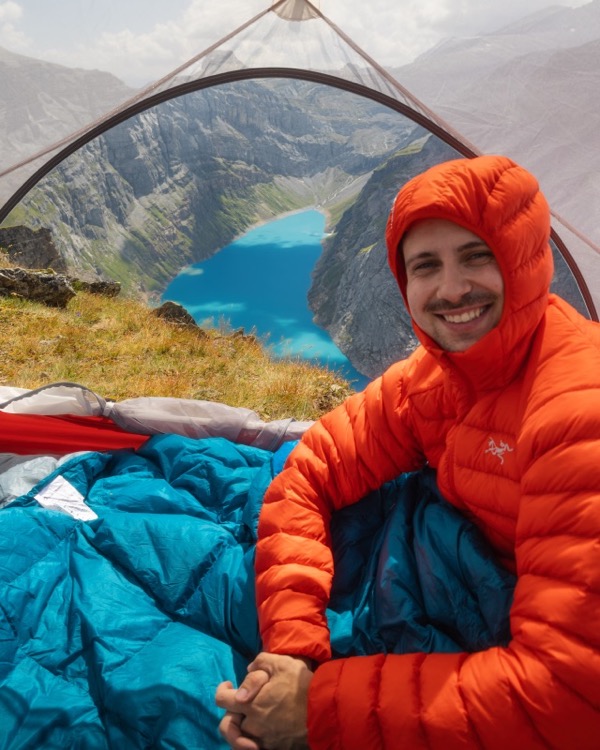
Leon Helg
Swiss filmmaker and software developer. Spends his free time in the Swiss Alps and maps his favourite spots for Hikebeast. Posts as @leon.helg on Instagram and TikTok.
Sources
- Official federal geodata, queried 27 August 2026 at the summit LV95 2'791'280 / 1'179'110 and at the Flüelapass 2'791'922 / 1'180'513. Hunting-ban districts, wildlife rest zones, BLN, parks of national importance including the Swiss National Park, floodplains, raised and lowland mires, moor landscapes, amphibian spawning sites and dry meadows and pastures all return a genuinely empty result set at both points. Verified with an invalid-layer control (
ch.bafu.this-layer-does-not-exist) that surfaced as HTTP 400 in every run, and a positive control at 2'626'000 / 1'154'500 that returned the Kiental hunting-ban district as expected. map.geo.admin.ch. ↩ - swisstopo swissBOUNDARIES3D commune geometry, filtered to the current year because that layer also serves historical boundary years, and the swissALTI3D height model, queried 27 August 2026. The summit was located rather than assumed: the widely quoted WGS84 coordinate 46.735769 / 9.941983 converts to LV95 2'791'301 / 1'179'116 and reads 3'130.7 m, while a 10 m grid over ±120 m puts the true high point at LV95 2'791'280 / 1'179'110, 3'146.4 m, against an official 3'146.2 m. Terrain on a 25 m grid over ±700 m, 3'025 nodes, slope from the local gradient: apex cell 12.4 degrees, best within 50 to 100 m 20.9 degrees, best within 100 to 200 m 16.6 degrees, best within 200 to 300 m 8.3 degrees and within 300 to 400 m 16.0 degrees, and zero nodes at or under 8 degrees inside 500 m. First flat ground 530 m south-south-east at 2'791'800 / 1'178'775, 2'735.9 m, 1.5 degrees, with 82 nodes at or under 8 degrees in the 500 to 700 m band; broad ground 700 to 1'000 m north-east around 2'791'850 / 1'179'550, 2'675.3 m, 0.7 degrees. Commune rays from the summit, bisected below one metre: Davos at 0.8 m south-west, 1.1 m west, 3.9 m north-west, 4.5 m south-east and 194.9 m south; Zernez to the north, north-east and east for more than 600 m. Reference points: Flüelapass 2'383.4 m, 1.7 km north-north-east; Chamanna da Grialetsch CAS 2'542.4 m, 3.2 km south-south-east; Flüela Wisshorn 3'084 m; Piz Radönt 3'064 m. map.geo.admin.ch. ↩
- Gemeinde Zernez, merger documents, consulted 27 August 2026. Today's Zernez was formed on 1 January 2015 from Zernez with Brail, Susch and Lavin. The Missiva dal proget da fusiun records the transitional regime in as many words: until the new unified building law enters into force, the communal executive applies, on the basis of transitional law, the corresponding existing acts of the former communes ("Fin a l'entrada in vigur ... applichescha la suprastanza cumünala, as basond sül dret transitoric, las ledschas vertentas correspondentas dals cumüns d'infin uossa"). That is why the question at this summit is not what Zernez prohibits but which fraction the ground belongs to. zernez.ch. ↩
- Graubünden ÖREB cadastre, extract for the summit parcel, EGRID CH507766870196, parcel 2492, land registry area 13'613'224 m², fetched 27 August 2026. Because an alpine parcel is kilometre-scale, the 18 restrictions were read together with a point query at the exact summit coordinate. The extract names the communal act in force by title for every Zonenplan restriction on the parcel: Baugesetz Susch (file 3744_V_Susch_BauG.pdf on the cantonal ÖREB document service), alongside the cantonal planning act and ordinance, the cantonal forest act and a communal Planungszone for the total revision of the local planning. A point 5 m to the south-west returns parcel 4372, EGRID CH570177192414, commune of Davos, and its extract references the Baugesetz Davos instead. Baugesetz Susch art. 51 "Campingzone" reads: "Die Campingzone ist für Campingplätze bestimmt. Es sind ausschliesslich betrieblich notwendige Bauten und Anlagen zulässig, wie sanitäre Anlagen und Verkaufskioske. […] Das ständige Stationieren von Wohnwagen, Wohnmobilen, Zelten und ähnlichen Einrichtungen in der Campingzone bedarf einer besonderen Bewilligung der Baubehörde. […] Zeitlich befristete Zeltlager können vom Gemeindevorstand ausserhalb der Campingzone bewilligt werden." There is no general prohibition on pitching a tent outside the building zone. oereb.geo.gr.ch. ↩
- Gemeinde Zernez, complete published law collection, 80 documents across the Zernez, Susch, Lavin and post-merger folders, downloaded and searched on 27 August 2026 with control terms counted per file. A German-language search of the whole collection returns no camping prohibition: every hit for "Camping" is "Campingplätze" as an object class in the water-supply, wastewater and fee ordinances. The Romansh terms return two. Uorden champester dal cumün da Zernez, approved by the Gemeindeversammlung on 8 March 1991, art. 7: "Id es in princip scumandä ad excepziun dal militar d'eriger tendas per pernottar o eir inters achampamaints e que sün tuot il territori cumünal. A quist scumond da pernottada suottastan eir rulottas ed auto-rulottas. Sün prövi privat esa excepziunalmaing permiss dad abitar in tendas, scha possessur dal terrain permetta quai." Art. 19 sets fines up to fr. 5'000. Uorden champester of the Lavin fraction, 2006, art. 9 "Tendas ed achampamaints": the same prohibition across the whole communal territory, excepting the military and officially defined camping places, with private ground open on the owner's consent. The Susch folder contains eight acts and no Uorden champester. Also consulted: Uorden da zonas da quietezza per la sulvaschina of the Cumün da Susch, 19 August 2010, art. 3 closing the zones from 1 January to 20 April with fines of fr. 200 to 1'000 and up to fr. 5'000 on repetition, and the Zernez and Brail equivalent of 26 June 2009 running to 30 April. Both are winter measures. zernez.ch. ↩
- Gemeinde Davos, Davoser Rechtsbuch, consulted 27 August 2026. Verordnung über das Campingwesen, DRB 30.22, enacted by the Kleiner Landrat on 10 May 2022, in force 1 June 2022, current version 1 June 2023. Art. 1 "Platzpflicht": "Auf dem Gebiet der Gemeinde Davos ist das Campieren, d.h. das Aufstellen von Zelten, Wohnwagen und Wohnmobilen, ausserhalb von behördlich bewilligten Standorten untersagt." Art. 8 "Strafbestimmungen" para. 2: "Das Campieren ausserhalb von Campingplätzen und bewilligten Standorten kann mit bis zu Fr. 200.- gebüsst werden. Der Kleine Landrat kann eine Ordnungsbusse festlegen." Ordnungsbussenkatalog der Gemeinde Davos, DRB 31.1, no. 20.f.1: "Campieren ausserhalb von Campingplätzen und bewilligten Standorten (Art. 1 DRB 30.22) Fr. 100.00". Delegation base: Baugesetz der Gemeinde Davos, DRB 60, art. 88 para. 4: "Für Gebiete ausserhalb der Campingzone kann die Baubehörde das Aufstellen von Zelten, Wohnwagen und Wohnmobilen zeitlich beschränken oder gänzlich untersagen." The Davos Gästetaxengesetz DRB 23 separately treats tents as guest accommodation for the visitor's tax. gemeindedavos.ch. ↩
- Swiss Alpine Club SAC, Merkblatt "Campieren und Biwakieren in den Schweizer Bergen". Quoted: "Ansonsten ist eine einzelne Übernachtung einer kleinen Anzahl Personen im Gebirge oberhalb der Waldgrenze in der Regel unproblematisch, wenn sie rücksichtsvoll erfolgt. Zudem ist ein Notbiwak grundsätzlich erlaubt." And: "Übernachte nicht zu nahe bei Hütten und beweideten Alpen oder erkundige dich, ob eine Übernachtung in der Nähe möglich ist." The leaflet's definitions also settle the wording question in the Davos ordinance: Biwakieren is a night without a tent under the open sky, Campieren a night in a small tent outside official campsites. Guidance and courtesy, not law. Read alongside ZGB SR 210 art. 699, a right of access to forest and pasture and never a right to spend the night. sac-cas.ch. ↩