Wild camping at the Fessisee
A night at the Fessisee is allowed. Canton Glarus has no camping ban and no camping fine, and the basin lies above the treeline, at about 2'170 metres. The ground belongs to the commune and is leased out, so you need the alp's yes. The number for that is the Äugstenbahn summer line, +41 55 640 81 53.
What do these mean?
Illegal A specific rule bans it, usually with a fine, and it can be enforced. Sleep somewhere else.
Not allowed No real place to camp here. A gated site, a developed area, or nowhere sensible to lie down, even if no fine is attached.
It depends You can sleep here, but there's a condition first: ask the landowner, book a spot, stay inside a set zone, or use a bivvy instead of a tent. The report says which.
Tolerated No rule clearly allows or bans it, but a single night is accepted in practice and nobody enforces against it. Normal for high bivouacs above the treeline.
Legal Camping one night is fine here. Either a rule allows it, or we checked every law and found nothing against it. Still: pitch late, leave early, no trace.
The Glarus rule, and why the answer starts as yes
Wild camping at the Fessisee starts from the permissive Swiss baseline and stays there, because canton Glarus never wrote the norm that would move it. There is no cantonal wild-camping prohibition, no bivouac prohibition, and no camping offence in the cantonal fixed-penalty catalogue. When a canton wants to ban a tent, it says so; Glarus did not.12
The clearest statement of the rule is the canton's own tourism board, which is unusually direct about it:
"Eine Übernachtung mit Zelt darf stellenweise sein, jedoch nur mit Einwilligung des Grundstücks- beziehungsweise Alpeigentümers, oberhalb der Waldgrenze oder im Gebirge."VISIT Glarnerland, the canton's destination organisation: a night in a tent may be pitched in places, but only with the consent of the landowner or alp owner, above the treeline or in the high mountains.
That single sentence carries the whole verdict. Two conditions, and the Fessis-Seeli meets both. It is above the treeline, sitting in a glacier-carved basin at about 2'170 metres where the only vegetation is alpine turf and scree. And the route is the landowner's yes, which is why the useful part of this article, further down, is a name and a telephone number rather than a statute.1
The Civil Code gets you onto the ground but not through the night. Art. 699 ZGB lets anyone cross forest and pasture within customary limits, which is the right you use to walk up to the tarns. It has never been a right to sleep there. So the overnight rests on the two things above, the absence of a prohibition and the consent of whoever holds the alp, and not on the access right by itself.12
One trap worth naming, because it catches people writing about Glarus. A search of the federal law portals turns up a fixed-penalty ordinance with a camping article, and it is tempting to cite it. It is the wrong canton. That catalogue is Lucerne's, not Glarus's, and it does not apply here. The accurate statement for Glarus is the plain one: no cantonal camping norm at all, and no camping line in the cantonal Ordnungsbussen list.12
So why is this article not two paragraphs long? Because the commune around the basin, Glarus Süd, is in the middle of a genuine wild-camping crackdown, and a reader who has heard about it deserves to know exactly where it bites. That is the next section, and the short version is that it names other places.
The commune's crackdown is real, and it points elsewhere
Glarus Süd is not relaxed about wild camping, and that is the honest starting point. The commune has been clamping down for a few years now, and it does it with teeth. The instrument is the judicial prohibition under Art. 258 of the Civil Procedure Code, a richterliches Verbot that the commune obtains for a defined piece of its own land, publishes in the Amtsblatt Glarus, and then enforces with a fine of up to CHF 2'000 per breach. This is not a tourism-office wish. It is a court order with a penalty behind it.6
But it is location-specific, and the locations are named. The bans already obtained and enforced are on the Panixerpass and at the Oberblegisee. The most publicised recent one is the Muttenchopf above the Limmernsee and Muttsee, the Instagram-famous ridge, where the CHF 2'000 fine was put in place after the crowds got out of hand. Beyond those, reporting and the commune's own statements list Tierfed, the Klöntal, Lauchboden and the Freiberg Kärpf as problem areas being watched.2345
Fessis is on none of these lists. We checked five independent sources, the tourism board, two 20 Minuten reports, glarus24 and SRF, and across all of them the Fessis-Seeli, Alp Fessis, the Gufelstock and the Spitzmeilen area never appear. The crackdown is aimed at the honeypots that went viral and at the valley trouble spots, and this quiet basin at the foot of the Gufelstock is not one of them.1245
There is one caveat, and it is about ownership rather than today's rules. The commune can only post a binding ban on land it owns; on other land it can merely recommend. Alp Fessis is municipally owned, one of the roughly thirty-nine leasehold alps the commune holds. So Glarus Süd could, in principle, place a Verbot here one day the way it did at the Oberblegisee. It has not. As of August 2026 there is no judicial prohibition covering the Fessis-Seeli, and the commune's general line where no specific ban exists is the same as the canton's: camp only with the owner's consent, and ask the commune, police or tourism office first if in doubt.4
Who to ask, and it is a real family. The alp is worked by the Aemisegger family, leaseholders of Alp Fessis since 1997, on ground the commune owns and lets out.8 The listed alp contact is Bruno Aemisegger, +41 79 524 28 05, given on the official Käsepass page for the alp; the next generation is Matthias Aemisegger, +41 71 688 20 11. The most practical single number is the Äugstenbahn summer line, +41 55 640 81 53, which handles access and is the natural place to ask. Call and ask to pitch one night, away from the herd and the huts. If you want the landowner rather than the tenant, that is Gemeinde Glarus Süd, Ressort Alpen und Landwirtschaft, or the tourism office.
There is no pitch fee here, so do not invent one. Unlike the Seealpsee or the Fälenalp, where a small informal rate is customary, no such figure exists for Alp Fessis, and we are not going to carry one across. The right courtesy is different in kind: buy a piece of their Alpkäse from the self-service Käsepass box on Ober Fessis, where they turn out roughly two and a half tonnes over a summer. That is how you thank a working alp for the ground.7
And a currency flag with a date on it. Glarus Süd is drafting a Campierreglement, intended as a template for canton-wide rules, to be published in 2026. That is exactly the kind of instrument that could add a general rule or a new named ban. This verdict is written as of August 2026 and holds on today's sources. If you are reading it after the reglement is published, re-check it against the new text before you rely on it.2
A basin of tarns above the treeline, and how you get there
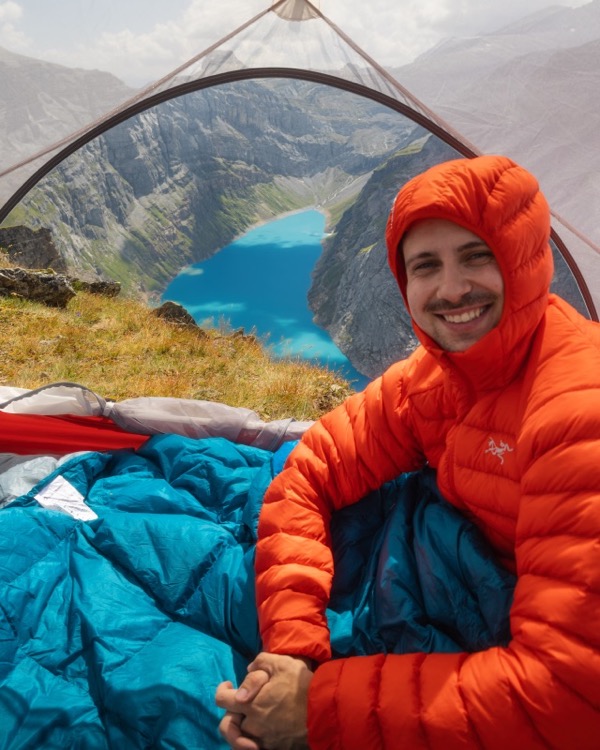
The Fessis-Seeli is not one lake but a scatter of them. Up to about fifteen tarns sit in a glacier-carved Verrucano basin above Alp Fessis, at the foot of the Gufelstock (2'436 m), somewhere around 2'170 to 2'179 metres. It is alpine ground, well above the treeline, and it is the kind of place where a small tent by a tarn looks after itself if you keep it discreet.9
The pin sits outside every federal reserve, and we checked each layer rather than assuming. On the federal map portal, at the basin there is no hunting-ban district, no wildlife rest zone, no BLN landscape object, no mire and no floodplain. The whole area falls inside the UNESCO Tektonikarena Sardona, which is a conduct designation and carries no camping penalty; the Sardona body itself runs an official overnight programme that invites people to sleep at 2'100 metres under the stars, which is the clearest possible sign that the World Heritage label is not a camping ban.610
Getting there. The standard approach starts at Ennenda near Glarus, takes the Äugstenbahn cableway up to around 1'000 metres, then climbs to the Aeugstenhütte at about 1'500 metres, a summer hut on the booking line +41 55 640 81 53. From there a path runs via Alp Fessis and Ober Fessis to the Fessis-Seeli at roughly 2'170 metres. You can also come up on foot from Sool. A pleasant loop takes in Bärenboden, the Aeugstenhütte, the Schafleger, the Fessis-Seeli and Ober Fessis in about five hours, and the ridge on to the Gufelstock adds up to roughly seven.79
Where to actually put the tent. Pitch on a grassy alp bench near a tarn, but off the grazed pasture and well away from the Ober Fessis huts. This is a working dairy alp, so the tent goes where it is out of the way of the cattle and out of the alp's daily working ground. If the weather turns, the nearest indoor fallback is the Spitzmeilenhütte SAC to the north-northeast.9
The rules that do apply here are the ordinary ones, not a camping ban. Open fire is regulated within fifty metres of forest under Glarus forest law and is banned outright during any cantonal Feuerverbot, so the simple rule is no open fire, cook on a stove, and check gl.ch/waldbrandgefahr before you go. Keep washing, soap and human waste at least fifty metres from the tarns and streams. Littering is a finable Ordnungsbusse everywhere, even where camping is not. And because this is a live alp, close the gates behind you, keep any dog leashed and clear of the cattle, and arrive and leave quietly.111
Where you can legally sleep
- A grassy bench by one of the Fessis-Seeli tarns, about 2'170 metres, for one considerate night, above the treeline and off the grazed pasture, with the alp's consent under the Glarus baseline. This is the honest answer to the question that was asked.
- Ask first on the Äugstenbahn line, +41 55 640 81 53, or Bruno Aemisegger on +41 79 524 28 05, and buy a piece of their alp cheese from the Käsepass box rather than looking for a fee to pay.
- Aeugstenhütte, about 1'500 metres on the way up, a staffed summer hut, booking +41 55 640 81 53, if you would rather sleep indoors.
- Spitzmeilenhütte SAC, to the north-northeast, the nearest indoor fallback if the weather turns on the ridge.
- Not the Panixerpass, the Oberblegisee or the Muttenchopf, which carry judicial prohibitions and a fine of up to CHF 2'000. Those are the places the commune has actually banned.
General rules for wild camping
This matters more where the answer is yes than where it is no. Glarus has never needed a camping rule at 2'170 metres, and the commune next door is drafting one. The list below is not law. On an alp where the tolerance rests on the alp's goodwill, it is the reason the answer above is still yes.
- No fire. An open fire has no place in the mountains. A gas stove is enough.
- Pitch late, strike early. Set up towards evening, gone again early. A bivouac is one night, not a base camp.
- Leave no rubbish. Everything you carry up you carry down, organic scraps and toilet paper included.
- At least 50 metres from any water for the big business, so you do not foul what people and livestock drink.
- Stay small and quiet. A small group, no speaker, no drone, dogs on the lead, and the alp staff's word goes.
Disclaimer
This article reflects my research and assessment to the best of my knowledge, as of August 2026. It is based on the publicly accessible and official sources linked below. It does not replace legal advice and is not a binding statement of the current legal situation.
The verdict rests on the absence of any camping prohibition at the federal, cantonal and communal level at this pin, and on the alp owner's consent. An absence can end: the commune of Glarus Süd is drafting a Campierreglement to be published in 2026, and it owns Alp Fessis, so it could place a judicial prohibition here in the way it already has at the Panixerpass, the Oberblegisee and the Muttenchopf. Before every tour, check the current sources yourself, get the landowner's or alp tenant's consent, and follow instructions on site. A genuine emergency bivouac in distress is a separate question from a planned camp. Anyone who spends the night outside bears responsibility for their own conduct and any consequences themselves. Hikebeast, Leon Helg and Saftladen GmbH accept no liability for decisions made on the basis of this text, and call on no one to break applicable law.
Frequently asked questions
Is wild camping allowed at the Fessisee?
Isn't Glarus Süd banning wild camping?
Do I need permission and is there a fee?
Does the UNESCO Sardona label ban camping?
What could change this verdict?
Leon Helg
Swiss filmmaker and software developer. Spends his free time in the Swiss Alps and maps his favourite spots for Hikebeast. Posts as @leon.helg on Instagram and TikTok.
Sources
- VISIT Glarnerland, the canton's destination organisation, wild camping page, consulted 1 August 2026. States the cantonal rule verbatim: "Eine Übernachtung mit Zelt darf stellenweise sein, jedoch nur mit Einwilligung des Grundstücks- beziehungsweise Alpeigentümers, oberhalb der Waldgrenze oder im Gebirge." The same page lists the places where wild camping is not tolerated in Glarus Süd, and the Fessis-Seeli, Alp Fessis and the Gufelstock do not appear on it. This is the primary statement of the canton's permissive baseline plus consent route. glarnerland.ch. ↩
- 20 Minuten, "Glarus Süd verbietet Übernachtungen am Muttenchopf", consulted 1 August 2026. Reports the judicial prohibition on the Muttenchopf above the Limmernsee and Muttsee, the Instagram-famous hotspot, and notes that bans already exist on the Panixerpass and at the Oberblegisee. Records that the commune is drafting a Campierreglement to be published in 2026 as a possible template for canton-wide rules. Fessis is not among the named locations. 20min.ch. ↩
- 20 Minuten, "Wer hier wildcampiert, soll bald 2000 Franken zahlen", consulted 1 August 2026. Sets out the CHF 2'000 fine attached to the commune's judicial prohibitions and states that the bans on the Panixerpass and at the Oberblegisee have already been enforced through the courts. Confirms the mechanism and the penalty level used across the crackdown. 20min.ch. ↩
- glarus24, "Gemeinde Glarus Süd reguliert das Campen in freier Natur", consulted 1 August 2026. Gives the commune's own list of problem areas and enforced spots, including the Muttenkopf, the Oberblegisee, Tierfed and the Panixerpass, and explains that the commune can post binding bans only on its own land and can otherwise merely recommend. The Fessis-Seeli and Alp Fessis are not on the list. Confirms that Alp Fessis being municipally owned means a ban would be legally possible there but is not in place. glarus24.ch. ↩
- SRF, "Glarus Süd sagt Wildcampern den Kampf an", consulted 1 August 2026. Reports that the commune's crackdown is aimed at the Muttsee and Limmern area and at the Instagram hotspots that drew crowds. The Fessis-Seeli is not among the targeted locations, which supports the finding that the enforcement is location-specific and does not reach this basin. srf.ch. ↩
- Federal geodata on the national map portal, queried 1 August 2026 for the Fessis-Seeli basin at about 2'170 m (WGS84 47.019199 / 9.138948, LV95 E 2'729'264 / N 1'208'973): no hunting-ban district (Jagdbanngebiet), no wildlife rest zone (Wildruhezone) and no BLN landscape object at the pin, and no mire or floodplain object. The basin lies within the perimeter of the UNESCO World Heritage Tektonikarena Sardona, which is a conduct designation and carries no camping penalty. Art. 258 of the Swiss Civil Procedure Code (ZPO) is the basis for the commune's richterliche Verbote, published in the Amtsblatt and fined up to CHF 2'000. map.geo.admin.ch. ↩
- Käsepass Alp Fessis, the regional alp-cheese route, consulted 1 August 2026. Names the alp operator as Bruno Aemisegger and lists the alp contact and the Äugstenbahn cableway summer booking line +41 55 640 81 53, with access via the Aeugstenhütte to the Fessis-Seeli. Describes the self-service Alpkäse box on Ober Fessis, where the alp turns out roughly two and a half tonnes of cheese over a summer, which is the courtesy this article recommends in place of a pitch fee. elm.ch. ↩
- Fridolin, "Glarus Süd ehrt langjährige Alppächter", consulted 1 August 2026. Confirms that the commune of Glarus Süd owns and leases out its alps and reports the Aemisegger family's long tenure on Alp Fessis, with Hansruedi Aemisegger recognised for around twenty-five summers on the alp. Establishes the ownership and leasehold structure that puts the consent route with the family and the landowner role with the commune. fridolin.ch. ↩
- outdooractive, Fessis lakes tour description, consulted 1 August 2026. Gives the elevation of the Fessis-Seeli as roughly 2'179 m, describes the basin of tarns as alpine and above the treeline, and places it inside the UNESCO Sardona area at the foot of the Gufelstock, with approach and loop timings via the Aeugstenhütte, Alp Fessis and Ober Fessis. Source for the terrain and access figures. outdooractive.com. ↩
- UNESCO-Welterbe Tektonikarena Sardona, "Sleep under the Stars" overnight programme, consulted 1 August 2026. The World Heritage body itself offers an official overnighting experience inviting guests to stay at 2'100 metres, which is direct evidence that the Sardona designation surrounding the Fessis-Seeli carries no camping penalty and is a conduct label rather than a ban. unesco-sardona.ch. ↩
- Kanton Glarus, Waldbrandgefahr and fire-in-the-open information, consulted 1 August 2026. Open fire is regulated within fifty metres of forest under Glarus forest law and is banned outright during any cantonal Feuerverbot, so the practical rule at the Fessis-Seeli is no open fire and cooking on a stove, with the current fire-danger level to be checked before departure. gl.ch. ↩
- Kanton Glarus, systematic collection of enactments (Erlass-Sammlung), consulted 1 August 2026. The cantonal law collection contains no wild-camping or bivouac prohibition and no camping offence in the cantonal Ordnungsbussen catalogue, which is the register-level confirmation that Glarus has no camping norm for the public. Note the common trap: the fixed-penalty catalogue with a camping article that shows up in a federal-portal search belongs to canton Lucerne, not Glarus, and does not apply here. gesetze.gl.ch. ↩