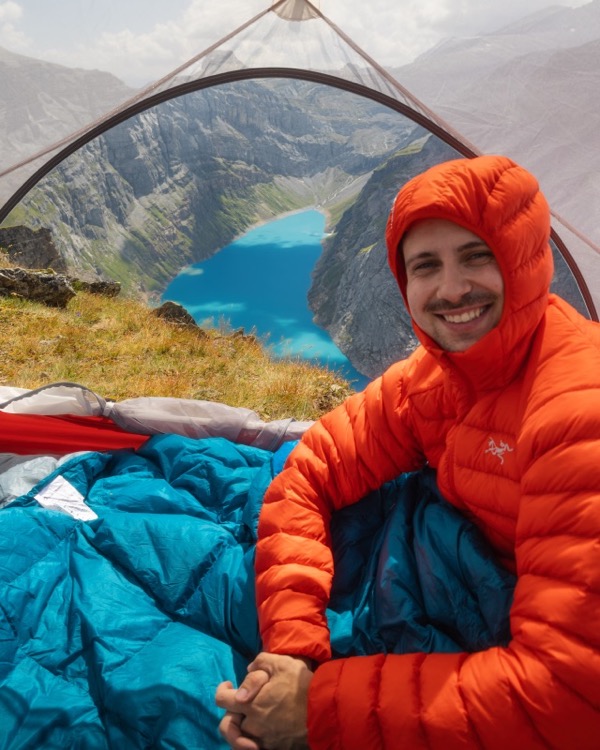
Wild camping on the Chaiserstuel
A night in a tent on the Chaiserstuel is allowed. No federal protected area covers the summit at 2'400 m, and Uri has no general wild-camping ban. Korporation Uri, which owns the ground, has published that camping on it is allowed in principle.
What do these mean?
Illegal A specific rule bans it, usually with a fine, and it can be enforced. Sleep somewhere else.
Not allowed No real place to camp here. A gated site, a developed area, or nowhere sensible to lie down, even if no fine is attached.
It depends You can sleep here, but there's a condition first: ask the landowner, book a spot, stay inside a set zone, or use a bivvy instead of a tent. The report says which.
Tolerated No rule clearly allows or bans it, but a single night is accepted in practice and nobody enforces against it. Normal for high bivouacs above the treeline.
Legal Camping one night is fine here. Either a rule allows it, or we checked every law and found nothing against it. Still: pitch late, leave early, no trace.
Federal layer empty, and the pin is in Uri
Wild camping on the Chaiserstuel has a short legal answer, and the value is in being able to say what was checked rather than just asserting it.
Federal. Queried at the summit on 1 August 2026: no federal hunting-ban district, no wildlife rest zone, no BLN landscape, no mire, floodplain or amphibian object. The nearest hunting-ban reserve, the Huetstock district, does not reach here: there is no hunting-ban hit at the pin and none within three kilometres. Two controls make the empty result meaningful. A positive proximity control returns a nearby reserve, so the layers answer. An invalid-layer control returns an HTTP error rather than an empty set, which is the trap that turns a typo into a false all-clear.1
Which canton. The mountain is commonly called the border between Nidwalden and Uri, and Wikipedia describes it that way. But a boundary runs along a line, and the exact summit coordinate has to fall on one side of it. Queried against the current-year boundary layers, the summit point returns a single, unambiguous canton: Uri (UR), commune of Isenthal, BFS 1211. That matters, because it decides which cantonal and communal rules apply, and it means the Obwalden and Nidwalden rules for the neighbouring flanks do not govern this pin.4
Cantonal. Uri has no general cantonal wild-camping prohibition. The bans that do exist in Uri are named and local: the Göschenen area, the Seewlisee and Silenen side, and the Urserntal and Gurtnellen ordinances. None of them is Isenthal, Bannalp or the Chaiserstuel. Under Swiss law what no norm prohibits is permitted, and at 2'400 m on an open, grassy summit ridge, well above the tree line, a single considerate night is the case the Alpine Club's own position describes.25
The landowner has already said yes, in writing
Here is what makes the Chaiserstuel a clean legal case rather than just an absence of bans. The land is not nobody's. Almost all of the alpine commons up here is Allmend owned by Korporation Uri, which by its own account is "die grösste Grundeigentümerin in Uri," holding roughly a third of the cantonal territory as alps and forests. And it has published its position on camping.6
Its official Wildcampieren page is direct: "Auf Gebiet der Korporation Uri ist das Campieren somit grundsätzlich erlaubt." Camping on Korporation land is allowed in principle, and it does not require you to register for a normal short stay. The conditions it does attach are plain and easy to stay inside:
- A stay longer than three nights, or a group of more than ten people, needs prior notification.
- Observe the rules of any protection zone.
- If you camp near an active alp operation, contact the alp farmer.
- Private roads need a permit to drive on.
- Pack out all your waste.
A solo tent for one night on the summit ridge clears every one of those without effort. You are well under three nights and well under ten people, so there is nothing to notify. There is no protection zone at the pin, which is what the federal check above established. And a treeless 2'400 m summit is not "near a farm operation," so the courtesy call to a Senn is for the valley, not the top.3
The honest read. This is about as unambiguous as a Swiss wild-camping verdict gets: no prohibition at the pin, and the actual owner of the ground has pre-granted permission and published the rules. That does not make it a free-for-all. The permission is conditional, and it stays real only because most people honour the conditions. Arrive late, leave early, leave no trace, and carry your rubbish back down.
The place, and what would change the answer
Summit: WGS84 46.877142 N / 8.467959 E, LV95 2'678'464 / 1'192'294, 2'400 m, commune of Isenthal, canton Uri, on the ridge between the Bannalp and the Isenthal side of the Urner Alps.7
The ground itself passes the common-sense test easily, which for a 2'400 m peak is not a given. Summit reports describe it as "sehr geräumig und grasbewachsen," very spacious and grassy, with a 360-degree panorama. A traverse account reaches the final "massiger Felskopf," a bulky rock head, by a short crack that ends on "flachem Gipfelgelände," flat summit terrain, with grassy alpine meadow along the ridge. So there is flat, dry, grassy ground to pitch on at and just below the top, and no road, lift, building or village anywhere near the pin.78
Two things would change this verdict, and both are worth a look before a trip:
- A new local camping ban. Isenthal has none for this ground today. Uri's bans are added area by area, so the thing to check is whether a new ordinance has named the Isenthal or Bannalp side. Uri Tourismus lists the local-zone bans.
- A change to the landowner's position. The whole strength of this verdict is that Korporation Uri has said yes in advance. If it ever tightened its Wildcampieren rules, the "landowner consent" half of this would move, so it is worth glancing at the page before a longer or larger trip.
Where you can legally sleep
- The summit ridge and plateau itself, for one solo night, on the flat grassy ground above the tree line3.
- Anywhere on Korporation Uri Allmend along the way up, under the same blanket permission, with a courtesy word to the Senn if you pitch beside an active Bannalp or Isenthal alp6.
- A mountain inn or hut in the Bannalp or Isenthal area, if you would rather have a roof.
- Notify first, or book, for anything bigger. More than three nights or more than ten people crosses the Korporation's notification line, so send word before you go.
General rules for wild camping
Here the answer is yes, and it is yes partly because the landowner chose to say so. That makes the list below more than good manners: it is the exact set of conditions the permission is built on, and honouring them is how the yes stays a yes.
- No fire. An open fire has no place in the mountains. A gas stove is enough.
- Pitch late, strike early. Set up towards evening, gone again early. A bivouac is one night, not a base camp.
- Leave no rubbish. Everything you carry up you carry down, organic scraps and toilet paper included.
- At least 50 metres from any water for the big business, so you do not foul what people and livestock drink.
- Stay small and quiet. A small group, no speaker, no drone, dogs on the lead, and the alp staff's word goes.
Disclaimer
This article reflects my research and assessment to the best of my knowledge, as of August 2026. It is based on the publicly accessible and official sources linked below. It does not replace legal advice and is not a binding statement of the current legal situation.
The verdict rests on the absence of any prohibition at the pin and on Korporation Uri's published permission for camping on its land, and either could change. Uri adds local camping bans area by area, and the Korporation can revise its rules. Before every tour, check the current sources yourself and follow instructions on site. A genuine emergency bivouac in distress is a separate question from a planned camp. Anyone who spends the night outside bears responsibility for their own conduct and any consequences themselves. Hikebeast, Leon Helg and Saftladen GmbH accept no liability for decisions made on the basis of this text, and call on no one to break applicable law.
Frequently asked questions
Is wild camping allowed on the Chaiserstuel?
Isn't the Chaiserstuel in Nidwalden, or Obwalden?
Do I need to register or ask anyone?
Is there any fee?
Is the ground actually campable up there?
Leon Helg
Swiss filmmaker and software developer. Spends his free time in the Swiss Alps and maps his favourite spots for Hikebeast. Posts as @leon.helg on Instagram and TikTok.
Sources
- Official federal geodata, queried 1 August 2026 at the Chaiserstuel summit, WGS84 46.877142 / 8.467959, LV95 2'678'464 / 1'192'294 (2'400 m): hunting-ban districts, wildlife rest zones, BLN, mire, raised-bog, floodplain and amphibian inventories all return a genuinely empty result set at the pin, with no hunting-ban district within three kilometres, so the Huetstock reserve does not reach here. Verified with a positive proximity control that returns a nearby reserve, and an invalid-layer control that returns an HTTP 400 error rather than an empty result. map.geo.admin.ch. ↩
- Canton Uri: no general cantonal wild-camping prohibition. Verified against the Urner Rechtsbuch in August 2026: the Polizeigesetz (RB 3.8111) and Polizeireglement (RB 3.8127) contain no camping provision, and the cantonal Natur- und Heimatschutzgesetz (RB 10.5101) contains no occurrence of campieren, zelten, lagern or biwakieren anywhere in its text, its art. 34 punishing only breaches of a Schutzmassnahme. The CHF 150 fixed penalty at no. 2.1 of the Ordnungsbussenreglement (RB 3.9223) therefore applies only inside a protection zone whose own reglement forbids camping. Uri's camping bans are consequently named and local, and where they exist they are COMMUNAL rather than cantonal: the Göschenen ban is the Campingverordnung der Einwohnergemeinde Göschenen of 29 April 2022, not a cantonal nature-protection reglement. None of them covers Isenthal, the Bannalp or the Chaiserstuel. rechtsbuch.ur.ch. ↩
- Korporation Uri, Wildcampieren page: "Auf Gebiet der Korporation Uri ist das Campieren somit grundsätzlich erlaubt." Camping on Korporation land is allowed in principle and requires no registration for a normal short stay. Prior notification is asked only for stays longer than three nights or groups of more than ten people; observe protection-zone rules; contact the alp farmer near an active alp operation; permits are needed for private roads; pack out all waste. Contact: Korporation Uri, Bahnhofstrasse 13, 6460 Altdorf, +41 41 875 21 00, info@korporation.ch. korporation.ch. ↩
- Official federal boundary layers, current-year records, queried at the summit point: the canton layer returns a single unambiguous record, Uri (UR), and the commune layer returns Isenthal, UR, BFS 1211. This places the summit on the Uri side of the ridge that is popularly called the Nidwalden-Uri border, and is decisive for which cantonal and communal rules apply. map.geo.admin.ch. ↩
- Swiss Alpine Club SAC, "Campieren und Biwakieren": a single considerate night above the tree line is widely accepted where no contrary rule exists, which is the situation here. Guidance, not law. sac-cas.ch. ↩
- Korporation Uri, Grundeigentum page: the Korporation is "die grösste Grundeigentümerin in Uri," holding roughly a third of the cantonal territory as alps and forests. This is why its published camping permission covers so much of the ground around the Chaiserstuel. korporation.ch. ↩
- Wikipedia, "Chaiserstuel": a 2'400 m peak in the Urner Alps, WGS84 46.877142 / 8.467959, described as the border between Nidwalden and Uri. Used for elevation, coordinates and the border characterisation, cross-checked against the federal boundary layers for the exact cantonal placement. de.wikipedia.org. ↩
- Summit and traverse reports on gipfelbuch.ch: the summit is described as "sehr geräumig und grasbewachsen," very spacious and grassy, with a 360-degree panorama, and a traverse account reaches the final "massiger Felskopf" by a short crack ending on "flachem Gipfelgelände," flat summit terrain, with grassy alpine meadow along the ridge. Used only for the terrain description that confirms flat, campable ground at the pin. gipfelbuch.ch. ↩