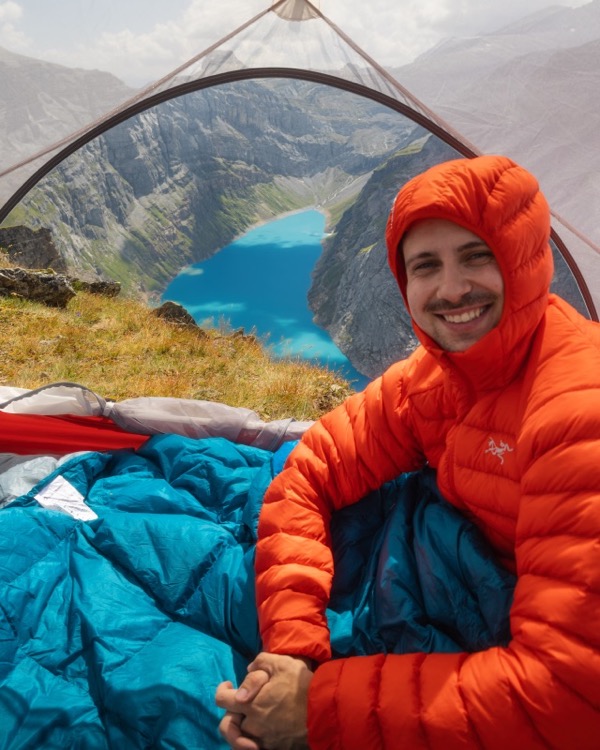
Wild camping at the Bristensee
You may stay one night at the Bristensee. The reglement for the Maderanertal bans tents in two named zones only, and this lake is in neither of them. The landowner, Korporation Uri, permits camping on its ground anyway. The steep basin is the harder part.
What do these mean?
Illegal A specific rule bans it, usually with a fine, and it can be enforced. Sleep somewhere else.
Not allowed No real place to camp here. A gated site, a developed area, or nowhere sensible to lie down, even if no fine is attached.
It depends You can sleep here, but there's a condition first: ask the landowner, book a spot, stay inside a set zone, or use a bivvy instead of a tent. The report says which.
Tolerated No rule clearly allows or bans it, but a single night is accepted in practice and nobody enforces against it. Normal for high bivouacs above the treeline.
Legal Camping one night is fine here. Either a rule allows it, or we checked every law and found nothing against it. Still: pitch late, leave early, no trace.
One reglement, two camping bans, and neither one is here
The Bristensee sits inside a cantonal protection area. That sounds like the end of the conversation and it is not, because the reglement that created the area is unusually precise about where its camping ban applies. Reading it properly is the whole job.
The instrument is the Reglement über den Schutz der Region Maderanertal und Fellital, RB 10.5111, adopted by the Uri government on 5 May 1986 and amended in 2006 and 2014. The cadastral extract for the ground under this lake lists it as covering 100 per cent of the parcel, so there is no argument about whether it reaches here. It does.26
The reglement then does something most protection reglements do not: it separates the wide outer area from a handful of small, named inner zones, and it puts the camping ban only in the inner ones. Article 7 paragraph 2 letter f, which governs the nature-protection zone at the Golzernsee, is explicit:
"Insbesondere ist verboten: ... f) zu zelten und zu campieren sowie Standplätze zu diesem Zweck zu überlassen."Canton of Uri, Reglement über den Schutz der Region Maderanertal und Fellital, RB 10.5111 of 5 May 1986, art. 7 para. 2 lit. f.
Article 6 says exactly which ground that covers: the shallow water on the west shore of the Golzernsee, the landward shore of the same lake, and the moors east of it. A second ban, in article 9b paragraph 2 letter j, forbids "zu zelten oder zu campieren" in the floodplain and glacier-forefield zones along the Chärstelenbach at Stössi, Stäuberboden and Griessboden, in the hintere Maderanertal.2
The Bristensee is in neither. The Golzernsee is 4.6 kilometres away on the far side of the ridge, and the floodplain zones are in the other arm of the valley entirely. What covers this lake is the outer Schutzgebiet of article 2, whose operative provisions are articles 3, 4 and 5, and those regulate building works, standortgebundene installations and road construction. Not one of them mentions a tent.2
And Uri writes camping bans when it means them. That is the control that turns this silence into a finding rather than a gap. In the reglement protecting the south shore of the Urnersee, RB 10.5110, the canton spells out "zu lagern, zu zelten und zu campieren sowie Standplätze zu diesen Zwecken zu überlassen" in the same drafting style. The vocabulary exists, the canton uses it, and it chose not to use it for the ground you are standing on.7
So what would the fine even be. Uri prices camping once, in the fixed-penalty reglement RB 3.9223, at "Lagern, Zelten oder Campieren in Schutzzonen ... 150 Franken", and it hangs that expressly on article 34 paragraph 1 letter a of the cantonal nature-protection act "in Verbindung mit dem jeweiligen Reglement". The penalty is parasitic on the reglement: it punishes camping the respective reglement prohibits. Here the respective reglement does not prohibit it, so the tariff has nothing to attach to.3
Cantonal and communal, briefly. The Uri nature-protection act itself, RB 10.5101, contains no occurrence of Zelt, Zelten, campieren, Camping, Biwak, Lagern, Übernachten or Wohnwagen at all, on a word-boundary scan whose control terms count normally. The Polizeigesetz RB 3.8111 and Polizeireglement RB 3.8127 are equally silent. At communal level, the Bau- und Zonenordnung of Silenen returns zero for every one of those terms across 142'000 characters, against controls that match 220 times for Artikel and 58 for Zone.35
The landowner says yes in writing
An absence of prohibition is one thing. A permission is better, and here there is one. The ground belongs to the Korporation Uri, the old corporate landowner covering the seventeen communes between Sisikon and Göschenen, and its published position on wild camping is not grudging:
"Auf Gebiet der Korporation Uri ist das Campieren somit grundsätzlich erlaubt und muss nicht angemeldet werden."Korporation Uri, "Wildcampieren", the landowner's published rules, read 22 August 2026.
Camping is in principle allowed, and it does not even have to be registered. The page then names its exceptions, and there are exactly two: the commune of Göschenen, where wild camping is forbidden outright, and the area around the Seewlisee, which is in this same commune and on this same owner's land. Bristen, the Bristensee, the Maderanertal and Golzern do not appear on the page at all.4
Do not read this article as covering the Seewlisee. That lake is 6.9 kilometres north of here, it is expressly prohibited by the same landowner, and the commune publishes its own notice for it. Same valley system, same owner, opposite answer. We have written that one up separately.4
The conditions the Korporation attaches are easy and you should keep them. Observe the rules inside nature and landscape protection zones, which here means the general Schutzgebiet and its building rules rather than a camping rule. Get the appropriate permission on private roads. Make contact with the alp people where you are near their operation. Inform the Korporation in advance if the stay is longer than three nights or with more than ten people. Carry your rubbish out in the official charged bags to the nearest collection point, and leave the site tidy.4
How hard does the alp condition bite here. Much less than at the busy lakes lower down. There are six buildings within 1.2 kilometres of this lake, all of them recorded as non-residential, and the nearest is the Bristenhüttli at 224 metres west. For comparison, the Golzerensee 4.6 kilometres away has 132 buildings inside the same radius, a bathing area, two inns and a cable car, and that is precisely why its verdict is weaker than this one. If the hut is occupied when you walk past, say hello. That is the whole of it.8
Practical contact for the Korporation, for the over-three-nights or over-ten-people case: Korporation Uri, Gotthardstrasse 3, 6460 Altdorf, 041 874 70 90.4
The lake is on the protected list, which is not the same as a ban
There is one more thing in the reglement with this lake's name on it, and it deserves to be handled honestly rather than quietly. Article 10 lists the individual natural features the canton protects by name, and letter o reads "Bristenseeli unter dem Bristenfirn". Alongside it sit the Lämmerbachfall, the Stäfelibachfall, the old ore workings at the Bristenstock and, at letter p, the Spillauisee in the hintere Etzlital. This lake is on that list.2
What that listing does, and what it does not do. Article 12 protects the article 10 objects against prohibited impairments and requires the competent directorate's approval for "Massnahmen und Veränderungen an und in diesen Objekten sowie in unmittelbarer Umgebung"ed, measures and alterations at, in and immediately around them. That is the language of physical works: diverting, excavating, building, draining. A small tent pitched at dusk and gone by breakfast alters nothing and is not a Massnahme in that sense.2
And the reglement proves the point against itself. When the same document wanted to keep tents off protected ground it did not rely on a general impairment clause, it wrote "zu zelten und zu campieren" into the prohibition list, twice, in articles 7 and 9b. It did not write it for the article 10 objects. Drafters who use a phrase in one article and omit it in another are usually saying something.2
One loose thread, reported rather than hidden. Article 12 paragraph 1 protects these objects "nach Artikel 6 der Verordnung betreffend Natur- und Heimatschutz". That ordinance is the one of 30 December 1963, and article 36 of the cantonal nature-protection act repealed it when the act came into force on 1 January 1988. The cross-reference has been dangling for close to forty years. It is not a hidden camping ban; it is a stale pointer, and it should not be reported as more than that.3
The map facts. Bristensee, WGS84 46.750364 N / 8.692364 E, LV95 2'695'794 / 1'178'451, 2'097.5 m, commune of Silenen, canton Uri, in the basin north of the Bristen with the Chli Bristen 230 metres east. At this altitude you are above the treeline in open alpine ground. The cadastral reference for the point is EGRID CH744607799433, Silenen parcel 222, and that parcel is 6'502'835 square metres, which is worth knowing because a cadastral extract at this scale describes six and a half square kilometres of mountain and not the patch under your tent.16
The single federal hit at the point is BLN object 1603, "Maderanertal, Fellital", 15'997.7 hectares of the federal inventory of landscapes and natural monuments of national importance. A BLN listing binds authorities when they plan and permit things. It does not fine a camper and it contains no camping provision.1
Where you can legally sleep
This basin is steep, and that is the real constraint. A water-masked scan out to 600 metres in 24 directions produced 191 dry samples and only 7 at 10 degrees or flatter. The lake was masked out first, which matters: the terrain model flattens water to the water plane, so an unmasked scan would have recommended the middle of the lake.8
The pitch: the shelf about 250 metres southwest, LV95 2'695'577 / 1'178'326, 2'141.7 m. Slope 2.5 degrees. It is 156 metres back from the water, so the fifty-metre rule is kept several times over, and 166 metres from the Bristenhüttli, which the flattest reading of all is not.8
- 2.5 degrees at 2'141.7 m, LV95 2'695'577 / 1'178'326, 250 m southwest, 156 m from the water. The recommendation.8
- 8.1 degrees at 2'135.9 m, LV95 2'695'653 / 1'178'310, 200 m southwest, 126 m from the water. Sloped but usable, and further from the hut again.8
- 2.1 degrees at 2'130.0 m, LV95 2'695'594 / 1'178'451, 200 m west. The flattest ground in the basin, and the reason it is third on this list is that it sits 45 metres from the Bristenhüttli. Legal, but you would be pitching in someone's doorway.8
What to avoid. The shoreline itself. Several of the flatter-looking readings within 100 metres of the pin sit 12 to 38 metres from the water, which fails the fifty-metre rule and puts you on the one strip of ground the lake's own protected status is about. Walk the extra two minutes uphill.8
General rules for wild camping
These matter more where you may than where you may not, and here you may. The Bristensee is a named protected natural object inside a cantonal protection area that has no camping rule, and a place like that keeps its permissions exactly as long as nobody gives it a reason to write one.
- No fire. An open fire has no place in the mountains. A gas stove is enough.
- Pitch late, strike early. Set up towards evening, gone again early. A bivouac is one night, not a base camp.
- Leave no rubbish. Everything you carry up you carry down, organic scraps and toilet paper included.
- At least 50 metres from any water for the big business, so you do not foul what people and livestock drink.
- Stay small and quiet. A small group, no speaker, no drone, dogs on the lead, and the alp staff's word goes.
Disclaimer
This article reflects my research and assessment to the best of my knowledge, as of August 2026. It is based on the publicly accessible and official sources linked below. It does not replace legal advice and is not a binding statement of the current legal situation.
The verdict rests on a zoned prohibition not reaching this point, plus the landowner's published permission, and both can change: the Uri government has amended RB 10.5111 twice already, in 2006 and 2014, and the Korporation Uri can add a name to its exception list the way it has for Göschenen and the Seewlisee. The reading of article 12 as covering physical works rather than a pitched tent is my reading of the wording and has not been tested in a court. Before every tour, check the current sources yourself, read any sign you find on the ground and follow instructions on site. A genuine emergency bivouac in distress is a separate question from a planned camp. Anyone who spends the night outside bears responsibility for their own conduct and any consequences themselves. Hikebeast, Leon Helg and Saftladen GmbH accept no liability for decisions made on the basis of this text, and call on no one to break applicable law.
Frequently asked questions
Is wild camping allowed at the Bristensee?
What is the fine for camping at the Bristensee?
Do I have to ask anyone before camping at the Bristensee?
The lake is listed as a protected object. Does that stop me?
Where is the flat ground at the Bristensee?
Leon Helg
Swiss filmmaker and software developer. Spends his free time in the Swiss Alps and maps his favourite spots for Hikebeast. Posts as @leon.helg on Instagram and TikTok.
Sources
- Official federal geodata and the national height model, queried 22 August 2026 at the Bristensee, WGS84 46.750364 N / 8.692364 E, LV95 2'695'794 / 1'178'451, 2'097.5 m. The hunting-ban, wildlife-rest-zone, national-park and parks, floodplain, raised-bog, fen, moorland, amphibian, dry-meadow and water-bird-reserve layers all return an empty result set at the point. Verified with a positive control at LV95 2'626'000 / 1'154'500, which returns federal game reserve no. 3 Kiental, and an invalid-layer control, which returns HTTP 400 rather than an empty set. The single hit is BLN object 1603 "Maderanertal, Fellital", 15'997.7 ha, an instrument addressed to authorities that contains no camping provision. Canton Uri, commune Silenen, current-year boundary records only. map.geo.admin.ch. ↩
- Canton of Uri, Reglement über den Schutz der Region Maderanertal und Fellital, RB 10.5111, of 5 May 1986, status 1 October 2014, adopted by government decision RRB 1986-397 and amended by RRB 2006-359 and RRB 2014-601. Art. 2 places the region under protection; art. 3 to 5 govern building works, installations and road construction and contain no camping provision. Art. 6 creates the Naturschutzzone Golzern in three zones, the shallows on the west shore of the Golzernsee, the landward shore, and the moors east of it; art. 7 para. 2 lit. f forbids in those zones "zu zelten und zu campieren sowie Standplätze zu diesem Zweck zu überlassen", with a preserved exception for tenting between the Seegäden and the stream at Stall Jauch. Art. 9a creates the floodplain and glacier-forefield zones along the Chärstelenbach at Stössi, Stäuberboden and Griessboden; art. 9b para. 2 lit. j forbids there "zu zelten oder zu campieren". Art. 10 lit. o lists "Bristenseeli unter dem Bristenfirn" among the protected natural objects, and lit. p the Spillauisee; art. 12 protects those objects and requires approval for "Massnahmen und Veränderungen an und in diesen Objekten sowie in unmittelbarer Umgebung dieser Objekte". rechtsbuch.ur.ch. ↩
- Canton of Uri legislation, read on the cantonal Rechtsbuch on 22 August 2026. Gesetz über den Natur- und Heimatschutz RB 10.5101: zero occurrences of Zelt, Zelten, campieren, Camping, Biwak, Lagern, Übernachten or Wohnwagen, on a word-boundary scan against controls that count normally (Schutz 91, Artikel 59, Natur 27); art. 34 para. 1 lit. a punishes contravening protection measures with a fine of up to 5'000 francs; art. 36 repeals the Verordnung of 30 December 1963 betreffend Natur- und Heimatschutz, which is the ordinance RB 10.5111 art. 12 still cross-refers to. Reglement über die Erhebung von Ordnungsbussen RB 3.9223, section 2 Umwelt- und Naturschutz, Ziff. 2.1: "Lagern, Zelten oder Campieren in Schutzzonen (Art. 34 Abs. 1 Bst. a des Gesetzes über den Natur- und Heimatschutz, RB 10.5101 in Verbindung mit dem jeweiligen Reglement) 150 Franken". Polizeigesetz RB 3.8111 and Polizeireglement RB 3.8127: no camping provision. rechtsbuch.ur.ch. ↩
- Korporation Uri, "Wildcampieren", the landowner's published rules, read 22 August 2026 and re-read specifically to check whether this lake is listed. General position: "Auf Gebiet der Korporation Uri ist das Campieren somit grundsätzlich erlaubt und muss nicht angemeldet werden." Conditions: observe the rules in nature and landscape protection zones, obtain the appropriate permission on private roads, make contact with the alp farmers where you are near their operation, inform the Korporation in advance if the stay is longer than three nights or with more than ten people, pack rubbish into official charged bags and carry it to the nearest collection point, and leave the site tidy. Named exceptions, and there are only two: Göschenen, "In der Gemeinde Göschenen ist das wilde Campieren verboten", and the Seewlisee, "Im Gebiet rund um den Seewlisee ist das Wildcampieren grundsätzlich verboten". Bristen, Bristensee, Maderanertal and Golzern do not appear on the page. Korporation Uri, Gotthardstrasse 3, 6460 Altdorf, 041 874 70 90. korporation.ch. ↩
- Bau- und Zonenordnung der Gemeinde Silenen, the version the cadastre names as in force, together with the partial revision approved by RRB 2023-52 of 31 January 2023. Read 22 August 2026 as full text, 142'394 characters. Zero occurrences of Zelt, campieren, Camping, Biwak, Lagern, Übernachten or Wohnwagen, on a word-boundary scan whose control terms match normally: Artikel 220, Zone 58, Silenen 26, Bauzone 11. webgis.lisag.ch. ↩
- Cadastre of public-law restrictions on landownership (ÖREB), canton Uri, extract for the parcel under the point, retrieved 22 August 2026. EGRID CH744607799433, Silenen parcel 222, 6'502'835 m², 176 restrictions. The single restriction covering 100 per cent of the parcel under the theme "Schutzmassnahmen für Natur- und Landschaftsschutzobjekte nationaler und regionaler Bedeutung" resolves to the Reglement über den Schutz der Region Maderanertal und Fellital. The other nature-protection entries on the parcel resolve to the Reglement über den Schutz der Gewässer im Gebiet Uri Mitte zwischen Silenen und Göschenen, RB 10.5118, which carries watercourse line objects and no camping provision, and to the Bau- und Zonenordnung Silenen. Note that an extract at this parcel size describes six and a half square kilometres, not the point. oereb.ur.ch. ↩
- Control on drafting style: Canton of Uri, Reglement über den Schutz des Südufers des Urnersees, RB 10.5110. Read 22 August 2026. Its prohibition list contains, in as many words, "zu lagern, zu zelten und zu campieren sowie Standplätze zu diesen Zwecken zu überlassen". The canton therefore has and uses an explicit camping-ban formula in its protection reglements, which is what makes the absence of that formula from the provisions covering the Bristensee a finding rather than an oversight. rechtsbuch.ur.ch. ↩
- Terrain and settlement analysis at the Bristensee, 22 August 2026, on the federal height model with a water mask taken from OpenStreetMap so the lake surface could not be scored as flat ground. Nine rings from 50 to 600 m in 24 directions, slope computed from a 25 m cross at each sample: 216 samples, 191 dry, 25 masked as water, and only 7 dry samples at 10 degrees or flatter. Flattest readings: 2.1 degrees at 2'130.0 m, LV95 2'695'594 / 1'178'451, 200 m on bearing 270, 94 m from the shore, which is 45 m from the Bristenhüttli; 2.5 degrees at 2'141.7 m, LV95 2'695'577 / 1'178'326, 250 m on bearing 240, 156 m from the shore; 8.1 degrees at 2'135.9 m, LV95 2'695'653 / 1'178'310, 200 m on bearing 225. Federal building and dwelling register within 1'200 m of the point: 6 buildings, all category 1060, non-residential, the nearest at 224 m (Bristenhüttli, 2'129.1 m). Distance to the Golzerensee 4'578 m, to the Seewlisee 6'944 m. map.geo.admin.ch. ↩